Charlie Beeker knows shipwrecks. In fact, they’re his job.
For almost a year, Beeker, director of the Office of Underwater Science and Educational Resources in the School of Health, Physical Education, and Recreation, has been exploring the waters off the coast of the Dominican Republic with the hope of verifying a pirate shipwreck.
On Tuesday, National Geographic will feature Beeker’s historic discovery.
While IU has been working in the Dominican Republic for almost 15 years, Beeker said the IU team did not investigate the shipwreck until the local government asked them to look at an interesting underwater site.
“There were cannons, and someone wanted to recover them,” Beeker said. “We put it off for a while, but then later we just kind of stumbled onto it. The key was we knew what we might have, and we worked hard to prove it.”
Beeker’s inclination was that the IU team discovered the wreckage of the Quedagh Merchant, a ship abandoned by 17th century pirate Capt. Kidd.
An IU team of graduate and undergraduate students along with faculty members traveled to the Dominican Republic last summer to work on the excavations. The excavations combined students and faculty from several disciplines.
Fritz Hanselmann, research coordinator at the Office of Underwater Science and Educational Research, worked with Beeker to initially assess, survey and map the shipwreck.
“This has been a phenomenal experience in so much as being able to take part in such a diverse project that couples archaeology, history, biology, a wide variety of fields,” Hanselmann said. “It uses a shipwreck not just as a piece of history and an archaeological record, but also as a means to test the biological resources and further economic development in the local region.”
While Beeker directed the overall project, Hanselmann directed the archaeological aspects.
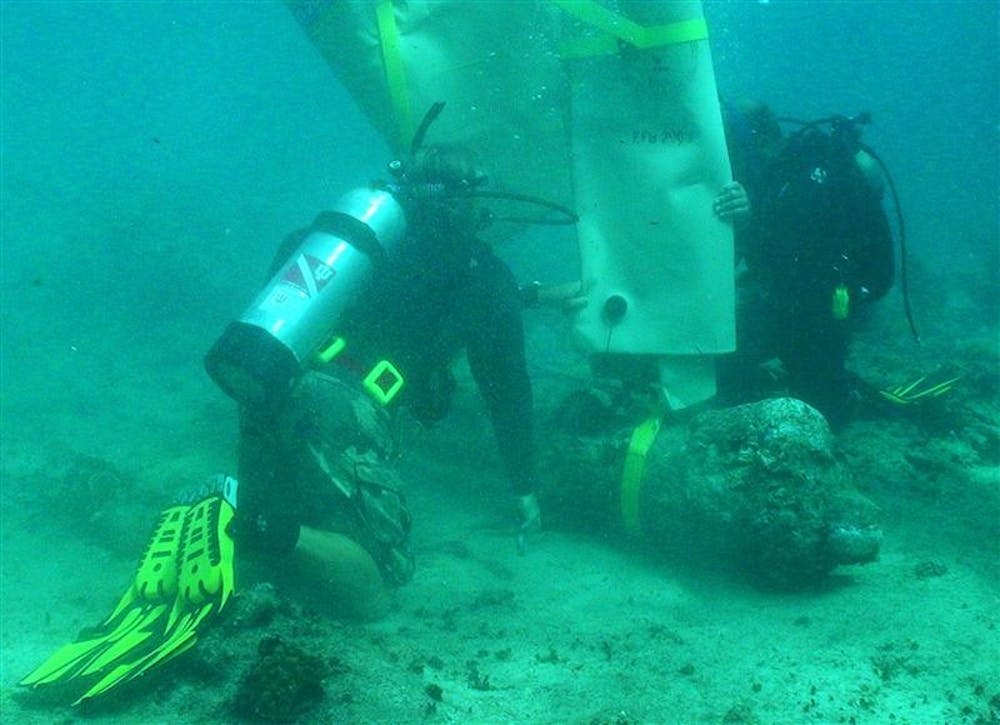
The team unearthed one of 26 cannons as well as several cannonballs. They also found wood in the hull and keel of the ship.
“What was significant was the scientific analysis of the wood,” Beeker said. “That’s what proved to us that the site was the pirate ship vessel the Quedagh Merchant.”
Scientific analysis of the timber proved the ship was made of teak wood. While teak wood is shipped all over the world today, in the 17th century, teak only grew naturally in west India, the place where Capt. Kidd testified the ship was built.
Initially, IU had to deal with treasure hunters who could have potentially damaged the site, but Beeker said IU is now in control and will preserve the area. The U.S. Agency on International Development awarded IU $200,000 to turn the Capt. Kidd site into an underwater park.
Beeker added that the Quedagh Merchant is the only pirate ship that has been found in the Caribbean.
“You’ve heard of ‘Pirates of the Caribbean,’” Beeker said. “Well, IU has it.”
IU’s historic find has not gone unnoticed. Beeker said last December several television networks approached the team about producing potential feature stories on the discovery. Ultimately, Beeker said, they decided on National Geographic. As a result, the Caribbean discovery will be featured at 9 p.m. Tuesday as part of the channel’s “Expedition Week.”
“It’s going to get a lot more academic scrutiny than other channels might,” he said. “They’re very good at making sure you have your facts correct, which we appreciate, being an academic institution.”
Beeker, along with project archaeologist Geoffrey Conrad, will also give a presentation on Monday at the Mathers Museum. The two members of the expedition will show clips from the National Geographic special, discuss the science behind the discovery and display replicas of artifacts from other wrecks in the Dominican Republic.
Though the verification is complete, Beeker said the work isn’t. The team will continue to make trips to the Dominican Republic and work on preserving the wreck for future generations.
After that, it’s on to the next site. The next shipwrecks on Beeker’s mind: Christopher Columbus’ six sunken ships from 1495.
IU discovery of Captain Kidd to be shown on TV
Get stories like this in your inbox
Subscribe