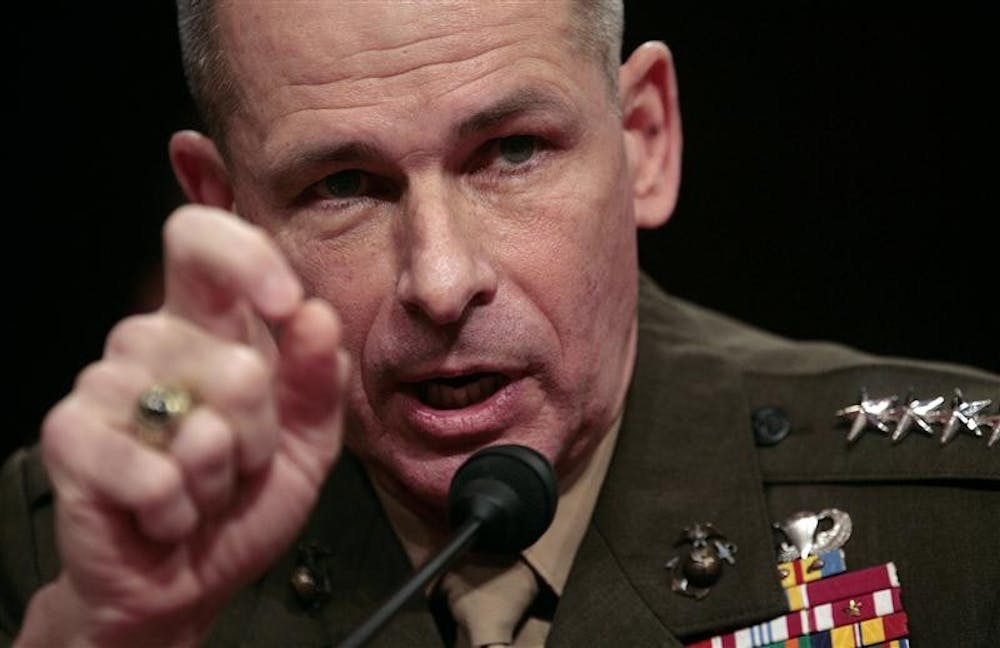
IU’s appointment of Gen. Peter Pace, who has openly spoken against homosexuality, to Poling Chair has sparked controversy within the University community and action within University bureaucracy.
IU’s Diversity and Affirmative Action Committee presented a resolution to the Bloomington Faculty Council on Tuesday criticizing the Kelley School of Business for awarding a distinguished University honor to Pace, former chairman of the Joint Chiefs of Staff. The Poling Chair award is funded by a gift from Harold Poling that is meant to bring leaders from around the world to meet with students.
Pace was responsible for a $700 billion budget, more than 2.4 million people and the largest fleet of aircraft and ships in the world, routinely dealing with life-and-death decisions.
His experiences have taught him the intricacies of work between private enterprise and government, Kelley School of Business Dean Dan Smith said in an e-mail.
But, throughout the past few years, Pace has made several remarks about homosexuality, including statements to the Chicago Tribune in a March 12, 2007, interview.
Pace worked under the military’s “Don’t Ask, Don’t Tell” policy, and under his jurisdiction, more than 5,000 members of the U.S. military were dishonorably discharged from the military because of their sexual orientations.
“To the gay and lesbian community on campus ... it is the equivalent slap in the face as if the University gave a distinguished honor to the head of the Ku Klux Klan,” said law professor Alex Tanford. “People are now very sensitive toward doing stupid, racist things that offend racial minorities. But we are not yet at the point where people are equally as sensitive about saying stupid, negative things about the gay community.”
The committee’s resolution expressed “concern and disappointment” regarding his selection for the honor and suggested the next time Pace returns, his speech should be open to the public so an open forum of discussion can be available to address these concerns, Tanford said.
“The problem was the awarding of a University honor to a person who has very publicly known, highly prejudiced views,” Tanford said.
Tanford also mentioned another issue: The speech was made available only to Kelley School students. He said he believes the Kelley School brought Pace here in a way that prevented the discussion of his views, and the University award Pace received could be symbolic of a lack of respect for the gay community.
But members of the gay community and the Kelley School disagreed.
“We have to keep in mind why he came,” said Robert Goodfellow, second-year graduate student at Kelley and president of Gay @ Kelley, the school’s gay, lesbian, bisexual and transgender resource organization. “He was invited to speak about the critical interactions between government and private business.”
While Goodfellow said he found Pace’s personal beliefs “abhorrent,” he said those beliefs had no bearing on Pace’s visits or his position within the Kelley School.
“General Pace was made the Poling Chair at the Kelley School,” Goodfellow said. “The Poling Chair does not serve as a platform for personal beliefs. He was given no platform for his personal beliefs.”
Pace was well-received by Kelley students and fielded questions on a variety of topics including the comments he made to the press about his views on homosexuality in the military, Smith said in an e-mail.
“General Pace was invited to the Kelley School to meet with our students and to share his perspectives on leadership,” Smith said. “Having General Pace speak at the Kelley School in no way is intended to be an endorsement of his personal beliefs.”
Controversy sparked over Pace’s remarks
Award is ‘slap in the face’ to GLBT members
Get stories like this in your inbox
Subscribe