Flash back to 1960, the year of the first televised presidential debate. Seventy million Americans watched a nervous and sickly looking Richard Nixon struggle his way through the debate, while a younger, charismatic John F. Kennedy confidently went through his speech focusing on what he wanted to do for the country.
Kennedy went on to win the election that year, with some claiming it was because Kennedy appeared more confident and better looking. While there’s no scientific proof that appearance cost Nixon the 1960 election, appearance has become an issue in every election, with incessant media attention being paid to looks and body language.
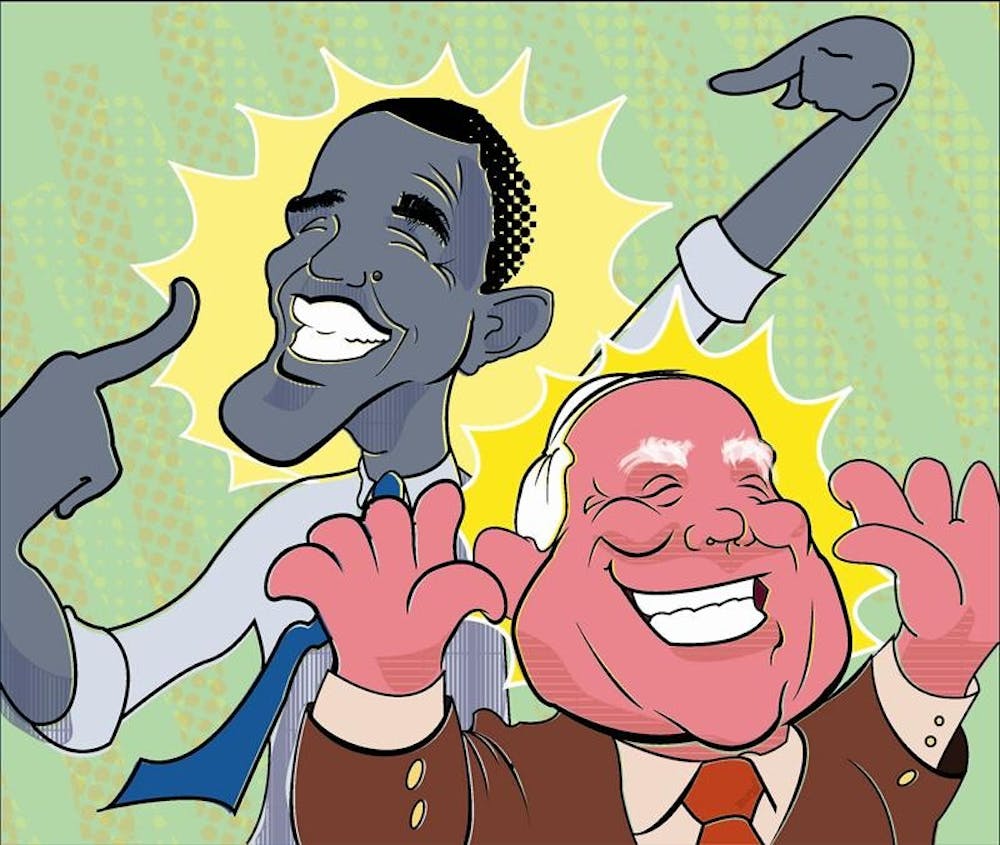
Flash forward to 2008, with a young Sen. Barack Obama running against a much older Sen. John McCain. While the country’s political concerns might be different 48 years later, the media still widely scrutinizes image as it did in 1960.
Political science professor William Bianco points out that voters’ perceptions go far beyond mere “looks” – a politician’s entire persona can affect how the voting public will react.
Age
“What you’re wondering about is if someone looks at McCain and sees someone old enough to be their grandpa and wonders if he knows what it’s like to be someone (just) out of college,” he said. “With Obama, you could ask, what does this graduate of Harvard Law School know about the trials and tribulations of people from southern, rural Indiana?”
Radhika Parameswaran, an associate professor of journalism who teaches “Race, Gender and the Media” and “Media and Society,” said a candidate’s age is a much bigger influence on voters’ perceptions than it is given credit for. She said voters and the media have a tendency to jump on the race/gender bandwagon while shortchanging how age effects voters’ response to a campaign.
Ultimately, voters’ thoughts about a candidate’s age come back to the relationship a president has with the nation.
“I think subconsciously we see the president as the ‘parent of the nation,” she said.
He has a “fatherly image,” and being an older man is part of that image, she said.
Voters also see an older candidate as having more life experience and fortitude, but also as inflexible and perhaps cranky. Younger candidates have the perception of vitality on their side, but not as much wisdom.
Gender
With female candidates such as Sarah Palin and Indiana gubernatorial candidate Jill Long Thompson running this year, and Sen. Hillary Clinton almost winning the Democratic primary, it might seem like the gender barrier has been broken. But seeing a woman in politics can still have an effect on voters.
Anna Strand, president of IU College Democrats, has already felt the effect of gender on the election. This year, Strand helped start Students for Barack Obama. Some women questioned her for not supporting Clinton in the primaries.
“I got a lot of criticism for not supporting the first viable woman presidential candidate,” she said. “This is where you hope people can get away from this appearance issue.”
The media is buzzing with the idea that McCain chose Palin because she’s a woman, Parameswaran said. However, to her, this theory smacks of “biological essentialism” – the theory that genes determine most of a person’s actions and choices – which she does not agree with.
“Women have always voted for the candidates who speak to their issues,” she said, not just because of gender similarities.
IU sophomore Brittney Sparks is a Republican who plans on voting for McCain. Sparks feels Palin’s youthful appearance is more of an asset than her simply being female.
“I think she can represent the younger voters in America,” she said.
While Sparks says she generally cares more about the issues than the candidate’s looks, she feels many others fixate on appearance.
“Today there is such a shallow mind set,” she said. “A lot of people see (McCain) and think he’s about to croak.”
Race
Sen. Obama is running to become the first black president in U.S. history. While the fight for equality has come a long way, Strand said Obama’s dark skin and a foreign-sounding name could play into the presidential contest.
“Unfortunately there are some individuals who would be Barack Obama supporters, but are questioning it because he’s of mixed races and has a name people aren’t necessarily familiar with,” she said.
But the more people learn about Obama’s policies, the less affected they will be by his appearance, she said.
Parameswaran noted that Obama’s race could impact his candidacy in a positive way, even among white voters. His age and race especially have become markers of “how cool he is,” and have attracted a younger audience.
Sparks also feels race won’t have a negative effect, especially because there’s never been a black person in the White House, and they might be voting to remedy that situation.
“I feel people would almost vote for him just because of that fact and not for what he stands for,” she said.
Despite the effect appearance can have on people’s perceptions, most are eager to say it won’t affect their vote.
“The appearance issue is the most superficial thing on the campaign,” Strand said. “People who take the time to dig a little deeper are going to change their mind very quickly.”
The image debate
Get stories like this in your inbox
Subscribe