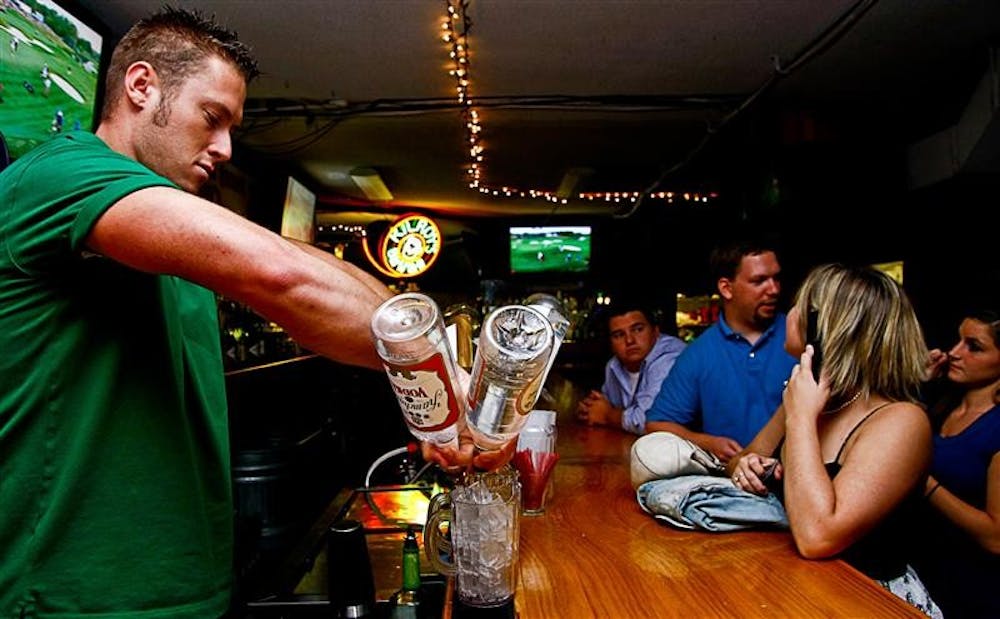
By 5 on a Friday night, most IU students are finishing school and making plans for the weekend, but senior Clark Baker, 25, is just starting his day.
“The hours aren’t bad,” he said. “But my sleep schedule is weird.”
Baker is one of the 25 employees that serve more than 500 customers that come to Kilroy’s Bar & Grill on a typical Friday night. Employees are assigned to either the Happy Hour shift that lasts until 10 p.m. or the later shift from 10 p.m. until 3 a.m.
Before the night can begin, the bartenders must set up the bar and restock everything from alcohol to napkin holders. But employees cannot begin serving drinks until they have paid their dues. All potential bartenders must first work as a doorman, server and a bar back.
Although Baker has worked each job, bartending has been the most lucrative position. On a busy night he can make $250 to $300 in tips.
Bartenders must work at least one weekend night and one weekday, but most employees, like Baker, work three to four days a week.
The chaotic environment does not deter students from working at the popular bar, but retaining staff can be a challenge because students eventually graduate, said general manager David Prall. To weed out less serious employees, Prall requires that employees work several other positions before becoming a bartender.
“I don’t hire bartenders,” Prall said. “Employees have to work their way up.”
Other than retaining staff, Prall said retaining shot glasses has been one of the biggest challenges. Prall said customers often try to steal the shot glasses with the Kilroy’s logo printed on them.
“Sometimes it just gets ridiculous,” he said. “We have had customers try to steal 10 or 20 shot glasses at a time.”
Prall said about 500 shots glasses are on hand in the bar at all times. Because of theft, Kilroy’s must order new glasses at least twice a month to keep enough on hand. To combat theft, he said some shot glasses do not have the Kilroy’s logo anymore.
“We just try to think of it as our advertising budget,” Prall said, noting that the bar does not usually advertise.
IU graduate Josh Luft, 24, has worked at Kilroy’s for three and a half years and has been a bartender longer than any current employee. Because he is a senior bartender, he is able to work in preferred areas along the bar. Regulars usually congregate at the back of the bar near the beer pong table, Luft said. The bar is also wider to keep unruly customers at a further distance.
“It is better to work farther back because you can be more selective about who you serve, and it is less hectic,” he said.
Bartending during busy nights can get chaotic, especially when students get impatient. Luft said he has had customers throw ice and even grab his arm to get his attention.
“It just gives you a shock because you are so focused on your job,” he said. “It is difficult when you have so many people yelling at you for drinks.”
During special events such as the Little 500 and Homecoming, the bar is especially crowded and bartenders often feel overwhelmed.
“At first I would get anxious and try to serve everyone,” Luft said. “But the older bartenders would tell me to calm down. We aren’t saving lives, and no one is going to die if they don’t get a drink.”
Bartending can also be confusing at first because of the extensive list of shooters a bartender must learn. Customers often invent their own shooters or ask the bartender to make one up. Even with a wide range of drinks offered, Baker said that one drink, the Long Island Iced Tea, was by far the most popular drink requested.
“Learning the shooters is difficult at first,” he said. “But first all you have to learn how to pour is a Long Island. The rest you can learn as you go.”
Life behind the bar
Get stories like this in your inbox
Subscribe