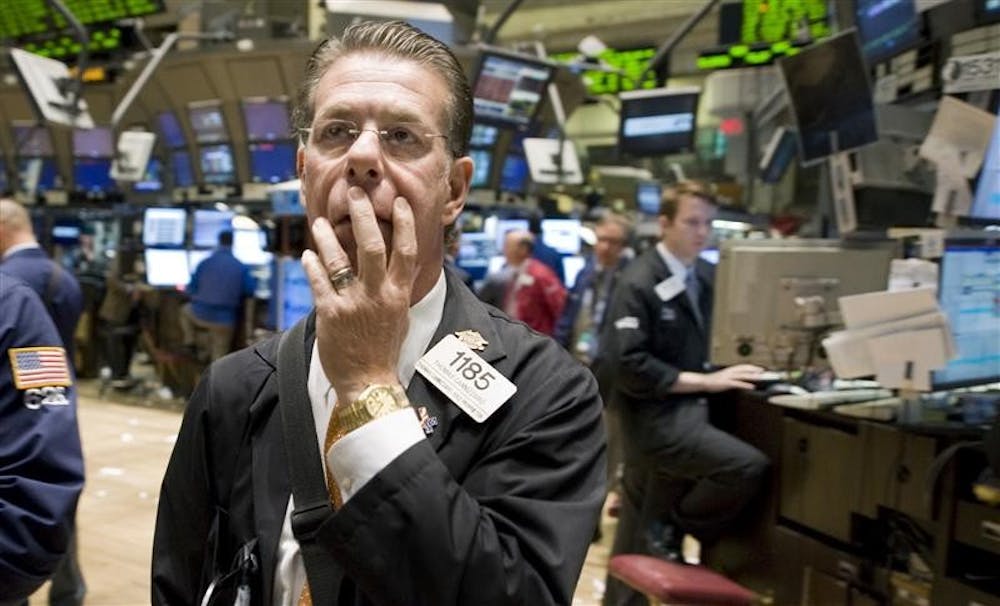
Despite a plunge of 777 points Monday, experts at IU say that the drop-off of the Dow Jones industrial average is not a major reason for concern or panic.
“The drop in the Dow itself is not necessarily going to affect the economy,” Allen Snively, a finance lecturer, said Monday. “Certainly the psychological impact of a drop like we had today certainly can affect people’s behaviors in terms of their ability or willingness to spend money, but the economy isn’t affected by a single day like this.”
Lawrence Davidson, an IU professor of business economics and public policy, said a stock market cycle must be studied over a long period of time in order to understand the strength of the market.
“What happens to the stock market over a couple of years or even a decade could give you a measure of how strong or weak an economy is,” he said. “What happens over the course of one or two couple days or even over the course of several weeks could be driven by psychological factors that change and reverse themselves and, therefore, don’t tell you anything about anything that is more lasting.”
But they caution against dismissing Wall Street’s woes.
Following Congress’ rejection of a $700 billion bailout bill Monday, the Dow Jones industrial average suffered its greatest ever one-day point loss. The bailout plan would have brought forth a number of measures that could have been beneficial to the economy, said Timothy Williams, student advisor of the Financial Club at IU.
“What the government plan will do is to absorb some of the bad debt that may eventually default and allow our lending to go on more normally than is currently possible,” Williams said. “This is essential for our economy, otherwise almost everyone will have very few means of financing.”
Without financing, the economy will be unable to support research and development, capital expenditures and business growth, he said.
“The plan also contains many components that deal with oversight and regulation, so none of this has to happen again,” Williams said.
The Dow Jones industrial average has been swinging violently during the past several weeks followed by slight recoveries. But Monday’s rejection of the bailout bill resulted in the Dow’s largest percentage drop since 1987, Davidson said.
There are several causes of the problem, but there is one
fundamental problem, said Randall A. Heron, an IU assistant professor of finance.
“There’s a credit crunch right now and a stumble in the housing market,” he said, “and a lot of leverage and quite a few things coming together. I think that it’s an indication of a big problem and concern that steps are not being taken quickly enough to address it.”
It is hard to come up with one sweeping solution, Heron said. He said he believes the bailout plan is important to economic success.
It is unclear where the market might head in the next few days. Even so, it is important to understand this is a time where market values are going to fall, and that, eventually, things will get better, Snively said.
“Certainly lots of things have to happen,” he said. “Probably at least until we get confidence from the bailout package, it will take a good year or so to kind of let this slide through the system. We also have a global issue we have to deal with, and that is the belief by international investors and other countries that the U.S. is a safe place to invest in again. That may take a while. I would suggest that we have at least 12 months from whenever we get this thing passed.”
But there are no guarantees a bailout plan will work, leaving many wondering what life will hold with a struggling economy.
“If the stock markets are collapsing, then people’s wealth is declining,” Davidson said. “One immediate effect is that it may influence how much people are spending. Spending in the United States has leveled off or is not growing, so this can’t help there. If people aren’t spending, then firms are going to have trouble with their revenues, so then there may be some cutbacks in business activity as well.
“It could be a serious thing if it keeps up.”
Nightmare on Wall Street
IU faculty say to think long-term about collapse
Get stories like this in your inbox
Subscribe