Bloomington lies within the scenic foothills of Indiana, hemmed in by
trees all along the highway and through the IU campus. The city’s very
name evokes a sense of greenery. If you combine that with the liberal
reputation Bloomington has garnered over the years, the local
environmental movement here is only fitting.
Bloomingfoods led the charge for a local and more environmentally
conscious town more than 30 years ago, when a group of residents
decided they wanted a change.
“At that time, there was sort of a renaissance of food co-op across the
country,” Ellen Michel, marketing manager of Bloomingfoods, said.
“People weren’t finding natural foods in the grocery stores.”
The co-op started out as a buying program from a food distributor until
it built up enough of a market to open a store in 1976. The company’s
mission statement still applies today.
“A lot of the things they were concerned about turned out to be broad
mainstream concerns now,” Michel said. “That was 32 years ago, and the
whole local foods movement just sort of blossomed in the last four or
five years. They were kind of ahead of the game, I think.”
The environmental movement really caught on in 1970, following events
like biologist Rachel Carson’s book “Silent Spring,” which launched an
attack on pesticides upon its publication in 1962. In December of 1970,
the federal government created the Environmental Protection Agency,
which was “born in the wake of elevated concern about environmental
pollution,” according to the agency’s Web site.
One result of the green movement, the U.S. Green Building Council,
recently launched a project in conjunction with Bloomington’s Housing
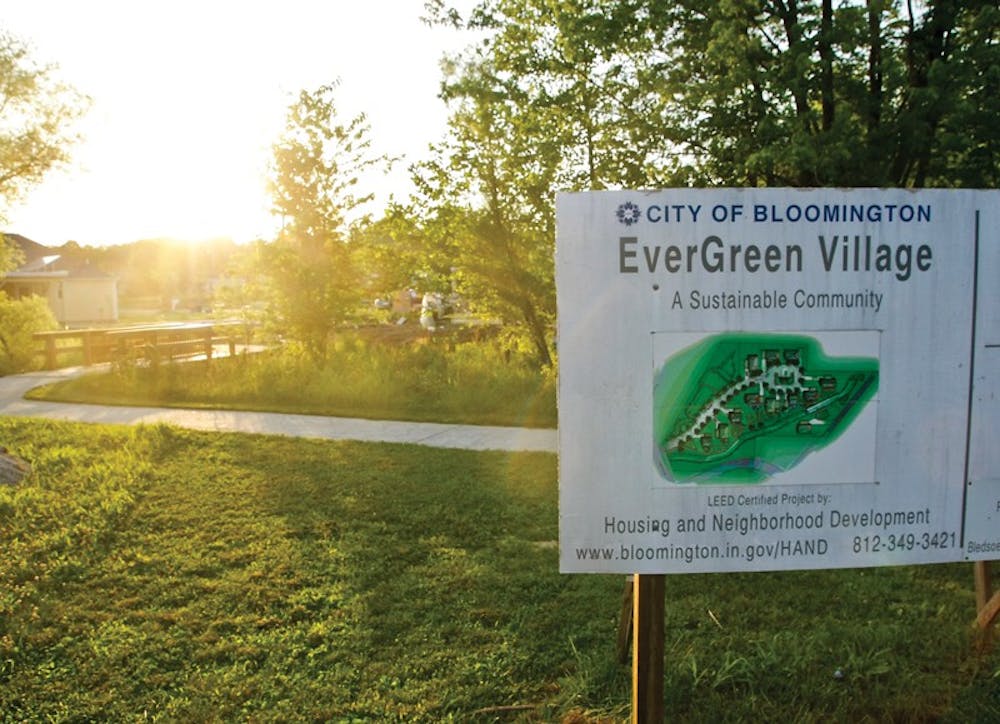
and Neighborhood Development Department. EverGreen Village is a new
housing development still under construction as part of the building
council’s Leadership in Energy and Environmental Design.
“The USGBC was founded in 1993 to bring together professionals from
every sector in the industry and to create a common definition for
green building,” U.S. Green Building Council Communications Coordinator
Ashley Katz said via e-mail.
The new housing addition is a pioneer project in the field of energy
efficiency for residential homes. Started in 2006, four of the 12
houses already have families; seven are still under construction.
“The last six or seven years the HAND department has really tried to
make our units more energy efficient,” Lisa Abbott, director of the
Housing and Neighborhood Development Department, said. “We don’t
believe that it makes sense to put a low-income family in a house
that’s expensive to operate. As technology has developed, we have
continued to move forward.”
The houses feature carpets made of recycled plastic bottles, pathways
of recycled pavement, solar panels and environmentally friendly
storm-water systems, Abbott said.
On the IU campus, environmental progression has been a focus since the
early 1970s with the founding of the School of Public and Environmental
Affairs. The latest college rankings issued by the U.S. News and World
Report list IU’s SPEA as the second best public-affairs graduate
program for 2009, tying Harvard and beating out the likes of Princeton
and Columbia.
Founding SPEA professor Philip Rutledge, who passed away last year,
spoke about the attitudes of establishing an environmental school in “A
Reminiscence: SPEA Deans I Have Known.” The passage ran in the winter
2001 issue of the SPEA Alumni Update newsletter.
“The concept of SPEA as a statewide system school to prepare a cadre of
managers to tackle the enormous public sector challenges emerging from
the turmoil of the 1960s was an idea whose time had come,” he wrote.
He felt SPEA “was to become the largest, most comprehensive, and,
arguably, the nation’s most innovative institution for the preparation
for careers in the public service.”
Rutledge and the other pioneers who helped launch both green and
locally driven programs paved the way for environmental awareness and
sustainability, and it seems as though that’s a tradition that will
never die.
ForEverGreen
Get stories like this in your inbox
Subscribe