
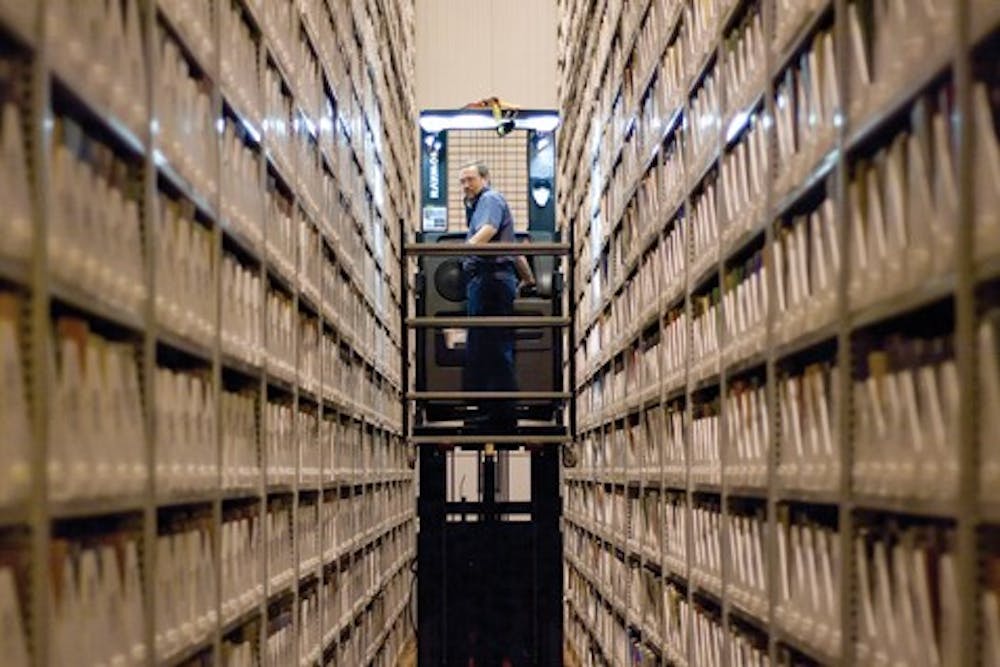
A “Last of the Mohicans” poster is propped up near Pam Cook’s desk in the East Tower of the Herman B Wells Library. Her current project, a seven-DVD set on belly dancing called “Tribal Basics,” sits nearby.\nCook, an IU alumna with a degree in English literature, works as an audio-video cataloger at the library. She and Vaughn Nuest, head of Auxiliary Library Facilities Management Services, are only two examples of library workers with atypical jobs.\nManaging the surplus\nWalking into the book safe inside the Ruth Lilly Auxiliary Library is like walking into a cave.\nThe dimly lit, cavernous room is a balmy 50 degrees with 30 percent humidity, which is the ideal climate for book preservation, Nuest said. Metal shelving 30-feet high runs through the room and books sit nestled on shelves in special acid-free and lignin-free trays. The entire library environment is designed to provide the best life possible for its literary inhabitants.\nNuest oversees the 1.7 million items housed in the building. He has worked as a librarian at IU for 27 years, including several as a student. \nHe said he understands the importance of a high-density shelving facility like the Auxillary Library Facility – he worked as an assistant building manager at the Wells Library before the ALF was built. Part of his job was to help facilitate the off-campus storage of extra books. The Wells Library was built with a capacity to accept books for the next 20 years, Nuest said. However, after 20 years, annual acquisition rates averaging roughly 100,000 volumes per year continued to flood the campus libraries until they were 2 million to 3 million volumes more than capacity. Today, he said, the IUB Libraries are digging their way out of the book surplus by using the storage capabilities of the ALF.\n“Our goal is to get all of the libraries to 80 percent capacity,” Nuest said. “But that is still 10 to 15 years worth of moving.”\nLiving in the “deluxe environment” of the ALF can add an extra 400 years to the lifespan of a book, Nuest said. The ALF staff tries to send every book back in better condition that it arrived in. This includes vacuuming books, freezing items that may have insects or mold in them and even recreating books in the preservation room.\nUnlike the Wells Library, books are sorted and stored by size to maximize space in the collections vault. Only five people have on-demand access to the vault in order to maximize security. So far, Nuest said, the system has had a 100 percent retrieval success rate. Any item requested before noon is delivered the same day, Monday through Sunday.\nWhile plans for an expansion that would increase collection storage by 150 percent are underway, Nuest said the ALF is one of the models other universities use when designing shelving facilities for library materials.\n“They spared no expense to make this the best environment possible for the books to live in,” he said.\nKnowing a little about a lot\nCook said she initially intended to have her job as cataloger with the Wells Library for six months. Over time, six months turned into 30 years.\n“Around 1979 we had some video cassettes, the old half-inch ones, and my boss wanted someone to bring them into the catalog,” Cook said. “No one wanted to do it and I volunteered.”\nCook now catalogs nonprint materials. These can range from DVDs, the bulk of her work, to posters, games and maps. However, not all items that come across Cook’s desk are commonplace.\n“One day I came back from lunch and I found a box labeled ‘human body parts,’” Cook said. “It was a box of model body parts. We also get things like cross-sections of the human brain, and one colleague had to catalog owl pellets once.”\nCook’s job normally entails enhancing previous catalog entries or creating entirely new ones. She writes a physical description of the item, compiles a summary and assigns a call number.\nAfter cataloging a variety of things, Cook said she knows a little about a lot of things.\n“I always tell people, if you see a librarian on ‘Jeopardy!’ bet on that one to win,” she said.
'No one wanted to do it, and I volunteered'
Get stories like this in your inbox
Subscribe



