Hookah: known by many different names, its use has spread from India to across the globe over its 400 years of existence. It can be found in smoky cafes of Cairo, as a decoration in Mediterranean restaurants, even in “Alice in Wonderland,” as a three-inch caterpillar blows colorful letters of its smoke into Alice’s face while she sits atop a tiny mushroom.
But the hookah, or water pipe, is more than just another way to smoke tobacco; to some, it is a relaxing pastime, to others, a piece of cultural heritage. Its tasty smoke has attracted people all over the world, and in modern America, its use has been reborn, particularly amongst the college crowd.
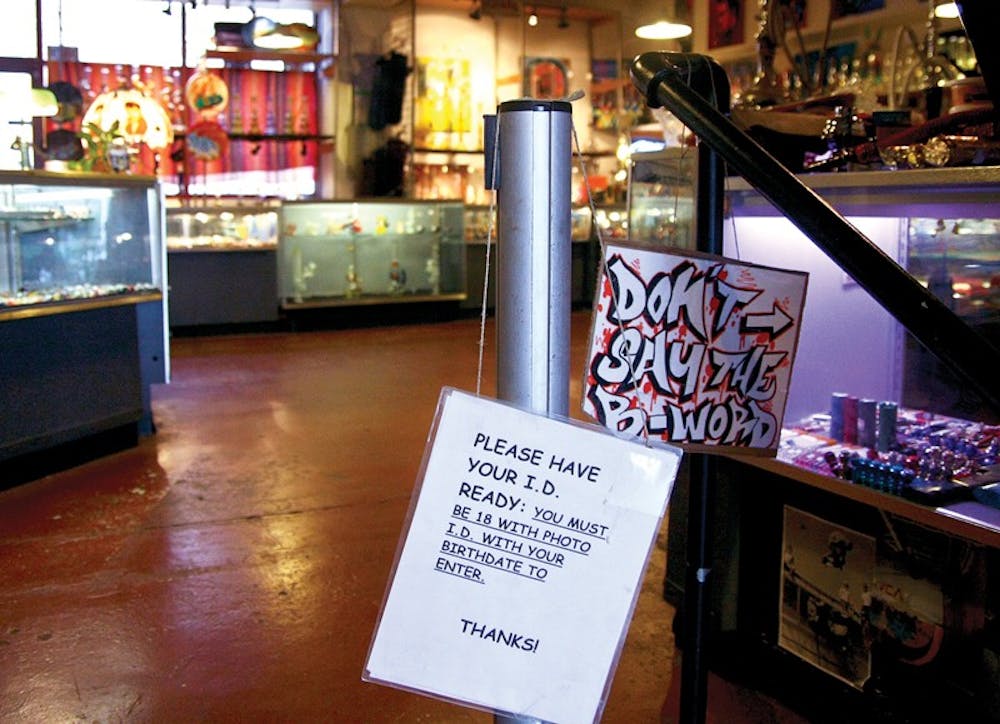
Gary Schneck, an employee at Amused Clothing, located at 212 W. Fourth St., recently moved to Bloomington from West Lafayette, and was surprised by the relative lack of attention paid to the hookah in B-town. He said that in West Lafayette it’s a much bigger trend.
A big difference in Schneck’s eyes is the lack of hookah bars, where people can publicly smoke hookah tobacco.
Commonly called shisha, this tobacco is usually sticky and wet, consisting of shredded tobacco mixed with molasses, honey or dried fruit. This gives shisha its sweet flavor.
Because of the shredded consistency of shisha, picking up the tobacco in chunks to pack is easy, but sometimes messy. After placing the desired amount of tobacco in the bowl, a layer of tin foil is spread over the top.
Holes are then poked in the foil, and a lit coal is put on top of it. Using tin foil is the most common method of reducing the amount of coal ash inhaled while smoking, but Schneck says that inhaling the smoke filtered through tin foil is unhealthy and can be harmful as well.
Though the water filtration may make smoking hookah seem like a safe way to enjoy tobacco, it carries the same risks as smoking cigarettes since it contains nicotine and other harmful chemicals. Lengthy smoking sessions and the risks of using coal and metal to smoke make hookah risky, according to the Department of Health and Human Services.
In Bloomington, hookah smoking is limited to personal use, which can be expensive.
IU senior John Quick said that he smokes shisha about twice a week with his neighbors, who own a hookah. His favorite part of smoking hookah is the smoke itself, he said.
“I just like the aesthetic look of free-floating smoke,” Quick said. “You get various flavors and you can mix them and get your own flavors. That and it’s really smooth.”
Quick’s favorite mixed flavor is one that a friend of his makes using cherry and Coke-flavored tobaccos that Quick said “tastes exactly like Cherry Coke.”
Quick also enjoys the social nature of smoking hookah. Smoking gives friends something to gather around and share while talking or watching a movie.
As for the dangers of smoking shisha, Quick considers hookah to be less harmful than other tobacco products like cigarettes and cigars due to the low-frequency use of it.
“It’s the safest smoking practice you can have,” he said.
Hookah tobacco is the only kind that Schneck smokes, and he describes the experience as a “chill, relaxed thing.”
“You can take it out(side); it’s relaxing; you can do it while you study,” he said. “You get a tiny buzz every now and then.”
Ali Akhras, a manager of 10th Street Market, located at 1823 E. 10th St., sees the hookah as a social device and as a group activity.
10th Street Market offers many hookahs and hookah products as well. Akhras said many people buy supplies, but few buy an actual hookah. He said that he sells a lot during the school year, but only about one a day during the summer.
If you aren’t afraid of the risks, smoking hookah can be an enjoyable, relaxing experience. Though finding a hookah to smoke in Bloomington can be difficult or expensive, it is adored by smokers all around the world. And more and more seem to be becoming interested in this fifth-century tradition.
Do you hookah?
WEEKEND investigates the flavor behind the water pipe
Get stories like this in your inbox
Subscribe