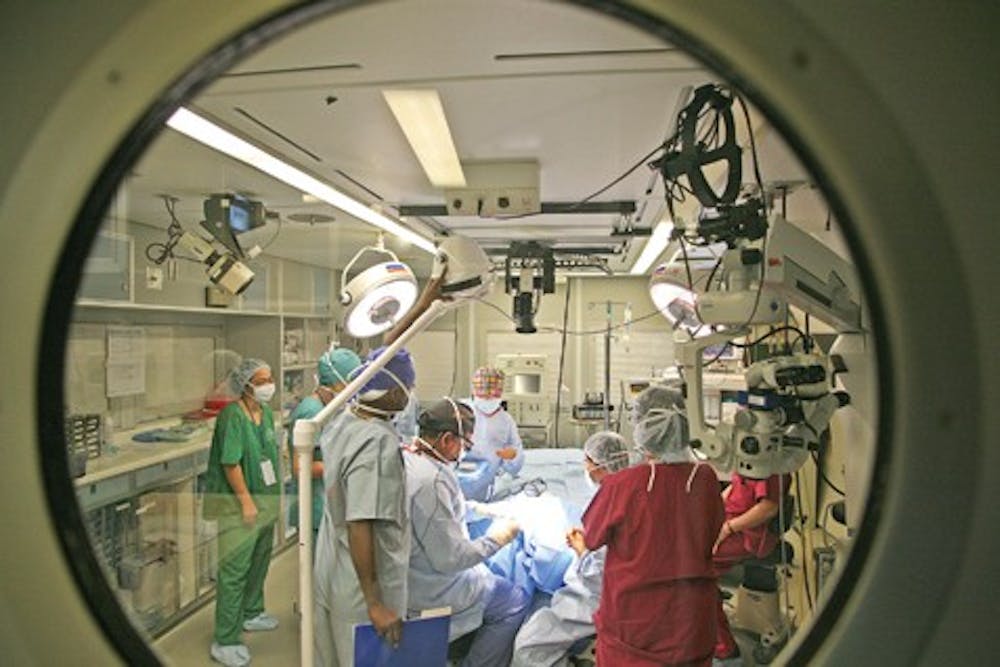
March 17 to 24 marked the first “Big Ten Week” for ORBIS International, the “flying eye hospital” that travels to Third-World countries to provide ophthalmology training and medical assistance to local doctors. \nVolunteer doctors from Big Ten universities, including one from IU, flew to Da Nang, Vietnam, to perform surgeries for people in need and to give lessons on how to deal with eye problems to local doctors. \nDr. Hua Gao, assistant professor of ophthalmology at the IU School of Medicine in Indianapolis, was one of the volunteers.\n“A long time ago, when I was in China, ORBIS came there,” he said. “I’ve always liked to do this. For a long time, this has been one of my dreams.”\nGao finally got his opportunity to work with ORBIS through a colleague who told him about the Vietnam trip. As a retinal specialist, Gao performed surgeries concerning retinal disease and retinal detachment.\n“I also dealt with patient care and trauma,” he said.\nDr. Keith Carter, a professor and department head of ophthalmology at the University of Iowa, also went on the Vietnam trip. Carter specializes in oculoplastic surgery, corrective or reconstructive surgery for areas in or near the eye, and has gone with ORBIS twice before to India and the Philippines. \n“They are all poor,” Carter said. “The technology is similar in all three countries. India has high (quality) eye care, but because of the density of the population they just can’t take care of it all.” \nORBIS launched in 1982 as the brainchild of Dr. David Paton, who was then head of the Ophthalmology Department at the Baylor College of Medicine in Houston, according to the organization’s Web site. Paton’s extensive traveling made him realize the need for better eye care on a global scale, so he dreamed up a “flying eye hospital” that has all the requirements of a hospital, but is located inside an airplane. The name ORBIS came from both the Greek word pertaining to the eye, and the Latin word meaning “around the world.”\nPaton took his idea to Pan American World Airways founder Juan Trippe, and the pair, along with some help from others, got their hands on a retired and beat-up DC-8 plane. Donations and grants helped Paton and his crew transform the plane into a mobile hospital, and the aircraft went on its maiden mission to Panama in 1982, according to the website. The plane is complete with an operating room, classroom and a recovery room, and cameras are stationed in the operating room so people can watch surgery from anywhere in the plane.\nSince then, the organization has upgraded to DC-10 airplanes and has established permanent offices in China, India, Bangladesh, Ethiopia and Vietnam, according to the site. \n“The countries that are the hardest hit is where they decide to go,” said Michelle Dackis, an account executive with Ogilvy Public Relations Worldwide, when represents ORBIS. \nDackis said ORBIS relies on statistics from organizations such as the World Health Organization to determine where the need is greatest and the surgery techniques are most lacking.\n“Usually they’re not even major treatments,” she said. “Most of the eye problems could easily be prevented.”\nWanda Martinez, associate ophthalmologist at the University of Wisconsin, also traveled with the Vietnam team for \ntwo weeks. \n“I saw many kids with crossed eyes and I saw many other patients with multiple problems,” Martinez said. “Many people were in accidents and had scars and problems with their eyelids.”\nMartinez taught the Vietnamese doctors to use the computer simulator they have on board, which re-enacts cataract and retinal surgeries.\n“There’s an incredible need, and ORBIS is trying to provide that need rather than just come in and do it and leave,” Martinez said.\nFor Martinez, one of the best things about traveling with ORBIS is being able to see the progress in these countries. Even though her group was stationed in a country where the evidence of war is still apparent, Martinez said she thinks the Vietnamese people are on the right path.\n“It was very inspiring to see people trying to be better,” she said. “Tons of Vietnamese women are going to school. The country is beautiful – the coast is amazing. There’s poverty, but there’s hope of progress.”
‘Flying eye hospital’ helps to develop Third-World countries
Get stories like this in your inbox
Subscribe