
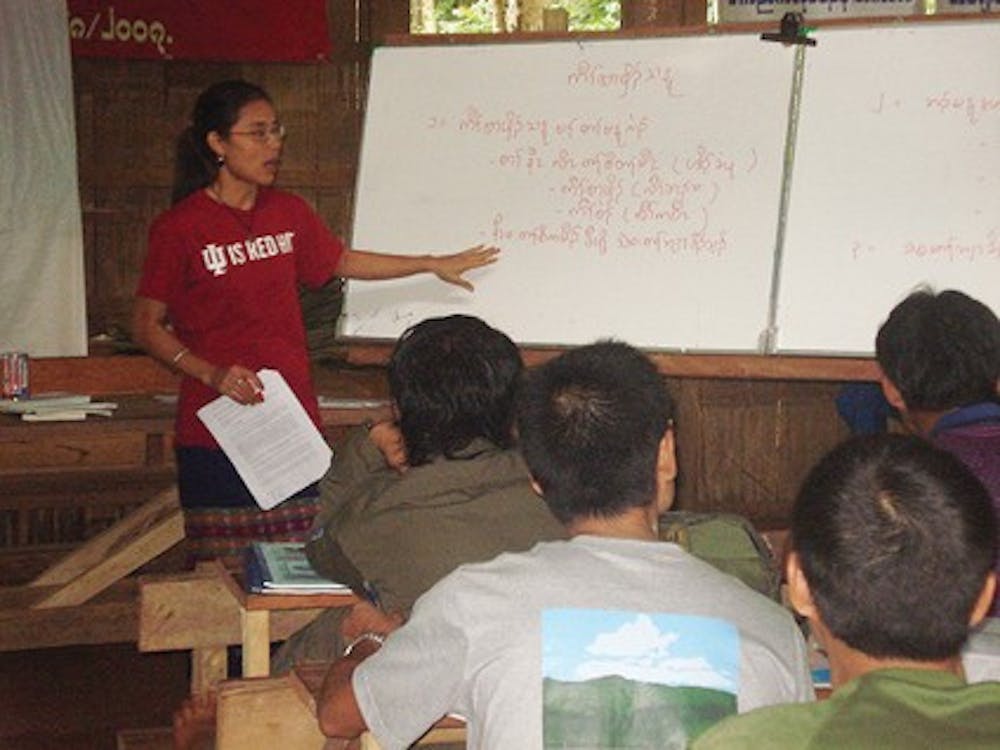
IU freshman Ying Lao’s first word in Shan, her region’s native tongue, was “independence.”\nTo her, it was a foreign-sounding word whispered discretely among the villagers in her small community in the Shan state of Burma. Ying Lao, who learned Burmese at an early age, heard an older man murmur the Shan word “kornkaw” when she was in 10th grade.\nThe first time she heard the word, she asked her father, the headmaster of a primary school, about the meaning of “kornkaw” and why everyone was afraid to utter the word above the level of a whisper. \n“It means ‘independence,’” her father said.\nA divided country\nYing Lao has been working to secure independence and a constitution in her home country since she discovered the meaning of “kornkaw.”\nAfter joining youth and women’s groups in Burma, she began helping to draft a new constitution in the ethnically divided country. She received the Burmese Refugee Scholarship and is now a freshman at IU. She believes her education in the U.S. will help her learn from the past and prepare to return home to Burma.\nBurma is made up of the ruling Burmese majority and a handful of ethnic minority groups, including the Shan. Tired of inequality, brutality and human rights violations, the Shan people decided to break away with the hope of becoming an independent Shan state.\nGrowing up, Ying Lao questioned why she had to study the Burmese language, a language she did not associate with herself or her community, instead of the Shan language her friends and family spoke. There were books in her house she couldn’t read, conversations she couldn’t understand. \nSomething is wrong, she thought.\nIn 1988, when Ying Lao was 3 years old, her father was arrested in an uprising for supporting the democractic movement and illegally teaching villagers the Shan language. Soon, the lessons began.\nEvery night after dinner, Ying Lao sat behind her father as he rode his bicycle around the village and taught her the Shan language.\nA curious and talkative child, Ying Lao continued to ask her parents about the strange events occurring in her village. She learned that the military forced villagers in nearby Shan states to flee their communities because they supported the democratic movement. They sought refuge in Thailand, where many became illegal migrant workers.\n“It was more dangerous to keep living in our own town because our villages are all gone,” Ying Lao said. “The economy is going down and down. At the same time, women are raped every day and we heard the news that people were killed because of suspicions that they are supporting the rebel group.”
Becoming an activist\nAfter she graduated from high school, Ying Lao’s family moved to Thailand to stay with a relative. With her father’s meager income and no legal status, she could not attend college.\nInstead, she became a member of the Shan Women’s Action Network, a community-based organization that provided human rights training to women. Through the group, she learned about many problems plaguing Burma: forced labor, rape and human rights abuse. \n“On one hand, I want to go back home,” Ying Lao said. “On the other hand, I can’t. What do I do? I have to make a change. I have to be part of something so when my country is safe I can go back.”\nAfter three months of human rights training on the Thailand-Burma border, Ying Lao learned that the heart of the struggle was not power abuse, but constitutional crisis.\n“At the beginning, people were not invested (in learning about the constitution),” Ying Lao said. “They think it is not about them. The most important thing to them is to have good health care and basic care. A place to live and food to eat is enough for them. What they don’t know is that the constitution is going to guarantee those rights for them.”\nWhile Ying Lao was invested in the cause, her age and gender worked against her in a culture dominated by elders and men. She decided to become an organizer for the Federal Constitution Drafting and Coordinating Committee on the border and coordinate a constitutional study team through the Women’s League of Burma. \nFor three years, she organized committee meetings with other state constitution-drafting committees and helped define gender equality so the new constitution would reflect women’s rights.\n“Everything I do is for only one reason,” she said. “I want to go home. I will do whatever I can or what can help me to go home. This is all I think.”
‘The government you \ndeserve’\nAye Hla Phyu, a third-year Ph.D. student in law and political science, was raised in Burma and fled with her family to the Thailand-Burma border in 1988. She came to IU through a refugee resettlement program. In Burma, she was active in the Shan Women’s Action Network and met Ying Lao when she was working on the constitutional drafting process. \n“We do not have very many women as outspoken in our movement, and Ying Lao is one of them,” Aye Hla Phu said. “If you care about ethnic minorities in Burma, it is impossible not to know Ying Lao.”\nWhile she’s at IU, Ying Lao’s position has been filled by another Constitution Drafting and Coordinating Committee member. Aye Hla Phyu has been involved with the Center for Constitutional Democracy in Plural Society at the IU School of Law. They don’t know what Burma will be like after they’ve completed their studies, but both women say they intend to find out.\n“You get the government that you deserve,” Ying Lao said. “It depends on how the people of Burma change, open and educate. Our people have to open our minds and be educated and be committed to work for change in our country.”\nAs she talked about her experiences, Ying Lao pulled out a small photo album with pictures from home. The book protects pictures of family members who encouraged her to pursue her education. Some snapshots show Ying Lao in a throng of students at a conference on government. Others depict young Burmese students explaining a brightly colored timeline to local youth. She paused at a picture of the Shan State Army.\n“That is kornkaw,” she said.



