
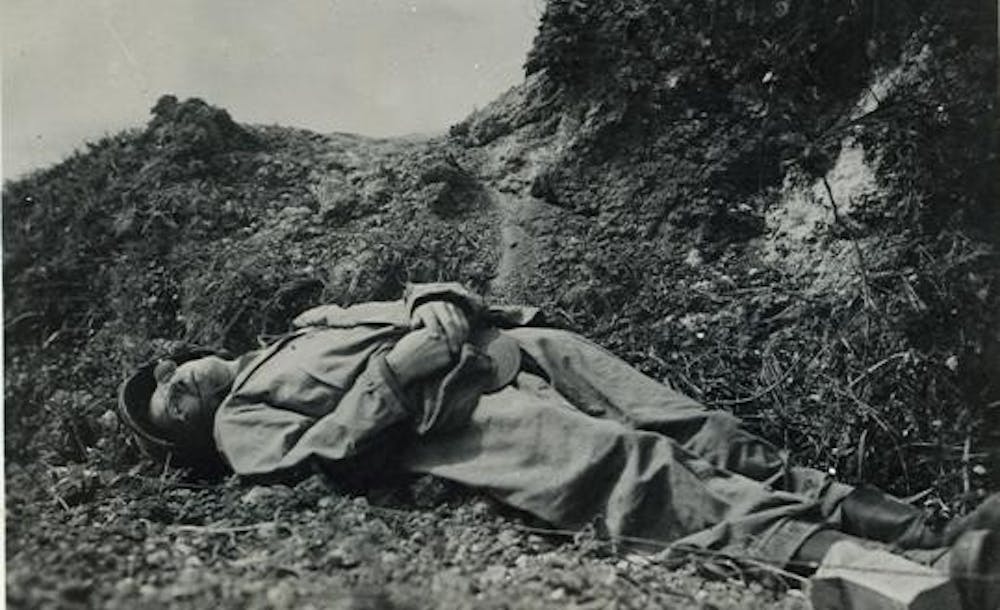
Since Ernie Pyle’s sudden death on the island of Ie Shima, people around the country have only been able to imagine the sacrifices Pyle made to the people of America as a correspondent reporter of World War II.\nSixty-two years after his death, a recovered photograph depicting Pyle lying on the ground after being shot shows the horrific but historical significance of Pyle and his cause.\nThe Associated Press reported that the photo was taken by an Army photographer who crawled forward under fire to snap the picture. The photograph was later withheld by military officials.\nOwen V. Johnson, associate professor in the IU School of Journalism, said he is still unsure of how The Associated Press came across the picture. However, two people are known to have it, Johnson said, and the picture also exists in two archival collections in Indianapolis and Dana, Ind.\nMany publications, however, did not want to publish the actual picture, said Jack Dvorak, School of Journalism professor and director of the High School Journalism Institute. They refused to publish it because it as rather graphic, he said.\n“It provides very clear evidence of the sacrifice that Pyle made, and that is giving his life just as he had described in the deaths of so many soldiers he was with,” Johnson said.\nPyle attended IU from 1919 until 1923. He majored in economics because journalism was not an available major at the time. He left IU just a semester shy of graduating with a bachelor’s degree to take a job in La Porte, Ind. He then went to work for Scripps-Howard News Service where he held a variety of positions, including reporter and copy editor.\nPyle then began to work overseas where he reported on the London bombings from 1940 to 1941, and then covered some of the first battles of World War II in North Africa in 1942, Johnson said. \nA Japanese machine gunner killed Pyle in 1945, and Pyle was buried with the soldiers he was with.\nJohnson said Pyle was the most famous journalist of the World War II period. Forty million people read his column daily in more than 400 newspapers around the country.\n“People depended on him to get a personal outlook on the war that no one else gave,” Johnson said.\nDavid Boeyink, an associate professor in the School of Journalism, said Pyle thought of himself as an ordinary person and that allowed him to identify with the GIs.\nThe photo is important to journalism, Johnson said, because it shows the sacrifices that so many journalists make in reporting news from dangerous places. Still, 62 years after Pyle’s death, a great majority of journalists still know and respect Pyle, and the IU School of Journalism building bears his name.\n“Looking at that photo,” Boeyink said, “(The idea) struck that, in fact, Ernie Pyle had made the ultimate sacrifice that the many soldiers that he covered through the war had made.”
WWII death photo of Ernie Pyle recovered 62 years after he died
Get stories like this in your inbox
Subscribe



