
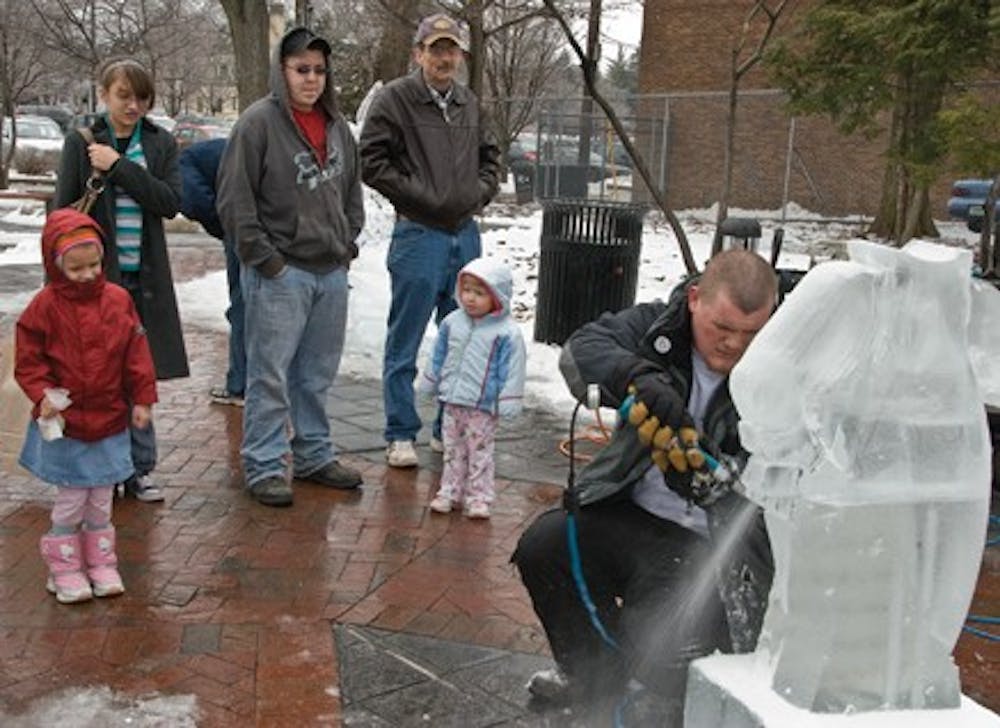
The president’s Oval Office desk sits under a white tent in the center of People’s Park on the corner of Kirkwood Avenue and Dunn Street. A sign at the bottom tells passersby to pose behind it and take a picture. A mother and her young son examine the desk in amazement.\nWell, at least it looks an awful lot like the president’s desk. President Bush would have to wear gloves to use this one, because the desk is actually an ice carving created by sculptor Jon Michaels and his brother, Jeff Roberts, for this year’s ArtsWeek, held Feb. 20-Mar. 1. \nThe two brothers and fellow ice sculptor Stephan Koch designed the unique sculptures for this year’s politically-themed Artsweek. \n“We’re trying to go with the theme of politics, but politics is such a polarizing subject,” Koch said. “We feel our job is to introduce some levity into the theme.”\nThe demonstrations will not only show a relation between politics and art but will also attempt to draw more attention to an art form that does not normally receive much. \nFor Koch, ice sculpting is a full-time job. He runs Indiana Ice Studio, and, like many other ice sculptors, he started at a culinary arts school.\n“Ice carving is a culinary art so I moved into the ice business from there,” Koch said. “I found over time that I was more of an artist than a scientist.”\nMichaels and Roberts, the two other ice carvers involved in ArtsWeek, started a different way. Michaels said he had always been interested in art and sculpting, so he taught himself to carve ice.\n“I’ve always been an artist and I just kind of fell into it,” Michaels said. “I started carving wood and I began to work full time with ice. I did a lot of learning, reading and watching and learning off of other people.”\nMichaels taught his brother, Roberts, to carve, so Roberts now helps with his brother’s business, Ice Creations, based in Napoleon, Ohio, Michaels has been carving for seven years, while Roberts has been helping out his brother for only six months. The two said they like ice because it is easy to work with.\n“You have more leeway as far as fixing repairs or cracks,” Roberts said. “If you make an error it’s easily fixed.”\nEven though the sculptures are easily repaired, they are also easily broken. Koch said. For his competition pieces, he likes to push the limits of the ice, even though a sculpture could crash at any moment.\n“This year I did a jellyfish and the jellyfish was about 40 inches long and stood on four inches of ice and was 40 inches tall, so it all balanced on this little portion of ice,” Koch said.\nKoch said a common misconception of ice sculptures is that they melt quickly, but said they last longer than most people would guess.\n“It lasts a lot longer than you think,” Koch said. “A sculpture can last eight hours at room temperature. It’s not like an ice cream cone.”\nMichaels said he recommends an apprenticeship for anyone interested in ice sculpting to learn about the different techniques and tools involved. Koch agreed; however, he said some sculptors are hesitant to share their skills because they do not want to create more competition. He said anyone interested in ice carving should take a class at a local community college. Ivy Tech Community College in Fort Wayne, for instance, offers an Introduction to Ice Carving class in its Hospitality Administration department.\nNo matter what route one takes to get there, Koch said a career in ice sculpting is a great one.\n“I carved some other things before, but ice is where I really have found my niche,” Koch said. “Ice sculpture is a way to create 3-D form very quickly.”
Breaking the ice
ArtsWeek brings carvings to Peoples’ Park in Bloomington
Get stories like this in your inbox
Subscribe



