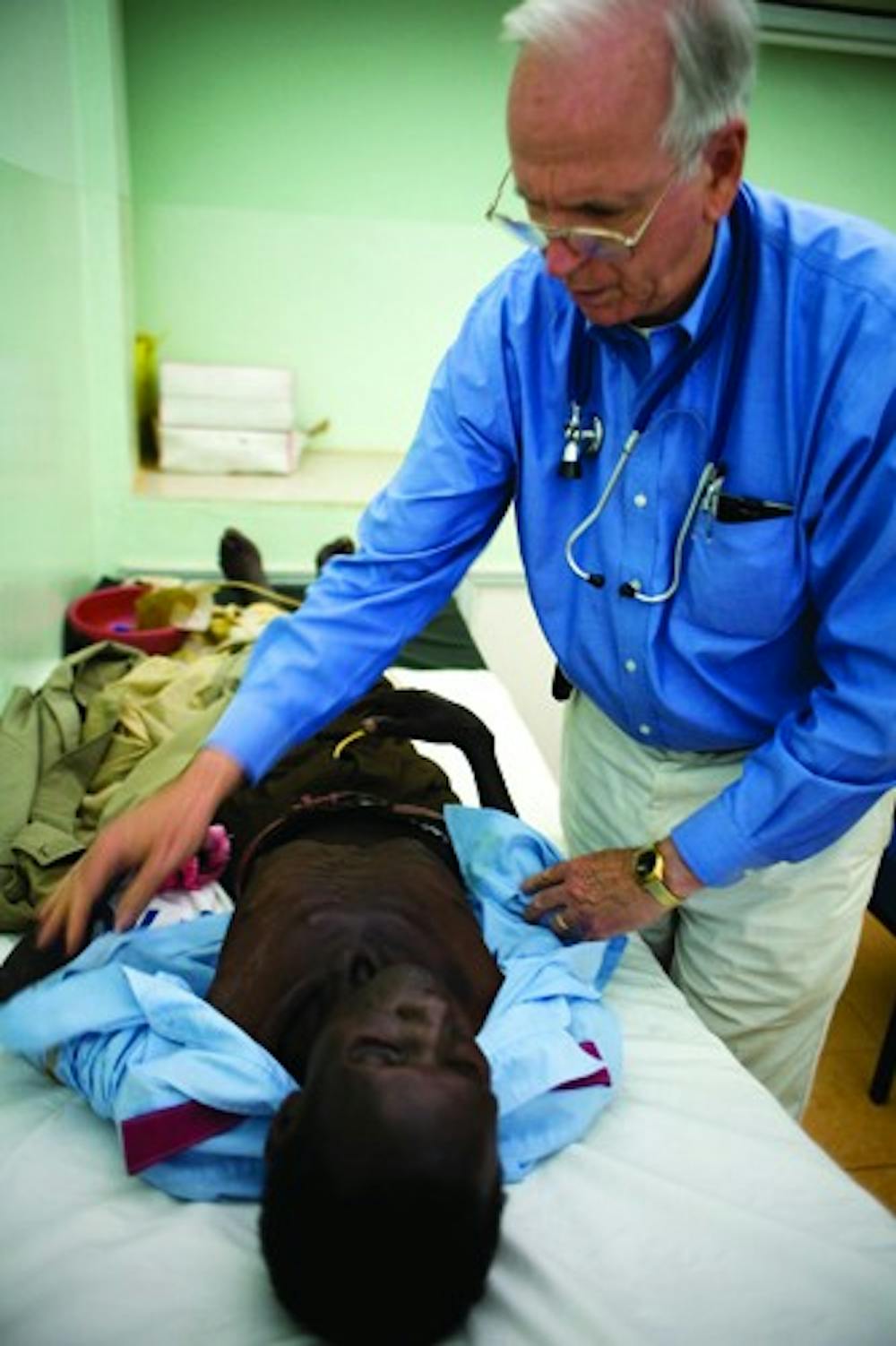
As IU professor, Dr. Joe Mamlin carried plates of beans and rice into the single dining room of his home – \na seven-house, 40-bedroom compound in Eldoret, Kenya – he heard the singing.\nInstead of witnessing glimpses of the tribal warfare ripping across Kenya, Mamlin and his wife, Sarah Ellen, watched as members of every tribe currently at war stood in one room of the compound crying, singing and praying. Together. As he described it, they became one with God, their voices combined as a beautiful music.\n“It was not like any prayer I had ever seen before,” Mamlin wrote in an e-mail. “It had a beauty that defined prayer.” \nPlaying children blanketed the floor of one room of the house as adults created a makeshift worship service in another. In the midst of the violence, the IU House was a place of peace. “I know church when I ‘feel’ it deep down,” Mamlin wrote. “This was church.”\nTheir tribes were still at war; these were the survivors. Five days before, Kenya had erupted in violence following the re-election of President Mwai Kibaki, amid claims of election fraud. Five days before, Kenya was a symbol of African democracy on a continent ravaged by epidemic, war and economic despair. Five days before, Mamlin and the people of Kenya lived differently. \nHIV patients were largely left without medication, as gang violence raged in Eldoret. Foreign workers, including IU doctors, professors and students, evacuated to escape what has already claimed more than 1,000 lives. Study abroad programs in Kenya are on hold and the medical residents planning to study there have been delayed. But Mamlin and his wife stayed.\nSince 1989, the Indiana University School of Medicine and Moi University School of Medicine have teamed up to foster new leaders in health care for the U.S. and Africa. In 2001, in the face of the deadliest pandemic in human history, IU and Moi responded by creating the Academic Model for Prevention and Treatment of HIV/AIDS (AMPATH).\nAMPATH treats 50,000 HIV-positive patients among its 26 clinics in both urban and rural Kenya. The treatment program is one of Africa’s largest, most comprehensive control systems. More than 1,000 Kenyans and Americans have taken part in the two-way academic, medical exchange. AMPATH alone consists of a staff of about 900 people, almost all of whom are Kenyan. And, at the center of the HIV/AIDS response team is Dr. Joe Mamlin.
Discouraging signs of a new year\nThe new year brought the worst day of Mamlin’s life. \n“In the emergency room I step over the dead to reach for those dying,” he wrote Jan. 1. This is the hospital where he worked for nine years, determined to curb the spread of HIV/AIDS. Outside, men with machetes, bows and arrows set the city on fire. Residents, fearing the violence – some having lost everything – turned to IU for help. Many seeking care at the hospital that day, were victims of torched church. 50 people were dead – a single incident in series of brutal attacks. \nThe IU House is located in Eldoret, a growing town in southwest Kenya. For Program Administrator Shawn Woodin, returning to Eldoret from the United States was just like returning home. \nIn times of peace, the streets are packed and the city never stops moving. There was always a conflict between people, cars, bikes – even cows and goats – all hoping to share the roads, Woodin said.\nLess than 15 minutes after the election results were in, “the place just exploded,” Woodin recalls. He received calls from his workers saying they had to stay home and defend their families. \n“I was just hoping for the safety of my wife’s family and of my workers’ families,” Woodin said. “The political parties have ethnic tones, but I knew that unless we were in the wrong place, we would not be targets.”\nOn New Years Eve, all U.S. citizens in Eldoret connected to the AMPATH program, with the exception of the Mamlins, were evacuated by chartered planes.\nFor the next several days, victims of the violence flooded the Moi Teaching and Referral Hospital. By the end of the day Jan. 1, the Mamlins had housed more than 70 Kenyan refugees from various warring tribes.\nThe IU program in Kenya has been well-respected by the community. Woodin’s wife, Chero, is Kenyan and he said people she knows always compliment the program and Mamlin.\n“They really accepted him as one of their own,” Woodin said\nDespite warnings from the U.S. Embassy that anyone harboring refugees would be risking their own life, the Mamlins continued to let Kenyans stay in the compound. Among the refugees, Kenyan nurse Joseph and his wife sought safety in Mamlin’s home. The two are from different tribes and decided to flee from their home after witnessing a wheat field in their neighborhood being converted into a battleground. Joseph looked on as men were forced into battle, becoming the first casualties of war, and tribe members chanted “eerie” cries, bows and arrows in hand.\n“My wife is Kikuyu while I am a Luhya,” Joseph wrote, describing their tribes, “We can’t escape to Luhyaland. Neither can we run to Kikuyuland. The thought of going separate ways to seek asylum in the polarized ends is equally heart rending. An encounter with any of the marauding warring factions will surely lack no casualty in my family.”
Glimpse of hope\nThe AMPATH staff all survived, but it’s been a challenge locating patients – many of who are displaced, living in refugee camps or are simply untraceable, Woodin said. A period of rebuilding awaits the troubled city. The conflict isn’t over, but for a time, Eldoret seemed peaceful and AMPATH resumed work Jan. 7. \nDespite the calm, supply chains were still disrupted. For days, less than five percent of AMPATH HIV-positive patients had access to clinic sites and many were out of the antiretroviral medication keeping them alive. Clinic sites were difficult to run without transportation and it took an AMPATH pharmacist almost three hours to walk to deliver drugs.\nMamlin recognizes that Kenya is faced with a choice: political reform allowing Kenya to lead Africa into the 21st Century, or civil war and a failed state.\n“Deep in our heart, Sarah Ellen and I believe Kenya will find a way to move back from the abyss now staring them in the face,” Mamlin wrote. “As they reclaim their lives, programs and pride the IU-Kenya program will be there for them. Do not be discouraged. Stay with us as we stay with our Kenyan family.”