
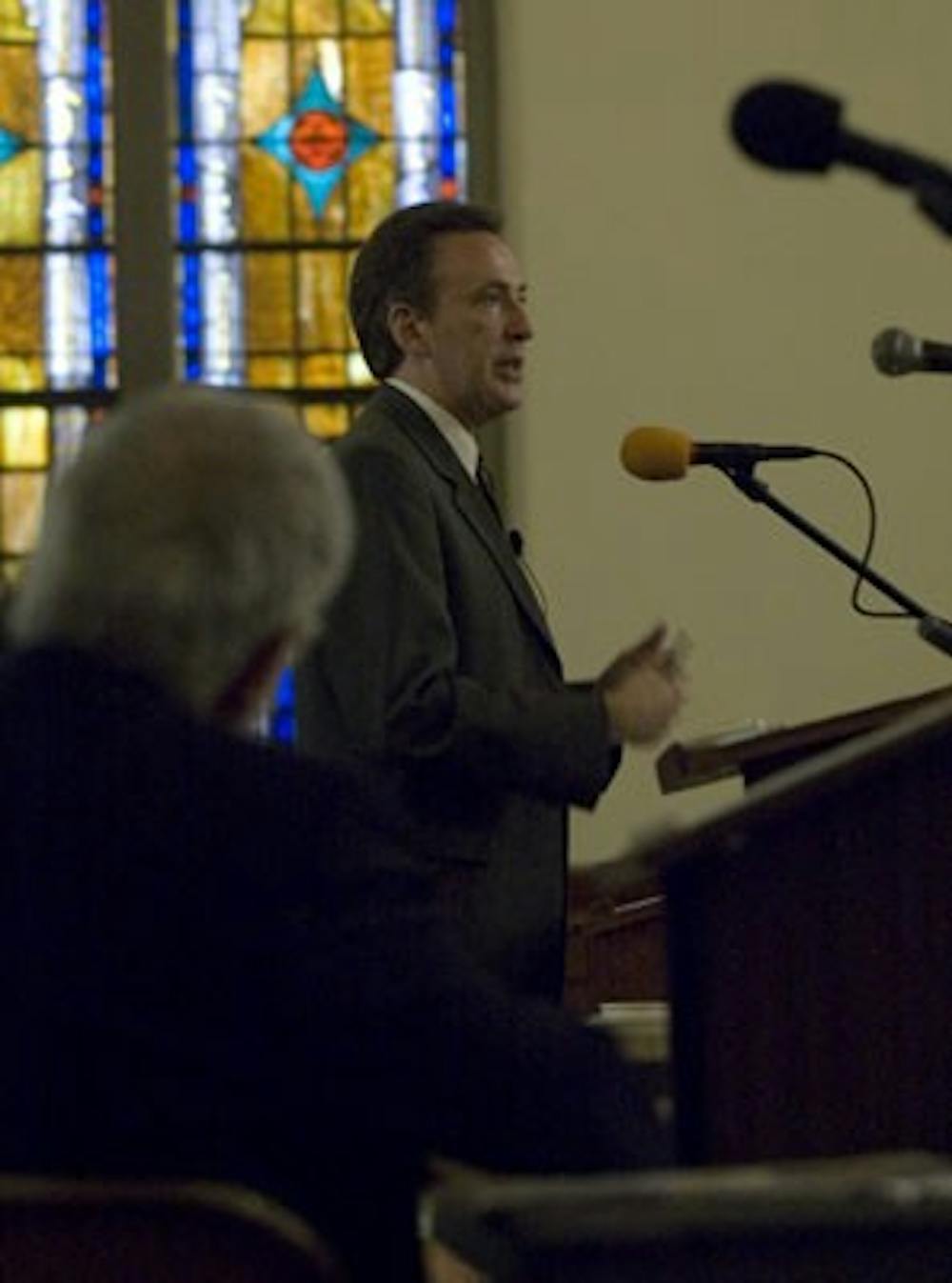
If elected, Republican mayoral candidate David Sabbagh said he would answer Bloomington’s poverty problem with training and “business friendly” policy, while Democratic incumbent Mayor Mark Kruzan said he would answer the call with direct funding and raising the “real income.”\nShalom Community Center hosted the public discussion titled “A Conversation About Poverty” Tuesday night. It was the second-to-last Bloomington mayoral debate of campaign season.\nSabbagh said he wants the city government to “bully-pulpit,” or use the position of power, to influence businesses and corporations to donate to social service programs and urged citizens to show “compassion.” Kruzan said social service programs should be treated as part of the “economic strategy” of an already generous Bloomington.\nBoth candidates agreed that poverty needs to be addressed in Bloomington and referred to the town as a “tale of two cities,” that of the comfortable and that of the poor.\n“I have nothing but the greatest respect for (Kruzan and Sabbagh),” said Joel Rekas, executive director of Shalom Community Center.\n“(Their differences) are priorities in approaches to solving some of these tough problems. But that’s why we have elections.”\nBoth candidates said the city government should play the role of a “social safety net,” but they differed in how far that net would extend.\nSabbagh said the community needs to provide “better-paying jobs” through “business friendly” initiatives. He also said he would like to use centers such as Ivy Tech Community College to provide training locally.\n“People want to accomplish something,” Sabbagh said. “People don’t want a government hand-out.”\nHe said the government should “empower” social service organizations so its clientele could “lift themselves up out of” poverty.\nHe said government should encourage social service organizations to use government assets, such as the Buskirk-Chumley Theater and public parks, to fundraise, but that the government could not “fund (the organizations) completely.”\nKruzan said government should view poverty as a “human development issue” and should respect and fund the social service organizations directly, which in turn would promote self-sufficiency.\n“Poverty isn’t a city issue, a federal issue (or) a state issue,” Kruzan said. “It is a community issue.”\nBoth candidates discussed affordable housing as a way the community could help alleviate some of the problem.\nSabbagh said he would partner with house-building authorities to provide more low-income housing at a lower cost to tax payers. Kruzan argued for incorporating historical housing and redevelopment of neglected housing to aid affordable housing efforts.\nJunior Dylan Grigar attended the debate because he was “curious as to the motivations of each of the candidates concerning the issue of poverty.”\nHe said the debate showed that Kruzan’s policies regarding poverty were strong for the next term, while Sabbagh still seemed to be figuring his out.\nBut he appreciated both candidates showing their support for continued awareness of poverty and its effects.\n“I think that a lot of Bloomington considers poverty an issue worth discussion,” Grigar said. “I think that’s true for most cities and towns"
Poverty issues drive mayoral debate, candidates’ differences
Get stories like this in your inbox
Subscribe



