
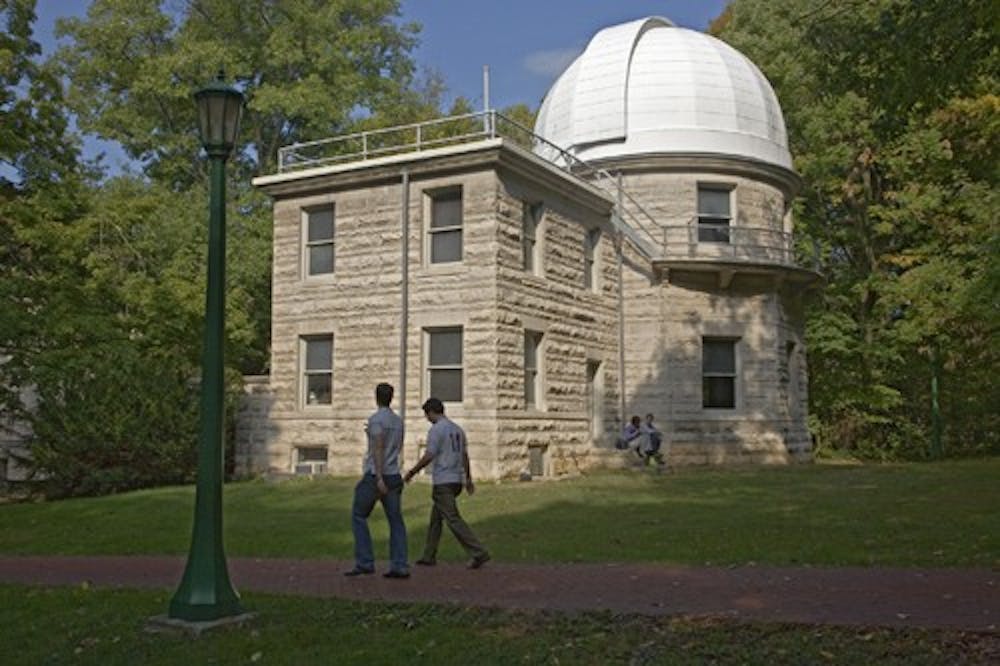
The weeds gripped mercilessly at the 100-year-old stones sitting deep in a tangled mass of trees. \nThe Kirkwood Observatory, built in 1900 and dedicated in May 1901, contains six rooms, including the wooden circular dome. It boasts two telescopes: a 12-inch refractor telescope and a solar telescope. While the telescopes are not used for research anymore, some astronomy classes use pictures taken by the solar telescope and transmit them directly to the classroom. The 12-inch telescope, part of the $6,516 spent on telescopes and fittings in 1901, is expensive and rare.\n“It’s an impressive-looking telescope,” said Con Deliyannis, associate professor of astronomy. “You wouldn’t be able to buy a telescope like that unless you custom ordered it and that would be hugely expensive.” \nThe observatory is named after Daniel Kirkwood, a well-known mathematician and astronomer.\nKirkwood is famous in astronomy for having discovered the Kirkwood gaps, the distances of asteroids to the sun. He was also the first to hypothesize that debris from comets make up meteor showers.\nThe historical significance of the observatory is nearly unparalleled on campus. In addition to the contribution of Daniel Kirkwood, former IU President Joseph Swain dedicated the building. The observatory is protected as a historical landmark, and because of this renovation has been kept to a bare minimum and strictly monitored so it stays consistent with the original. \n“The dome had started developing problems that needed to be refurbished but because it’s a historical landmark it had to be refurbished in the same manner it was originally built, which is out of wood and with a curved dome,” Deliyannis said. “We wanted to keep the spirit of the original alive.”\nThe last renovation took place during the 2001-02 academic year, but aside from electrical wiring and regular cleanings, all paid for by the astronomy department, not much has changed since 1901.\nToday the Kirkwood Observatory offers students and the public a chance “to see the stars,” as graduate student Ankit Khare put it. The astronomy department opens the observatory to the public on clear Wednesday nights. Public admission is free, but it also holds various events for groups, including the Women in Science program and the Chinese Culture Club, for about $20. \nMany students enjoy both the academic purpose and excitement the observatory offers them.\n“I think we should have places like this if it can get people interested in stargazing or astronomy,” said Abhijit Mahabal, a graduate student. “It’s a fun time and helps you understand physics better.”\nThe observatory receives about 1,000 visitors annually, although certain times of the year are more popular than others, including times when it features viewings of Saturn, Mars and the moon.\n“Kirkwood Observatory connects us all to something much bigger than ourselves,” Pilachowski said. “It opens our minds to the extraordinary universe we live in.”
A window to space
Historic Kirkwood observatory has 2 telescopes
Get stories like this in your inbox
Subscribe



