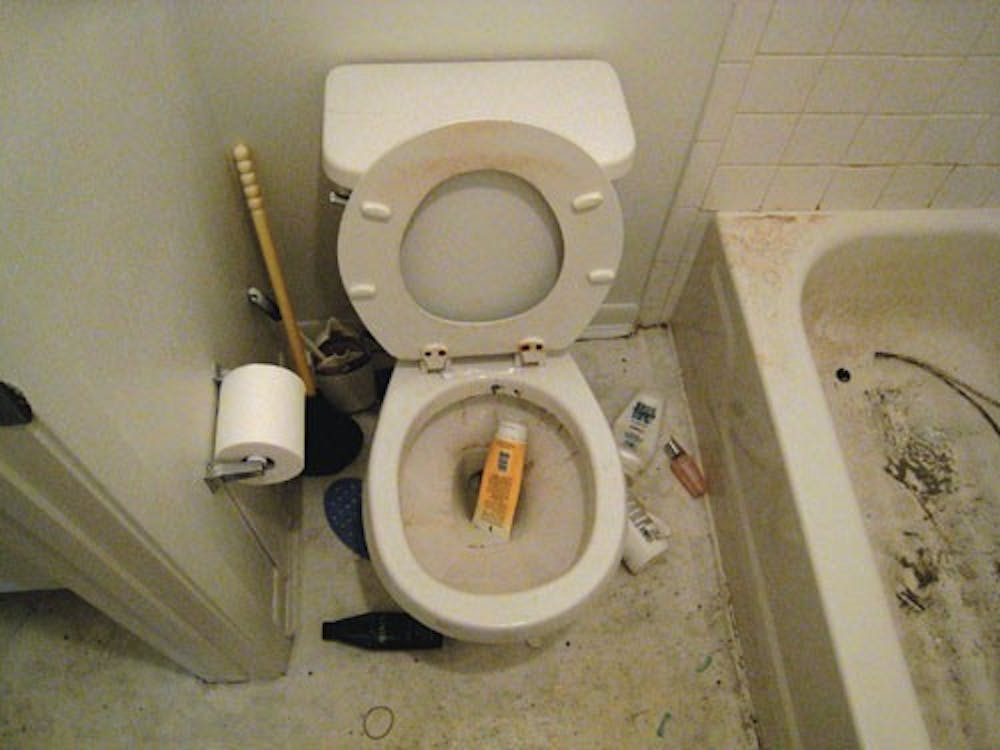
When senior Brad Yuska arrived to move in at College Park–Campus Corner apartments Aug. 24, it looked as if the former tenants hadn’t moved out. \nDirty napkins, tissues, plates and plastic littered the floor. There were broken couches and beds nearly blocking the front door. Food was rotting in the refrigerator. \nExposed wires jutted out of the walls, every fire alarm was two years past its expiration date and he couldn’t find the managers.\nYuska’s fiance, Samantha Schinder, said there were about 20 other angry, displaced tenants, many of them international students.\n“I remember one of them saying, ‘I hate America,’” Schinder said.\nYuska was unable to live in his new place until Aug. 30, two days after fall semester began.\nYuska’s problems, were not too uncommon though. James McGillivray, an attorney at IU Student Legal Services, said there were 356 landlord-tenant complaints filed from June 2006 to June 2007.\nMany students moving into apartments are first-time renters, McGillivray said. They don’t know their rights, they don’t know what to expect and they don’t have the knowledge to protect themselves, he said.\n“Indiana doesn’t have particularly strong pro-tenant laws,” McGillivray said. “So I really separate it into law and common sense.”\nRobert Hoole, neighborhood compliance officer at Bloomington’s Housing and Neighborhood Development, said they received 101 complaints last year. Past complaints included “air conditioner caught on fire” and “100 to 200 bats in the attic.” Rarely are complaints life-threatening, Hoole said.\nHowever, Lindsay Stafford’s problem was.\nStafford, a senior, and her roommate, senior Brandy Feit, complained of a gas smell for three days in their apartment they were renting. On the third day, Feit’s new carbon monoxide detector went off. Finally, their apartment’s maintenance person shut off their water heater, claiming it was the root of the problem.\nStafford went back to studying, but couldn’t stay awake. She woke up with a pounding headache, when her boyfriend called.\n“He was supposed to come over, but I’d been sleeping all afternoon,” Stafford said. \nHe convinced her to leave, after they discovered the carbon monoxide detector had been sounding. \n“I was feeling pretty out of it, really drowsy and confused,” Stafford said. \nShe said her father, a doctor, told her she probably was suffering from carbon monoxide poisoning.\nIndiana law doesn’t require carbon monoxide detectors in homes, but there are safety measures students need to know.\nBy Bloomington city ordinance and city code, landlords must give tenants the “Tenants’ and Owners’ Rights and Responsibilities,” a pamphlet distributed by the city. \nThe pamphlet gives tenants emergency contact information for their landlord/manager, explains the maximum number of people allowed to live in the rental unit and provides an abridged copy of the city code.\nBloomington code mandates that tenants and landlords thoroughly inspect the unit within 10 days of the move-in date. \nMcGillivray said this sets a baseline to judge any damage incurred later in the year. However, it also requires the tenant to examine safety features preemptively.\n“Check fire extinguishers, smoke alarms, secure doors and windows ... check out nonseasonal appliances,” McGillivray said. “It’s not too much to take pictures.”\nAll windows and doors must be able to be securely closed, without gaps, for safety reasons. Every floor, including upper floors, must have exterior fire escapes. The house must be free of vermin (everything from carpenter ants to sewer rats) and clean to a standard that it meets health and safety requirements, he said.\n“But it really starts before you move in,” McGillivray said. \nHousing and Neighborhood Development holds records of all rental unit inspections, landlord licensing and complaints. McGillivray encourages people to go downtown and review the file.\nCode requires units to be examined by the landlord and a Housing and Neighborhood Development inspector every three to five years. Hoole said all inspections are public record.\nHoole said it’s helpful sometimes to see the last cycle inspection and the landlord’s history of responsiveness.\n“That kind of info can be useful if you look at the file and there have been 15 complaints in the last two years,” Hoole said. “On the other hand, it can be misleading because that property may have changed hands recently.”\nIn Yuska’s case, the apartment complex had changed management that summer.\nCandus Halstead, an assistant manager at the apartment complex, said there was miscommunication with the move-in dates and that many apartments were assigned before they were ready.\n“We listened to each and every complaint and we’re working to have everything done by (Sept.) 24th,” Halstead said. \nYuska’s problems were resolved because he promptly talked with Halstead and management. Hoole and McGillivray both said that neither organization can help students before they’ve spoken with a landlord.\nSometimes, McGillivray said, that’s all it takes. However, he said, it’s best to know how to protect yourself in the first place.
Home sweet homeless
1st-year tenants need to know their rights as a renter, says IU legal services
Get stories like this in your inbox
Subscribe