
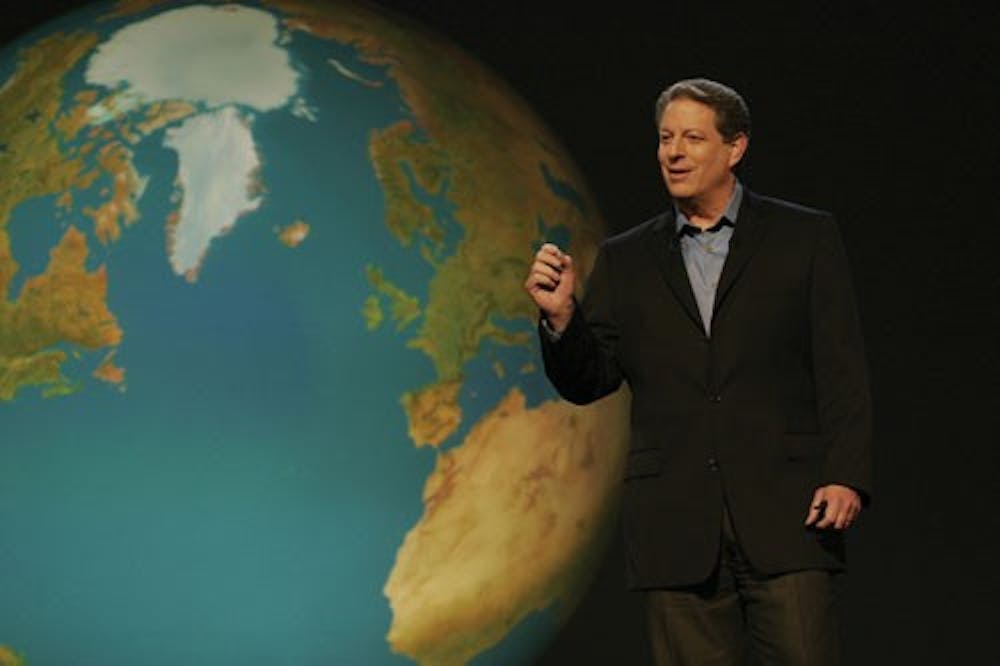
"Does global warming exist?” is no longer a question stumping citizens and scientists alike, says Philip Stevens, a professor in the School of Public and Environmental Affairs. Now, he says, the question is: “How do we fix it?”\nA coalition of IU organizations and local businesses are taking the first steps toward fighting global warming,\naccording to a news release from the Indiana Public Interest Research Group.\nThe contributors to this cause are INPIRG, the Environmental Management\nAssociation, the IU Environmental\nLaw Society, and IUCoupons.com, according to the release. These players are working on turning the University from a “climate change contributor” to an “environmentally friendly institution.”\nThe recent rise in temperatures gives global warming substantial scientific\nmerit, Stevens said. Of the last 10 years, nine were the hottest to be recorded, he said.\n“There is a discernible human influence\non global warming,” Stevens said. “We can’t explain the temperature\nchange without humans.”\nStudents, teachers and administrators\nall can have an impact on global warming and its prevention, said junior Elliot Hayden, the Campus\nClimate Challenge Coordinator for INPIRG.\nAmong Big Ten schools, IU received\nthe worst grade – a D-plus – on the College Sustainability Report Card released in Jan. 2007, according\nto the Sustainable Endowments Institute.\nEven the air that students are breathing is environmentally unfriendly,\nHayden said.\n“Students are subjected to health risks every time they choose to get up and go to class,” Hayden said. “But unfortunately, students just don’t care about the health risks of bad air.”\nHayden said that IU can increase its good air and lower its carbon-dioxide\nemissions by making a few changes, such as switching to natural gas instead of coal, using energy-efficient\nflorescent bulbs or recycling.\n“The biggest problem at IU is that we don’t have the right incentives\nto make people care,” Hayden said. “And people respond to incentives.”\nThe most obvious incentive for IU to become more energy efficient,\nHayden said, is the money IU would save.\n“The challenge is that when looking at the short term, the University\nwill be spending money on upgrades,” Hayden said. “But in the long term, IU will save hundreds of thousands, if not millions, of dollars.”\n“The initial cost makes it more difficult,” Stevens said. “But if we make the investment, it will eventually\npay for itself.”\nIn order for humans to undo the damage they have done to the atmosphere,\nmany things are going to have to change, said Jeff Riegel, director of the an avian conservation site Web site BirdCountry.US.\n“There is no one thing that anybody\ncan do,” Riegel said. “There is no magic silver bullet.”\nRiegel said he his coming to campus March 21 to give a presentation\non the Oscar-winning movie “An Inconvenient Truth.” He is one of the 50 people handpicked and certified by Al Gore to give the presentation,\naccording to INPIRG.\nRiegel’s presentation is only one of the events that has been planned to help IU’s conservation efforts.\nINPIRG is having a membership drive from April 9-13 and is planning\na large Earth Day celebration April 20 from 4 to 7 p.m. at Dunn Meadow, Hayden said.\nThe celebration will consist of bands, booths, food and a fun competition\nwith prizes. All the participants\nwill also have the opportunity to help plant trees in Dunn Meadow,\nHayden said.\n“It is disheartening to know that more people don’t really care about environmental issues,” he said. “But with a combination of luck and really hard work, everything will fall into place.”
Sweating the heat
Gore-approved speaker to present ‘An Inconvenient Truth’ tomorrow
Get stories like this in your inbox
Subscribe



