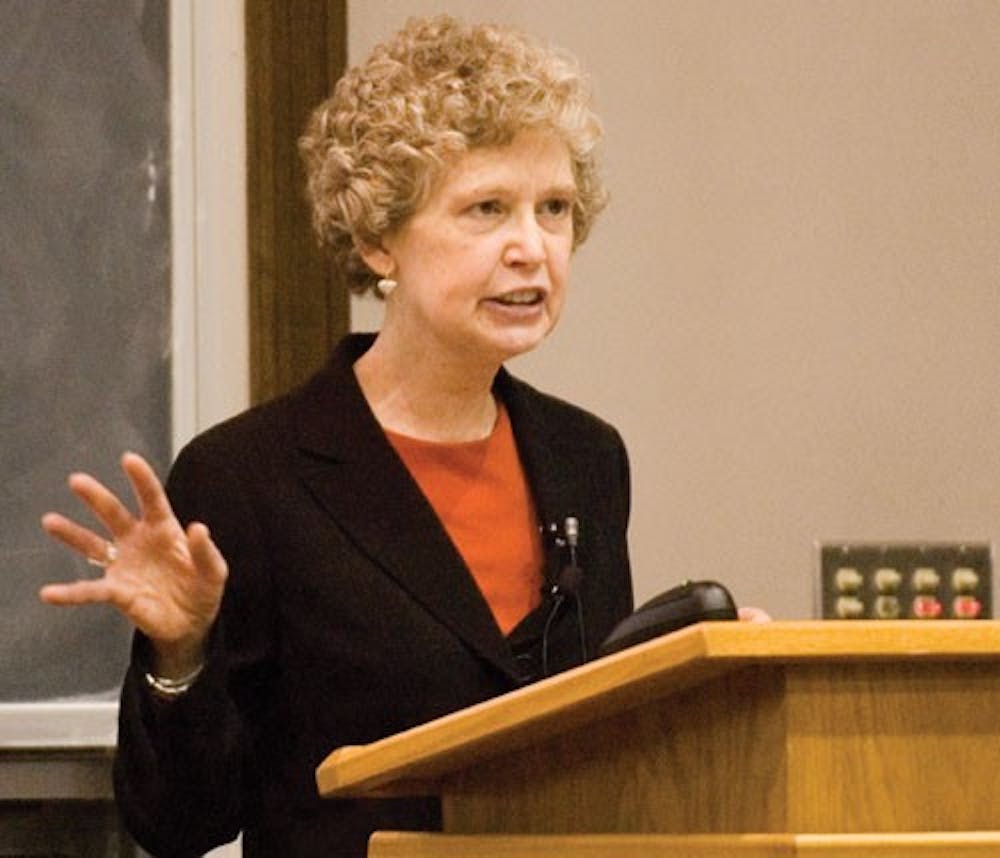
Rebecca Dresser, a professor of law and ethics at Washington University in Saint Louis, urged students and faculty to confront the myths about dying that the Terri Schiavo case brought to America’s forefront in 2005. \nDresser said that the Schiavo case should make Americans examine the response to the need of seriously ill patients and families, better allocation of health care resources and the reasons the United States should give attention to its medical-law policy issues.\n“What’s wrong with our myths?” Dresser asked a crowd of about 50 faculty and students. “I think they impose harm and promote pre-existing denial of death. … They distract from the meaning of the death of patients and unresponsive medical institutions.”\nDresser said there are three basic myths regarding death in American culture: living wills are infallible, the idea of the quality of life and the life extension.\nDresser, a member of the President's Council on Bioethics, has recently gone through radiation therapy for a tumor in her mouth. She understands that each myth is “comforting, but false.” She encouraged debate and discussion that would lead to more concrete policy in America, saying that it wasn’t up to the experts, but to the people.\nDresser used books by author Joan Didion, journalist Marjorie Williams and futurist author Ray Kurzweil, and texts from the President’s Council on Bioethics to assist in showing the many ways myths form about death and treatment for life-sustaining treatments.\nFuturists, like Kurzweil, believe that humans will “transcend” biology and that “(disease and death) are problems to be overcome.” \nDresser was skeptical, saying it would be “unwise to buy into” Kurzweil’s vision. She admired those writers, thinkers and experts who realized the “ambivalence and uncertainty” that end-of-life treatment is inherently connected to.\nWith the baby boomers reaching their elderly years, Dresser said that America’s problems with death would only be exacerbated. She also said that cases such as Schiavo’s will not be uncommon because many of the elderly patients with medical problems such as dementia will not be able to make their own decisions. Again, Dresser stressed the need for more national debate.\nThe audience stayed for 20 minutes after the speech to ask Dresser questions ranging from ideas about universal health care and insurance policy to organ donation, and comfort in death. When asked about death with dignity, she talked about her own experience going through radiation treatment for her tumor. She said that in her case, treatment with dignity was “to be treated with respect as a person, not as a unit.”\nThe audience seemed to appreciate Dresser’s thoughtfulness and the ideas presented in her speech.\n“I thought it was an unbiased and objective speech,” said Smita Das, a freshman microbiology major. “It was about important questions that at least I hadn’t thought of about Terri Schiavo and myths about death.”
Schiavo case the subject of professor’s discussion
Get stories like this in your inbox
Subscribe