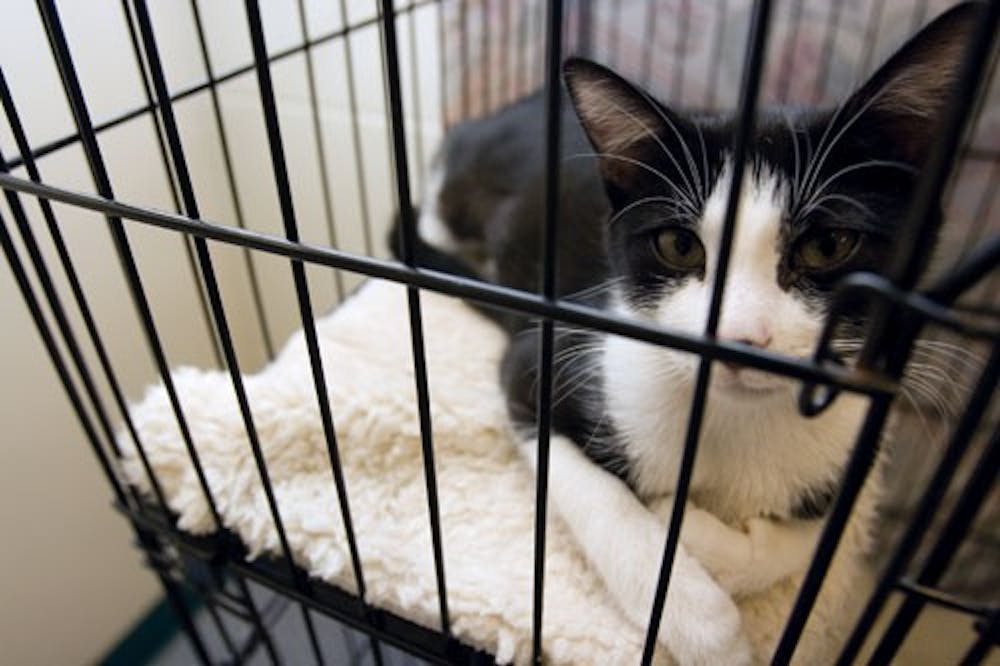
Scurrying across the tile floor, a rabbit bounces. Following this fluffy cotton ball, a cat slinks, silently meowing. \nUpon entering the Bloomington Animal Shelter, such a scene greets entrants. But they aren’t the only animals visitors will see.\nLining the walls to the reception area are numerous cages filled with cats, dogs of all ages. Barks and whimpers echo from the hundreds of these animals awaiting adoption. \nTo address pet overpopulation in Monroe County, Monroe County is pushing The Adopt Today! Campaign that was launched last month is an effort to encourage adoption and other efforts to curb the area’s increasing overpopulation over the years.\n“You can’t adopt away the problem,” said Sarah Hayes, CEO of the Monroe County Humane Association. “There cannot be enough homes in the community.”\nWith the shelter accepting more than 5,000 animals a year, the overpopulation of animals in the community continues to rise.\nOf the 5,000, about 1,200 are euthanized each year, said Sarah DeLone, the education program director for Monroe County Humane Association.\nDeLone said the reasons for euthanization vary.\n“For dogs, most are euthanized due to behavioral or health issues,” DeLone said. “There are not a whole lot of dogs euthanized for space. But with cats, there are still so many that are euthanized because of space, so it’s a big issue still.” \nDuring 2006, the Bloomington shelter received more than 5,000 animals, including 2,567 cats. Just 868 cats were adopted last year. \nTaking care of animals is costly, and if animals’ basic needs cannot be paid for, Monroe County’s problem of animal overpopulation will only escalate, DeLone said. \nThe shelter is open admittance, meaning it accepts any homeless animal from surrounding counties, Hayes said. \n“Working here in the shelter building, I do see the effects of pet overpopulation every day and each year,” DeLone said. “And I also, unfortunately, see the number that don’t end up getting homes.”\nIn May 2004, the Bloomington shelter expanded its location, and as a result it brought in more animals. \n“We want people to adopt, and we want spay and neutering to occur,” DeLone said. “Spay and neutering is the ultimate way to make a difference.” \nHayes and the Bloomington shelter’s director, Laurie Ringquist, said spaying and neutering the incoming animals of their respective shelters could help lower the number of homeless animals in the future.\nThe Adopt Today! Campaign encourages adoption rather than euthanasia. Animals that aren’t adopted within a certain time frame are sometimes euthanized, Ringquist said.\nHayes said low-income areas of the community are especially affected because costs of surgery and other medications that prevent animal overpopulation aren’t easily affordable.\nFor 15 years, the Monroe County Humane Association has been running the SNAP program – Spay Neutering Assistance Program – which aims to help families with the cost of surgery for their pets. \nEach year, the humane association pays $32,000 to the citizens who need assistance in the community to have their pets spayed and neutered.\nHayes said that out of 18,000 animals that arrive at Monroe County animal organizations each year, about 800 to 900 are spayed and neutered that wouldn’t have been able to be.\n“We’re encouraging spay and neutering and making funding available,” Ringquist said. \nKeith Dayton, an IU senior faculty lecturer, teaches Z302: Managing Behavior in Organizations, a class that has been incorporating agencies like the Humane Association into the curriculum.\n“(The human association) asked to be part of the class, even brought the dog Journey, which was a big hit for students,” Dayton said. “The students were exposed and came up for some ideas that the humane association could utilize as part of the community.”\nDayton said he class project was successful because it exposed students to community groups that need assistance.\nHe has one of the projects, a marketing campaign’s poster, hanging on his door, which explains how people can be with animals besides owning them – such as visiting or walking the dogs.\nRingquist said those working at the shelter deal with these problems daily.\n“Animals affect us deeply every single day, and that’s why we have a shelter,” she said. “Of course, as a shelter we are disturbed and troubled, and we work all day every day to try and control it.”
Local animal shelter hopes to solve overcrowding
Get stories like this in your inbox
Subscribe