
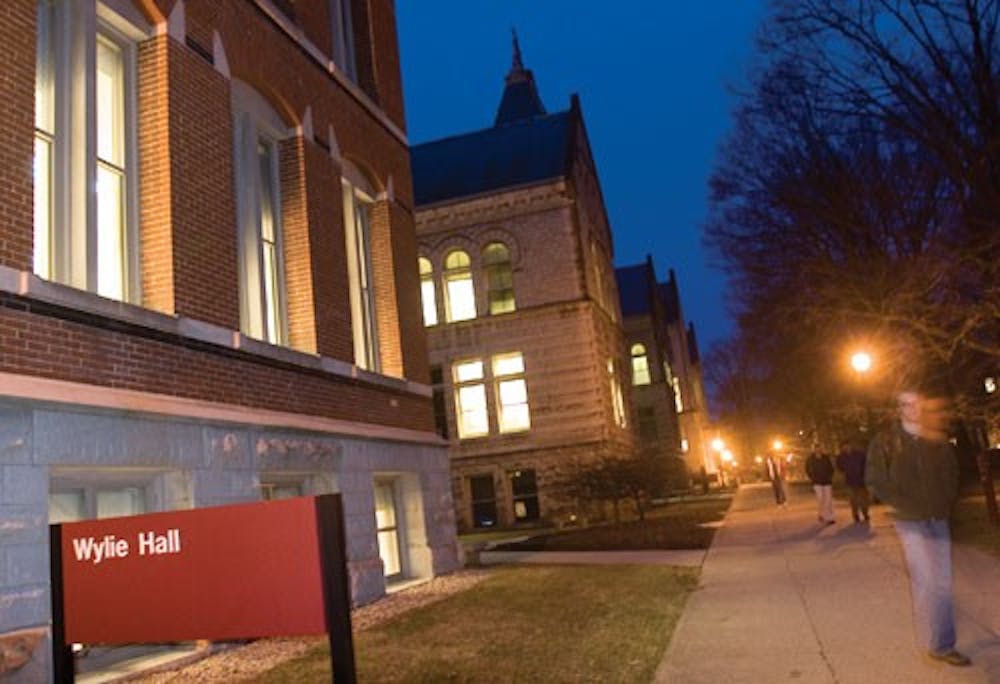
Owen Hall, Wylie Hall and Bryan House have one trait that sets them apart from other buildings on campus. All three are made of brick, rather than the more popular limestone, showing a glimpse into IU history that many students passing by might not notice.\nThe buildings represent a change from what IU architect Robert Meadows described as the limestone style of the campus. He added that the buildings in the future of IU will most likely not be made of anything other than limestone.\n“Each of IU’s eight campuses has a unique style of building, with materials that are specific to each area,” he said. “This campus is a limestone campus.”\nMeadows said IU’s buildings are made of limestone because there is a lot of limestone in southern Indiana. A look into IU’s early history provides insight as to why Owen and Wylie halls were made of orange-red brick instead of limestone.\nIf it isn’t obvious at first that Owen Hall is old, it is once someone steps inside. The building’s tall ceilings and doors tell its long history, as does its distinct aged smell. Richard Owen, who was a geologist and professor of natural science at IU, is the building’s namesake. Owen Hall originally housed the department of natural sciences and a museum. \nWylie Hall, was built at the same time as Owen Hall despite its newer looking appearance. The building received updates when the economics department moved there from Ballantine Hall. Wylie Hall was named for Andrew Wylie, IU’s first president. In its early days, Wylie housed the chemistry and physics departments, as well as the library.\n“Wylie seems pretty cool,” said Emily Honeyman, a junior. “I’ve only been in it once. It looks like an old school house.”\nTrustees had the buildings constructed in 1884 after a fire destroyed one of the two buildings that comprised University, which was located nearer to downtown. The buildings made up what was then known as the State Seminary. The trustee president at the time of the fire, David Banta, felt that the University should move closer to Dunn Woods. There, he believed the University would have “more growing room,” according to a pamphlet in the IU Archives.\nMeadows said he believed Owen and Wylie halls were built before the commercial quarries around Bloomington opened. But according to the Monroe County Historical Society, commercial quarrying began around 1827 in Stinesville, Ind., located about 15 miles from Bloomington. This was before Owen and Wylie halls were built. According to the pamphlet in the IU Archives, trustees gave 30,000 bricks from the burned building to be used in the construction of the buildings, and permitted the builders to use “(limestone) quarry upon the grounds.” \nAs for Bryan House, another look into more recent history explains why it was made of brick.\nIn 1924, William Lowe Bryan, IU’s 10th president, had the house built after trustees and faculty expressed the desire to build a house on campus for the president. According to a 1996 pamphlet in the IU Archives, Bryan built the house in colonial revival style. He also wanted the house to model Woodrow Wilson’s brick Georgian-style home in Washington, D.C.\nMeadows said that the architects propose their building plans to the trustees, who can approve them, reject them or revise them. The architects aren’t limited to just limestone, but they are encouraged to utilize the rock that is natural to Bloomington.\nIn fact, after the IU Art Museum was built by architect I.M. Pei in 1941 with poured concrete, Meadows said that the trustees asserted that using any material other than limestone “wouldn’t happen again.”
Brick buildings on campus tell story of foundation of IU’s history
Limestone will be material of choice for future
Get stories like this in your inbox
Subscribe



