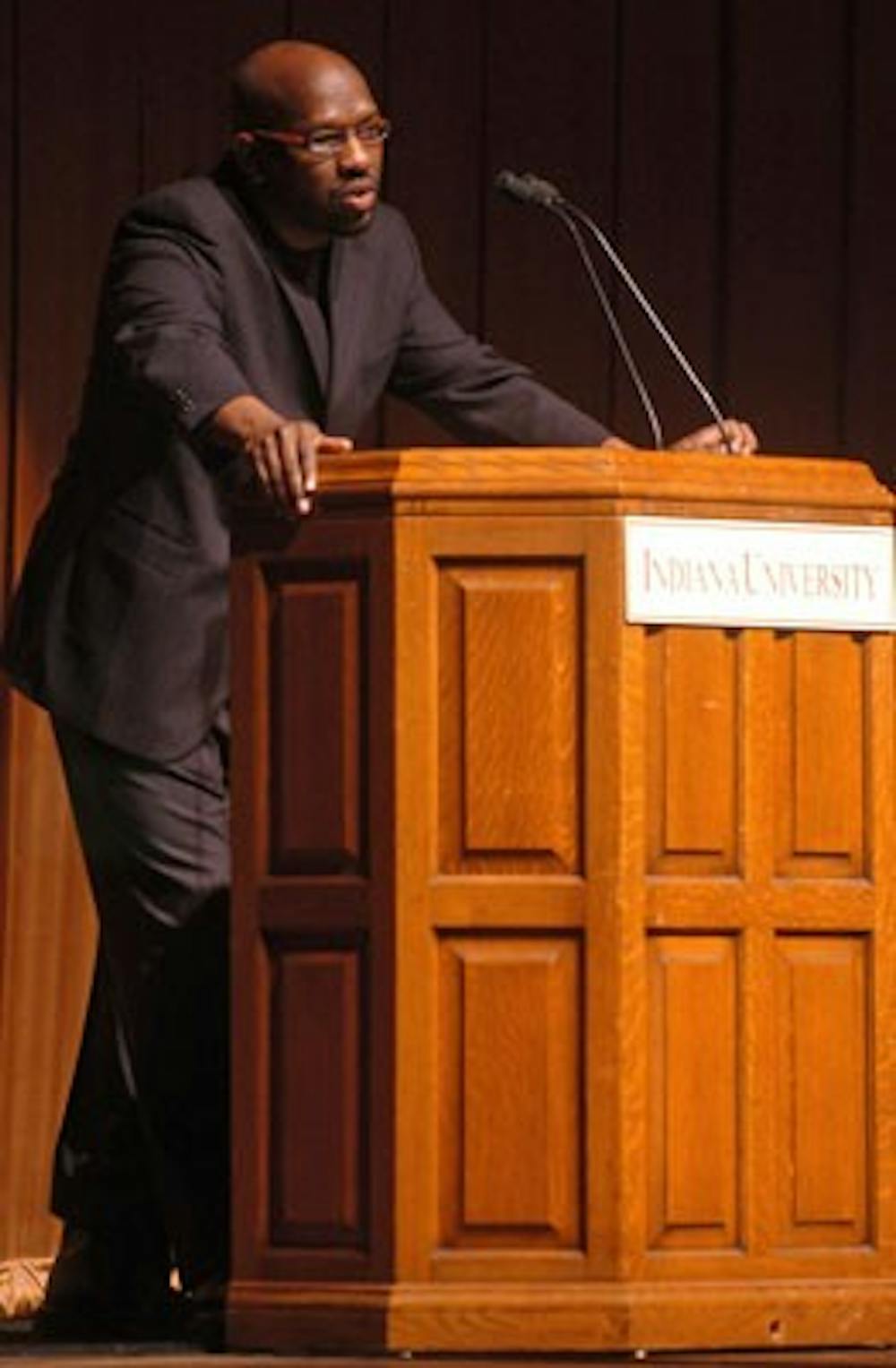
Hip-hop expert Bakari Kitwana challenged IU students to use the music that’s part of their everyday lives as a means to change the political atmosphere of the nation during his speech Tuesday at the IU Auditorium.\n“You can’t really have a political movement without a political infrastructure,” Kitwana said. “The hip-hop movement has created a national infrastructure – young activists that understand the power are tapping into it to make a political change.”\nKitwana, the Union Board’s featured speaker for Black History Month, proposed that more involvement in the political atmosphere could help bring about change in the way the government works today.\n“I think when you start to see how powerful hip-hop is we can have a serious shift in power and make an impact,” he said. “(The) civil-rights struggle is done – we’re at the point when we have force electoral politics to where they need to be.”\nKitwana is the founder of the National Hip-Hop Convention and the former editor of The Source magazine. He and has written articles for the New York Times and the Boston Globe and has written several books, including “The Hip Hop Generation: Young Blacks and the Crisis in African American Culture” and “Why White Kids Love Hip Hop: Wankstas, Wiggas, and Wannabes and the New Reality of Race in America.”\nHe talked about the relevance of hip-hop in the black community today and used statistics and information from various studies to illustrate how the music has affected the political landscape since the civil-rights era.\nKitwana stressed the importance of different generations in making hip-hop what it is today. Throughout his speech he referenced the civil-rights movement, which he defined as the “black baby boomers” – the “hip-hop” generation of people born between 1965 to 1984 – and the “millennial” generation born after 1985. \n“Hip-hop at its origins was very political, but in recent times it has not been,” he said. “The history of the emergence of hip-hop is rarely discussed. It’s as if hip-hop came out of nowhere, but really there’s a direct line between the civil rights and black power movement and the emergence of hip-hop.”\nAfter laying the foundations, Kitwana focused on the changing face of hip-hop throughout the years, identifying how and why hip-hop culture lost some of its political value.\n“At one point, you had hip-hop artists with a political message going platinum with those who didn’t, but today you will not find a political album with that much success,” he said.\nKitwana identified the lack of morality among some hip-hop artists at the personal level as one of the greatest flaws of the music genre. He said hip-hop artists have to take the initiative to put principle back into the music.\n“We’re at a point where it’s clear the government is going to regulate the images we see and the music we hear,” he said. “Artists have to step it up. It’s clear we need a hip-hop movement that can reach across all races and generations if we want there to be a change.”\nHe pinpointed degradation of women and use of the N-word as components that must change if hip-hop wants to be relevant in politics.\n“I thought it was really interesting how he described the way hip-hop needs to change the way people look at women,” sophomore Kristin Miller said. “He made a lot of good points that I’d never even thought of before.”\nKitwana drew on various statistics and studies to illustrate how a poor economy has impacted the hip-hop and black communities, arguing that it would be accurate to compare the lower-class blacks to citizens in Third World countries. \n“In the past few years, we’re seeing the greatest decline in jobs since the Depression,” he said. “I believe as society provides no solutions to this national phenomenon, increasingly we’re seeing youth look for some solutions and an escape in hip-hop.”\nWithin this discussion, he talked of the irony that even with dwindling job opportunities, the American dream has changed to the detriment of youth today. \n“It used to be you worked hard and bought a house in your 30s, but the American Dream is you have to be rich by 22 at any costs, but this isn’t realistic,” he said.\nKitwana spoke about blacks’ presence in politics, saying that although there is black representation in government, the connection between the politicians and the people is still missing. He used presidential hopeful Illinois Sen. Barack Obama as an example.\n“Blackness is used as political divide,” he said. “We have Obama running for president, but a lot of the conversation we hear about it is how the black people aren’t going to vote for him because he’s not black enough.”\nFollowing the lecture, attendees engaged in a question-and-answer session with the speaker, where topics ranged from the future of hip-hop to the absence of traditional rap groups.\n“I think his message is something that a lot of people need to hear,” said junior Kelli Zimmerman, director of the Union Board’s Diversity Performance committee. “It’s eye-opening to learn how hip-hop can shape politics.”
Author speaks about political power of hip-hop music
Bakari Kitwana lectures on music in civil rights
Get stories like this in your inbox
Subscribe