Sunday_8:21 p.m.
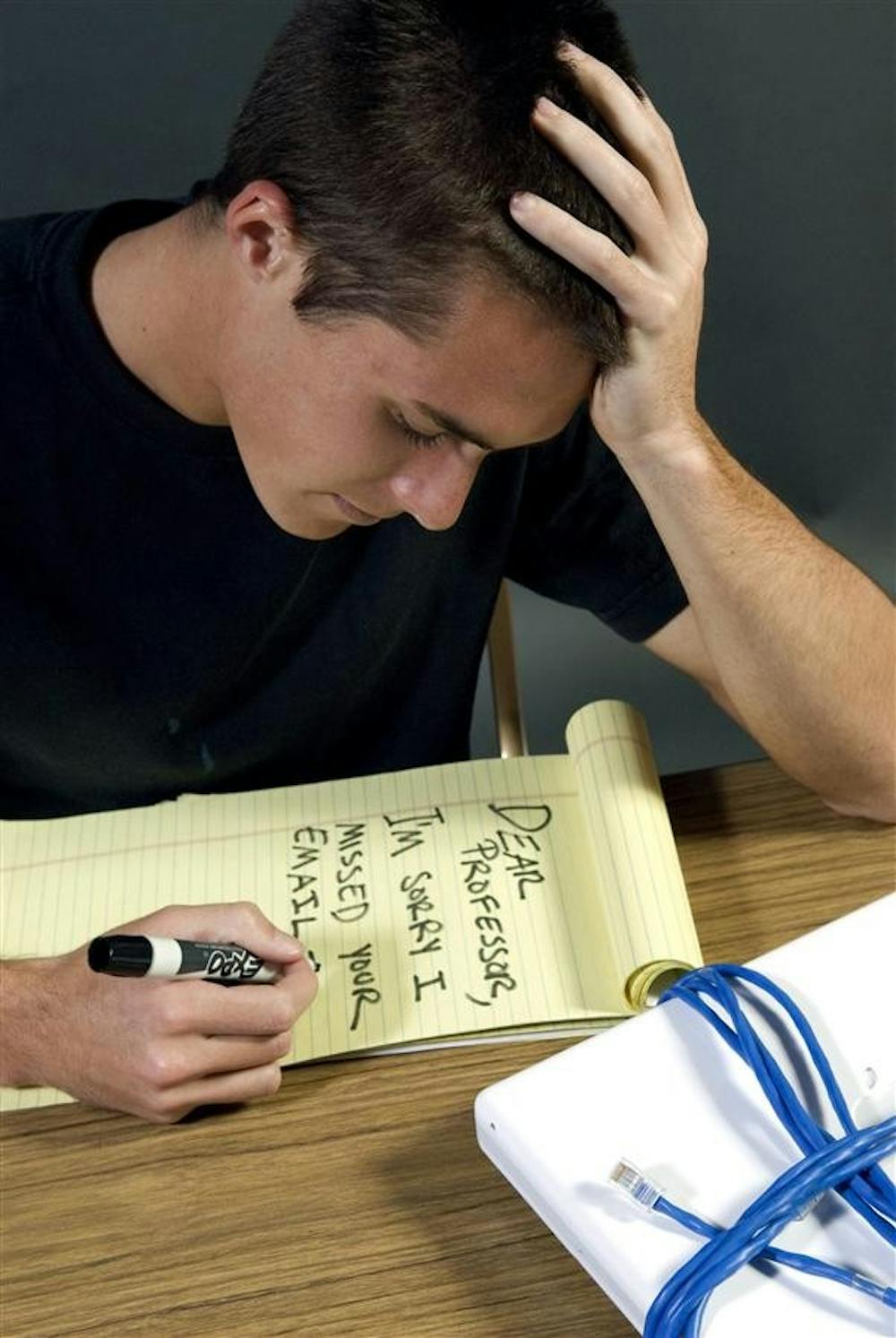
It is the night before I will no longer be able to use the Internet. I am having mini panic attacks. Is there anything I need to do before I quit?
I have a story due in a journalism class – what if I need to research for it?
I have a test in philosophy on Tuesday – what if the teacher puts a message about it on Oncourse?
I have an assignment for a sociology class, and the teacher said she will send an e-mail if there are any changes – what if I don’t get the e-mail?
My heart is beating faster than usual, which strikes me as incredibly lame, but does not deter my opinion that there is no way a week without the Internet could be a good thing.
8:22 p.m.
I check my e-mail, just to make sure I didn’t miss anything. There is an e-mail from my mom, which I read. My mom never writes anything I need to know. I should have known that before I read the e-mail. I delete it.
8:24 p.m.
I check Facebook. Normally, I don’t even really use Facebook. I realize I am overreacting to this whole ordeal.
8:28 p.m.
This undertaking seems like such an irrational thing to do; I decide to play some music to calm me down. I keep telling myself that this is stupid, and then I tell myself to shut up. Things alternate this way continuously. I never knew I was so addicted to the stupid Internet.
Paul might be overreacting this early in the experiment, but Internet addiction is certainly very real.
Dr. Hilarie Cash, cofounder of Internet/Computer Addiction Services in Redmond, Wash., says she was first introduced to the problem of Internet addiction in 1994, when few academics were writing or talking about it. The case involved a young man who was losing grip of his marriage because he was addicted to the online game, Dungeons & Dragons.
Cash receives at least one or two calls a week from people around the country seeking help for an online addiction. They are mostly men preoccupied with video games or pornography, but Cash says women experience Internet addiction as well; they just aren’t calling her.
“This addiction is something which is largely unrecognizable because it’s new,” she says. “So it’s really difficult for someone to know if they have a problem.”
Nancy Stockton, director of Counseling and Psychological Services at the IU Health Center, says Internet addiction is different from addiction to, say, nicotine because it doesn’t have negative consequences in and of itself. Instead, the Internet robs time from human relationships and keeps people shut out from the real world.
“Most of us need an escape from reality,” she says. “Some people lose control and escape way too much.”
Still, online compulsion is less often a chief complaint at the IU Health Center than it is a contributing factor to other issues, like relationship problems.
Rory Starks, a graduate student at IU studying immersive mediated environments, says those interpersonal issues only perpetuate Internet addiction. For example, people might spend a lot of time online and turn their friends away. This can result in them feeling lonelier, and therefore, they turn back to the Internet to fulfill that feeling of intimacy.
“It can effectively snowball in certain people,” he says. “It can make them almost like a hermit.”
Monday_7:42 a.m.
My morning seems unusually empty since I routinely waste a good bit of it doing pointless things online. This leads to an important realization: There is no tool more efficient at wasting a few minutes than the Internet. It’s not like you say, “I have five minutes before I leave for class; I think I’ll read a book.” But you can check your e-mail and surf the Web for four or five minutes, which is what (I expect) many of us do when we have a little time to kill. You don’t actually accomplish anything; you just feel like you do. Maybe I’ll waste less time this week. Or, more likely, maybe I’ll just find new ways to waste time.
7:50 a.m.
I wonder what the weather will be like today. I cannot go to The Weather Channel’s Web site like I usually would, so I walk outside. This is a much nicer way to find out what the weather’s like than staring at a computer screen. Unfortunately, it looks like rain.
8:08 a.m.
I head out the door for a short run before class. While running, I see my friend, George. Somehow, the first words out of my mouth are, “Hey, guess what I’m doing this week?” There is no way he’ll guess, so I tell him. “I’m going a week without the Internet.” He seems only mildly interested, which surprises me, since in my mind, my task is epic.
He tells me that he already checked the weather this morning, and I can only assume he means he checked it online. “It’s going to rain,” he says.
We part ways. There are two results of this interaction. One, I realize that it is impossible to totally avoid the Internet, even if it’s your intent. People will inevitably tell you things they learn or see online. Two, the Internet has created a false sense of security. George assumes that if the Internet says it will rain, it will rain. I, too, think it will rain because I stepped outside this morning, but George feels absolutely sure.
Paul raises an interesting notion: We’re beginning to trust the Web more than what we can see and feel outside our doors. Cash says some people use the Internet as an escape from reality, and they fail to distinguish cyberspace from the physical world.
She is concerned with people spending more time online than in the real world, where they obtain skills necessary for meaningful living – like being an effective husband, wife, or parent.
She added that people who spend a lot of time using the Internet for recreational activities develop a desire for more external stimulation. They’re no longer comfortable with reading. They have shorter attention spans.
“Moderation is the key,” she says. “Research is showing that two hours or less of recreational use of the Internet will not lead to harm, but more than that can lead to an addiction.”
Tuesday_1:28 p.m.
I am two minutes early to my meeting with my academic adviser, but she lets me in anyway. Again, even though I’m trying to avoid the Internet, I can’t escape it. She pulls up my transcript on the school’s server, and we talk about what classes I should take. It dawns on me that my mission may be doomed to fail since I have to register for classes on Friday, and I do not know if this is possible without using the Internet.
3:47 p.m.
I talk to one of my editors about registering for classes. He says I can do it without the internet if I go to the registrar’s office in Franklin Hall. I call Franklin Hall (via 855-IUIU, since I can’t look up the number myself) and ask if there is a way to register without the internet. The lady asks me to repeat myself to make sure she heard right. When I ask again, she says that the University no longer allows students to register without OneStart except for extreme cases. I wonder if an experiment for an article for INside counts as an “extreme case.”
THURSDAY_1:07 p.m.
A teacher asks how my week without the Internet is going. I tell her that it sounded like a good idea for a story, but it is more trouble than it’s worth. I don’t know who is trying to get ahold of me, I don’t know if I will be missing anything when I walk into any given class, and since e-mail is now considered official correspondence by IU, it seems like the risk I am taking by not keeping up with it could be pretty big.
Here I learn another lesson: As a college student, going without Internet is a selfish undertaking. I am making other people’s lives more difficult, as well as my own. If anyone wants to get ahold of me and doesn’t know me very well, they have to go through all kinds of hoops to find me. My e-mail address is posted on IU’s directory. My cell phone and address are not.
Paul is right to be concerned that without e-mail he will become unreachable. A recent congressional report states that “increasing numbers of Americans are becoming ‘wired’ and view e-mail as their preferred form of communication.” That said, nothing really substitutes for real face-to-face contact with people, says Dr. Stanley Wasserman, IU professor of sociology, psychology, and statistics.
“The interactions you have (in person) are better psychologically than any other form of communication,” he says. “Body cues clearly are important, and you just don’t have those if all you’re doing is IM’ing somebody.”
Wasserman points out that online communication is still a pool of study relatively untapped as far as social psychology is concerned.
“I suspect people are going to be studying different communication patterns for years to come,” he says. “It’s revolutionary.”
Cash, however, is on the forefront of that line of study. She says online communication modes provide a false sense of intimacy with another person.
“It’s fine in limited doses,” she says. “It is not at all an adequate substitute for getting to know a person slowly and building a relationship. Intimacy is properly satisfied in face-to-face interaction with somebody that you can touch and hear and see and smell.”
It’s OK to use online communication tools like AOL Instant Messenger to supplement a relationship, she says, but people need to get to know each other slowly, in person.
1:30 p.m.
I meet with an academic advisor, who I have to talk to in order to get permission to enroll in a certain sociology class. She says I could have simply e-mailed her to ask for the permission, and I remind her about my plight. She sighs and says she remembers, then goes onto her computer to give me the permission. She reminds me that although I was not physically sitting at the computer, I could not have gotten permission to enroll without her using the Internet, so I’m still reliant upon the Internet even though my mission is to avoid it. I tell her that this lesson has become very clear to me this week.
She tells me to include it in my story. I will.
2:30 p.m.
I walk to Franklin Hall and into the Office of the Registrar. I ask the woman behind the big desk if there is any way I could possibly register for classes without using the Internet.
“No.”
She could not be any clearer about this.
Reality sets in. My mission is irresolutely doomed to fail.
The Web has evolved since Cash first became aware of Internet addiction more than a decade ago. The development of more psychologically sophisticated Web sites and online graphics for gaming and recreation – especially those with chat capabilities – is vaguely concerning to her. Cash wants to make sure people still care about what she calls “the real world” and sustain relationships with others by communicating in person.
However, Starks said there have been studies where people with social anxieties were
able to transfer communication skills they develop in cyberspace into real life.
After all, he says, any means to get people to communicate is a good thing.
Friday_9:30 a.m.
I give up. I go online to check my classes. While I’m at it, I might as well check my e-mail. If I’ve gotta go down, I’m not gonna fight it.
9:32 a.m.
Whoa! Sixty-five e-mails! I check only the ones I think are urgent, but it’s nice to get rid of that feeling I’ve had all week that maybe I was missing something.
Saturday_12:15
I go online and surf the Net for a while. It’s a huge relief to know I’m back in the loop. It feels like I’ve been rescued from some faraway place and have been reintroduced to civilization.
To go without the Internet is to constantly have your hands tied. In class, teachers constantly mention Web sites we should look up for information: Check such-and-such site for internship opportunities or such-and-such site for summer grants. Magazines and newspapers tell readers to check such-and-such Web site for more in-depth stories. Without the Internet, all this information disappears. Once I get back online, it’s all available again. That is what the Internet does for us now: It connects us to people, to distant places, and to information.
In-and-of itself, that can’t be a bad thing.
The Web That Binds Us
Our generation is plugged in. But are we disconnected?
Get stories like this in your inbox
Subscribe