
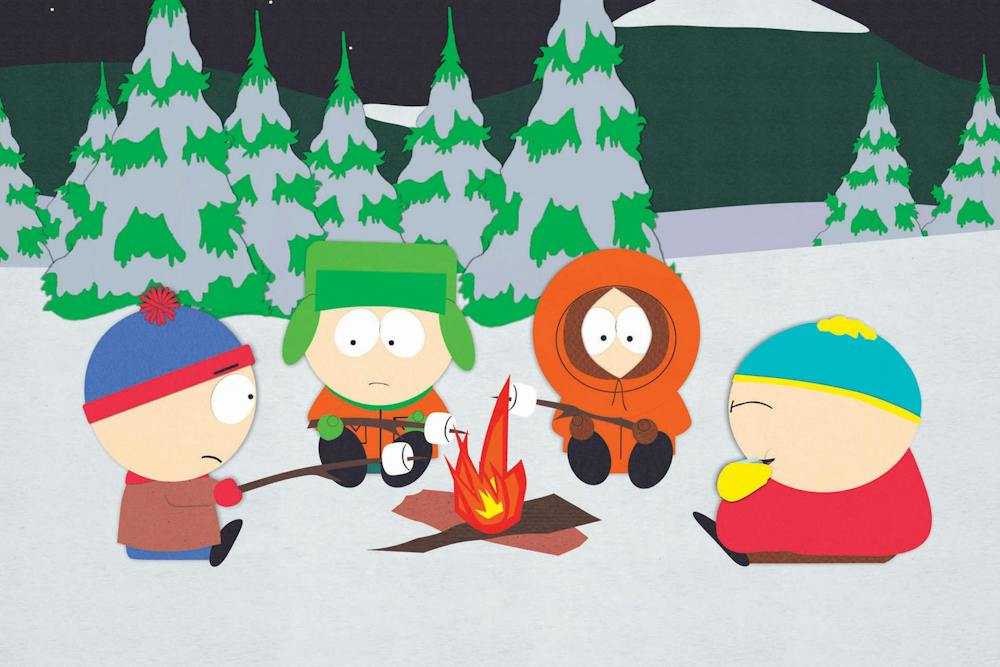
The first two episodes of “South Park” Season 29, which premiered Sept. 16, continue the show’s classically absurd and politically relevant themes. In a twist this season, the show has changed its namesake, the town of “South Park,” to “South America.”
Changing the town’s name instantly sets the stage for geopolitical renaming commentary. A clear jab at President Donald Trump’s attempted renaming of various federal buildings and geographic locations, such as of the Gulf of Mexico to the Gulf of America, I was amused to see the satiric name change in the season’s promotion.
The first two episodes, however, present a clear shift in political tone from the previous season.
While “South Park” has never shied away from political commentary, Season 28 was characterized by extreme choices, such as including AI deepfakes of the president, a noticeable skyrocketing of offensive skewering.
I enjoyed the previous season immensely, but going into Season 29, I hoped that the intensity would be a bit more subdued, as another season in that pattern would be exhausting.
To my delight, the ferocity characteristic of last season is not so pronounced in the new season. While it is by no means absent, it has returned to a more restrained level, if “restrained” is even a word effectively applicable to “South Park.”
“South Park” almost exclusively peddles satire and has been heavily criticized for its vulgarity; it has often included stereotypes that are racist, misogynistic, homophobic, transphobic and all other offensive possibilities. And, as a show written primarily by two straight, cisgender, white men, these criticisms are completely valid.
There are certainly some parts that are a bit too offensive for my taste, but I am content with not loving every choice by the creators and still enjoying the show. While “South Park” may insult, it insults equally.
Episode one, “South American Biker Gangs,” incorporates classic “South Park” character dynamics with vulgarity and nods to current events, forming a strong and entertaining first episode.
This episode begins with a classic Eric Cartman tantrum in which he feigns suffering to exploit his gullible mother. Through a torrent of snot and tears, he convinces her the only way for the other kids at school to stop bullying him is for him to get an e-bike.
Cartman’s pathetic self-pity never fails to amuse me because it is such an integral component of his character. He may be narcissistic and manipulative, but those traits are juxtaposed by simple childhood fragility. He antagonizes others until someone insults him back, and he suddenly turns from the bully into the self-proclaimed victim. Recognizing this typical Cartman pattern, you already know the shenanigans he will get up to on an e-bike.
In an alternative to e-bikes, Randy Marsh, a notorious air-head and the immature father of Stan Marsh, preaches the benefits of road cycling.
This set up of “rival biker gangs” satirizes stereotypes of South America, referencing stereotypical South American gang culture and conflating it with American hipster fads and petty inter-generational animosity. This dramatized gravitas of adults warring with children over technology deescalates such themes in our real-world experiences. In the current moment of political and social tensions over immigration, I was thrilled to see a blunt representation of petty social frenzy. Fear of immigrants being dangerous is rendered as absurd as anger over people riding e-bikes.
Episode two, "Billionaire Weenietown,” follows Butters.
An infestation of “invasive billionaires” has taken up residence in Butters’ backyard and is building a data center. The “billionaires” are presented as ant-like pests, and their colony consists of two factions: those that wish to remain out of the public eye and those that wish to voice their opinions, most specifically on podcasts.
I found this episode funnier than “South American Biker Gangs” because of the specific exaggerated ironies throughout the episode.
First, Butters, a normally docile character, exhibits uncharacteristic rage for most of the episode. I found Butters’ rage to mirror the general social upset surrounding much of current politics, but specifically on AI and data centers. Seeing a characteristically sweet character like Butters utterly outraged by political issues validates people also experiencing such outrage.
A second irony was in the refrain repeated by several characters that, “Things will get better in November, that’s when Grand Theft Auto VI comes out.” Also present in the first episode, this phrase shows a wide-spread political disillusionment by insinuating that people believe the game will have a more positive effect on the country than the November midterm elections will.
In classic “South Park” fashion, these first two episodes each incorporate extensive political commentary with bizarre and completely unpredictable story lines, keeping me simultaneously amused and confused.
Returning to content more tame than the previous season, “South Park” veterans and new viewers alike will appreciate this episode’s classic, immature absurdity. I have no idea as to what to expect from the rest of the season. I hope to see more parodies of current popular culture happenings, as I find satire never fails to make life more digestible.



