
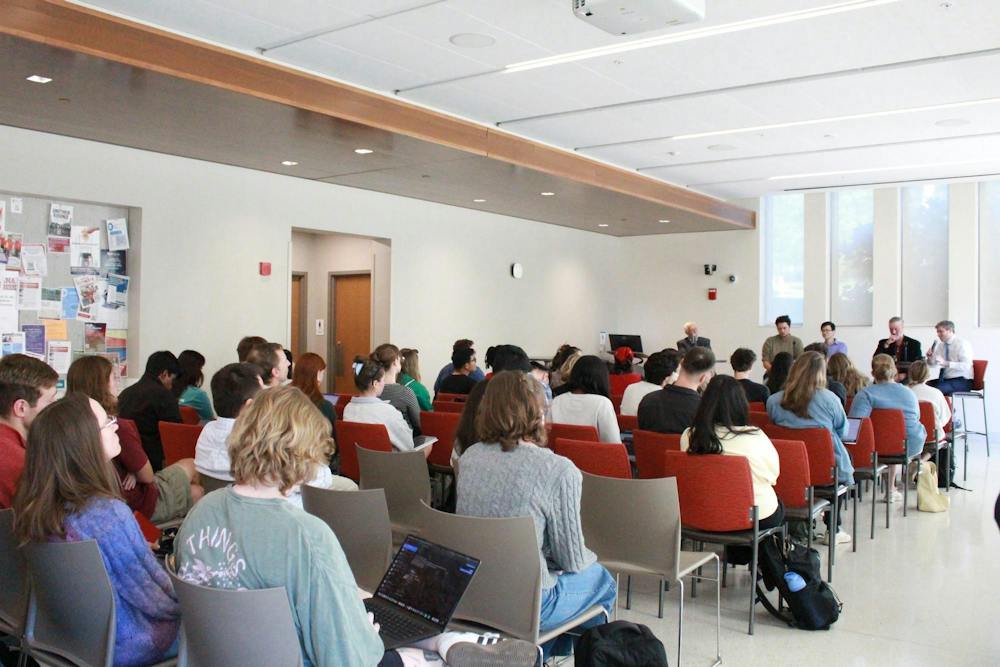
Panelists debated issues surrounding data centers at a panel sponsored by the O’Neill School of Public and Environmental Affairs on Tuesday. It was moderated by Ken Richards, an O’Neill professor of economics and sustainability.
Nationally, just one in nine Americans support the construction of data centers in their communities. Opponents of data centers, which includes all four of the panelists, argue that downsides like noise and air pollution, strained infrastructure and higher utility bills outweigh the potential benefits, which the panelists described as unclear, for local communities.
Panelist Justin Ross, a public finance, economics and policy analysis professor, noted the positive economic impacts of data centers.
“If you take a look at, like, roads, they don’t directly employ anyone,” Ross said. “It is still crazy to think about their contribution to the economy.”
Ross drew parallels between roads and data centers, which often employ few workers, but he argues they could still contribute to the local and national economy.
Studies have found employment, wages and income all increase after the construction of a data center in a community. However, panelist Bryce Gustafson, an organizer for the Citizens Action Coalition, Indiana’s largest and oldest consumer and environmental advocacy organization, feels this is an oversimplification of the truth.
“Not a lot of local jobs,” he said. “They are specialized jobs.”
Gustafson explained that data center employees, who he said are often not local to the area, and the companies who own the centers benefit most from their construction. Gustafson also pointed to the 50-year tax breaks Indiana offers some data centers, which benefit the data center companies and deprive the local community of tax money.
Panelist Saul Levin with the Global Center for Climate Justice criticized a frequent Meta talking point, which the company has often raised on what he described as a “press offensive around the country.”
“Meta has been advertising all over the country that the Rayville, Louisiana, data centers are responsible for local teachers being granted $50,000 bonuses,” Levin said. “None of the marketing documents mentioned that this was already in local statute.”
According to the New York Times, a local ordinance in Rayville mandates that 1% of local sales tax revenue goes to teachers; the huge bonuses for teachers in the town this year are partly due to sales taxes paid by construction workers working on the data center, who will leave after it is built.
The panelists also discussed the power dynamics between local communities and data center companies. Levin explained this dynamic by asking guests a simple question.
“Raise your hand if you’d be comfortable negotiating against a lawyer who makes $500,000 a year,” he said.
No one raised a hand.
Wu agreed, asking “(If this is a win-win,) how much win do they get and how much does the community?”
The panel also discussed artificial Intelligence bubbles, which is the concern that more money is being poured into AI than the amount of revenue generated.
Attendee Wade Catt raised concerns of noise pollution from data centers. He said the noise from data centers poses risks of cardiovascular disease and other negative health impacts.
He pointed to Monrovia, a town in southwest Indiana where a data center was recently built. Catt said he knows people living by data centers in Monrovia and elsewhere who have struggled with noise pollution and said their homes have lost equity as a result.
Catt also expressed his frustration with a lack of transparency in data center construction, noting that communities often aren’t adequately consulted before construction.
“We don’t have the power to resist this,” Catt said to nods of agreement. “It is something that is happening to us.”



