
Editor's note: All opinions, columns and letters reflect the views of the individual writer and not necessarily those of the IDS or its staffers.
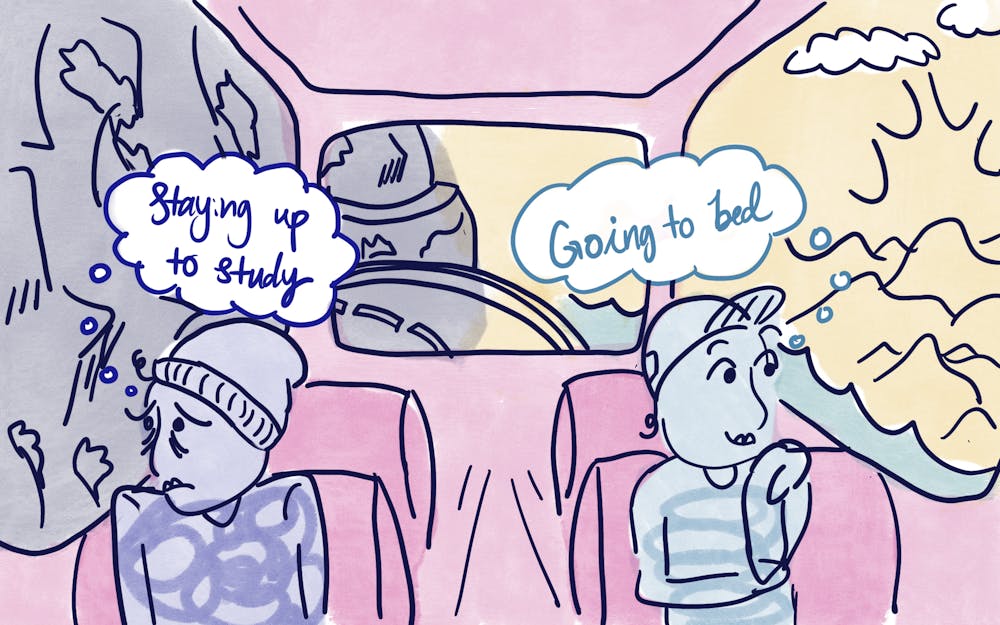
The sleepless nights we spend studying betray us come class time.
As I sat in my neuroscience class, headache raging, caffeine shakes battering me from trying to jump back into the rhythm of early wakeups and busy classes, a slideshow lecture projected onto the screen: “Brain and Behavior - Sleep.” Ironic, I know.
Returning from spring break gives a much-needed final surge of motivation to complete this last half of the semester. But it doesn’t help that my sleep schedule is out of whack. After stress-induced sleep deprivation thanks to midterms the week before break, I took advantage of the free time break offered to sleep in and stay up late.
But the sleep we sacrifice is key to learning. We’ve all heard the pros of getting sleep pushed on us since we were young, from bedtimes as kids to the recommended 8 hours. Despite this, many college students can attest to pulling an “all-nighter” to study.
The problem for those not sleeping enough is that our brain crystalizes what we learn in the fourth phase of the sleep cycle. I learned in class that sleep is divided into two stages: non-REM and REM sleep. During REM sleep, our new learning becomes knowledge as the brain processes the information.
The brain learns in three stages: acquisition, consolidation and recall. Not sleeping enough hurts all three. Our brains receive information, build and strengthen connections between pieces of knowledge and bring memories back to mind. Consolidation is an essential step, in which connections between information are strengthened, so knowledge can be used later. The most important time for sleep to improve consolidation has been found to be in the hours following whatever lesson is trying to be committed to memory.
We only enter REM after three previous stages of non-REM sleep, however. Because of this, it takes us a while to enter REM. You have to have been asleep for about one to two hours, while a healthy sleep schedule involves cycling through this sleep cycle four to six times.
Long story short, to get the benefits of REM, you must be asleep long enough to enter it and stay asleep long enough to enter it multiple times throughout the night for proper learning to really take hold.
Want to be more attentive and focused? Sleep is also when the brain cleans itself. If we don't get that time during sleep, new studies suggest our brains will take the time to do it when we’re awake instead, whether it’s convenient to the work we’re trying to get done or not. Research from the Massachusetts Institute of Technology has examined what happens when we have failings in our focus stemming from sleep deprivation.
When we sleep, cerebrospinal fluid (CSF) rushes into our brain and flushes out metabolic waste that’s built throughout the day. The MIT study demonstrated that when we’re sleep deprived, this process still happens, but it happens when we’re awake. The problem: we experience a significant reduction in attention as it occurs. The study involved giving 26 participants a visual and auditory test twice, once before sleep deprivation, and once after.
Unsurprisingly, the sleep deprived did worse, with slower reaction times, sometimes even missing the signals they had previously noted when they’d had a good night's sleep. The brains of these participants — who were wearing an EEG cap to measure brain activity and lying in a functional MRI scanner — saw CSF moved outward from the brain when attention lapsed, and back in when attention returned.
So, if after a night of study sessions and staying up late, you struggle to grasp questions on test day, miss details or fall short of your best, that's not just a feeling. It’s your physiology. Your short-term memory that kicks in is not as effective as getting that REM, allowing your brain to turn information into knowledge and letting the waste that accumulated throughout the day be flushed out when you’re asleep. It’s especially important when you need to be focused on answering questions to a test worth 20% of your grade.
Life gets busy. But the science is in; sometimes the best studying is closing the book earlier and getting some much-needed shut-eye.
Elia Crisan (she/her) is a freshman studying neuroscience.



