
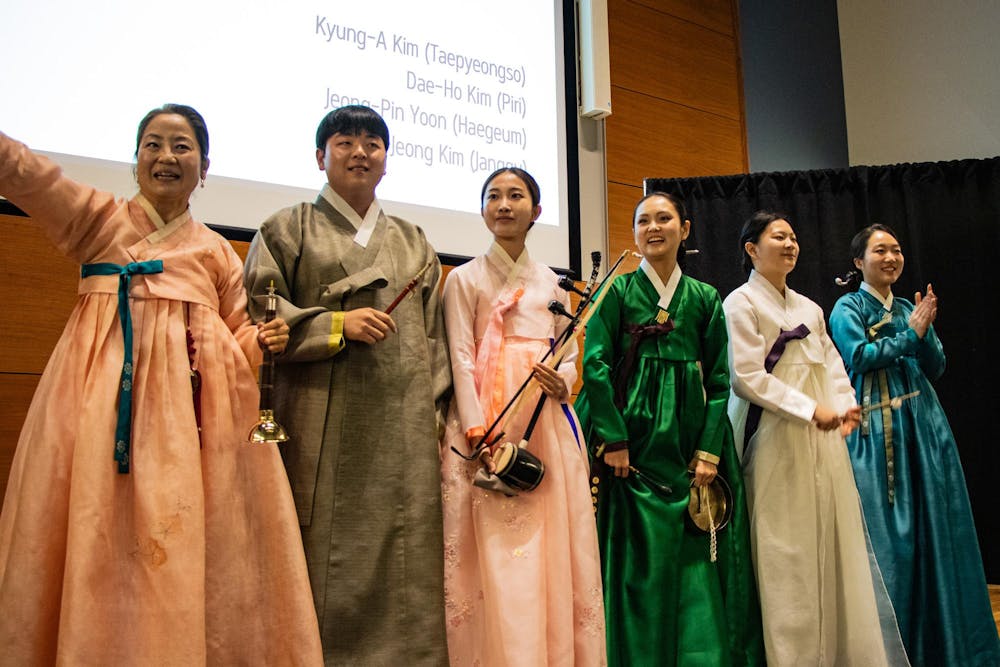
Musicians from Seoul National University took the stage in the Global and International Studies Building’s Shreve Auditorium on Monday night to perform “Enlightened Connections: Bridge to Korean Music.” The performance was presented by the university’s Korean music department in partnership with IU’s Institute for Korean Studies and East Asian Studies Center.
The performance at IU was one of many in Seoul National University’s 2026 Global Exchange Project, which serves to strengthen and expand the Department of Korean Music’s international outreach by showcasing both traditional and modern Korean music through a traditional instrumentation and costuming.
The exchange project has led the ensemble to IU as the final performance of their tour through parts of the United States.
The ensemble first spent a week at the University of Hawaii before traveling to three surrounding performance spaces within the state.
The ensemble then performed at Purdue University on Feb. 21, where they showcased traditional Korean instruments and how to play them in a pre-show exhibit. Professor Kyung-A Kim and Korean musicology graduate student Eui-Jin Kim then did a seminar Monday morning before traveling to Bloomington.
The hour-long performance began at 7 p.m. Monday, with Eui-Jin Kim introducing the small ensemble and explaining that the first few songs would be solo performances of traditional Korean music accompanied by Seo-Jeong Kim as a percussionist.
Kyung-A Kim took the stage with her piri to begin the first piece, titled “Sangnyeongsan,” which is the opening movement to Yeongsan Hoesang, a piece of Korean court music repertoire.
The piri is a double-reed Korean instrument in the oboe family, consisting of the reeded mouthpiece and eight finger holes producing different notes. Kyung-A Kim has played the piri for 38 years, now teaching her craft and leading the department of Korean music at Seoul National University.
Sharing her craft throughout the United States was something that she was excited to do, she said, hoping to connect with audiences through music she has spent years performing.
“I believe that this could be a window to connect and help us emphasize Korean traditional music,” Kyung-A Kim said.
As Kyung-A Kim left the stage, Sunny Jung took to the stage to perform “Chunseol” with her 18-stringed gayageum, a traditional Korean instrument which traditionally has 12 strings and moveable bridges.
Jung is the executive director of the Korean Performing Arts Center and has played the gayageum for almost thirty years. “Chunseol” is one of her favorite pieces to perform, especially enjoying how it reminds her of when springtime is coming.
“This is my favorite song,” Jung said. “When the spring is coming, you can see still snow like today, yesterday. So, this piece introduced that escape. So, I really enjoy each section, I especially like the last part.”
Three more solo pieces were performed, showcasing instruments like the saenghwang, a traditional Korean wind instrument that Eui-Jin Kim compared to a hand-held organ while moderating between songs.
After the solo pieces, all members of the ensemble were invited onto the stage to perform three more songs titled “Frontier!,” “K-Pop Demon Hunters OST” and “Eolssiguya.” The selections were a combination of new and old, attempting to catch the attention of members of the audience with less knowledge of traditional Korean music.
While making the selections for the music, Kyung-A Kim wanted to pick music that American and Korean audiences would get excited about.
“We wanted our Korean music to be more familiar and friendly to the audience in Indiana,” Kyung-A Kim said. “So, we had to mix with the traditional pieces and the newly created compose pieces so that we could, like present, also the traditional music and also the timber and the sound and ornamentation that we make in Korean tradition.”
The concert ended with a crescendo of Kyung-A Kim’s piri at the end of “Eolssiguya,” indicating to the rest of the ensemble the music was coming to a booming end.
Laura Judson, assistant director of the East Asian Studies Center at IU, helped coordinate the details of the performance. She said the event presented itself as an amazing learning opportunity for those who do not see performances like it often.
“I think it can teach people the appreciation of things that might be new and different, and it can also teach them how universal music is,” Judson said. “You know, it’s a universal language, everybody understands it.”

