
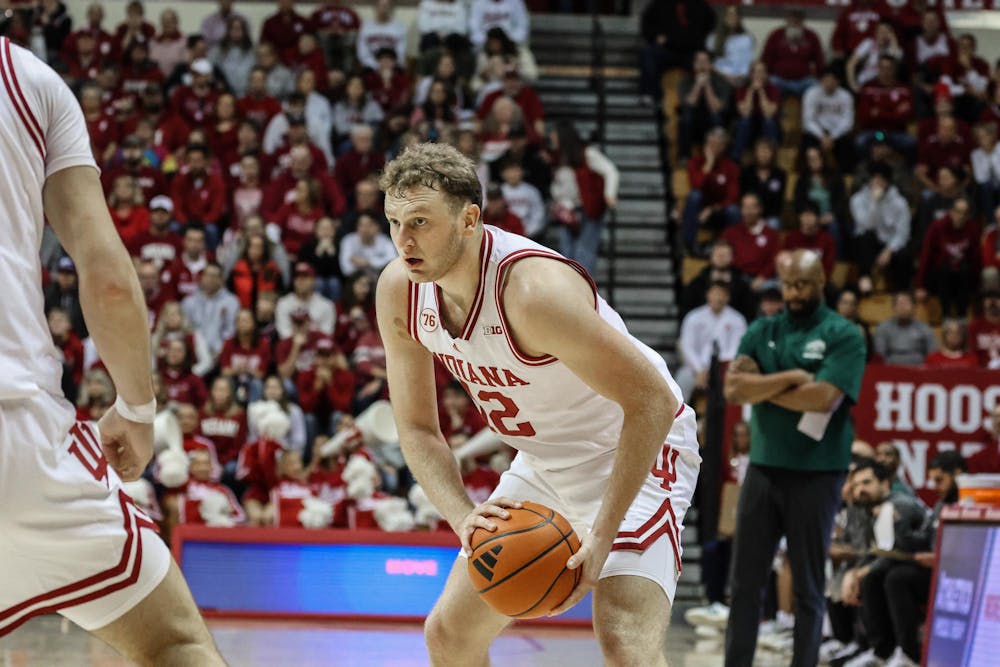
Stark differences exist between Indiana men’s basketball and Indiana baseball.
One is played inside the famed Simon Skjodt Assembly Hall, while the other is just a stone’s throw away at Bart Kaufman Field. The hardwood Hoosiers aim to shoot the basketball into the hoop, while the Cream and Crimson on the diamond want to hit the ball where opponents aren’t.
But there are some similarities between the two. When one player gets hot, others follow. And when a handful of players go cold, others do, too.
Such evidence was proven in Indiana men’s basketball’s 78-58 victory Saturday over Chicago State University inside Simon Skjodt Assembly Hall in Bloomington. The Hoosiers improved to 9-3 overall with their final nonconference contest looming Monday.
“One guy hits a home run, you see two or three other ones, everybody starts hitting,” Indiana head coach Darian DeVries said postgame. “Sometimes shooting can be that way, too.”
It certainly was Saturday.
The Cream and Crimson’s prowess from beyond the arc was displayed from the onset Saturday. Fifth-year senior guard Lamar Wilkerson connected on all three longballs while sixth-year senior guard Tayton Conerway drained a 3-pointer as the Hoosiers made their first four attempts.
After two misses, Indiana made three more shots from long range. Three misses ensued before redshirt senior forward Tucker DeVries connected on back-to-back 3-pointers.
The Hoosiers made five of their final 12 3-point attempts to close the first half. They entered the locker room at halftime with a 23-point advantage, having made 14 of their 26 attempts — a staggering 53.8%.
“Guys kind of feed off one another,” Darian DeVries said.
But when Indiana returned to Branch McCracken Court for the second half, its touch from long range was gone. The Hoosiers missed their first 16 attempts from beyond the arc in the second.
Junior guard Nick Dorn ended the not-so-good streak, connecting on a 3-pointer with just under eight and a half minutes left in the game. However, the Cream and Crimson missed their final three attempts of the contest.
“I thought that second half, you could definitely feel it go in a different way for us,” Darian DeVries said. “We kind of lost a little bit of our confidence. They weren't shooting it with the same swagger that they're accustomed to.”
Indiana went 26 for 62 from the field against Chicago State, and 15 for 46 from beyond the arc — the most attempts in a single game in program history.
For as superior as the Hoosiers looked in the first half, they looked just as inferior in the second half.
“That's the just how basketball is, you know?” senior forward Reed Bailey said. “You make shots some halves, [miss] shots the other. Everybody out there is capable enough to be making those. We all believe in our guys and we're going to knock those down.”
The shots didn’t change across the final 20 minutes Saturday. The looks the Hoosiers converted in the first half were still present in the second — they just didn’t fall.
“We were getting really good, clean looks by some of our best shooters,” Darian DeVries said. “So, it was one of those halves where you go 1 for 20.”
Throughout the early part of Indiana’s first season under Darian DeVries, it has demonstrated its ability to make 3-pointers in bunches. In eight of the Hoosiers’ first 12 games, they’ve made at least 10 longballs, including 17 against Penn State on Dec. 9.
But the Cream and Crimson also had a pair of contests — against the University of the Incarnate Word and the University of Kentucky — where they’ve made fewer than five 3-pointers.
No matter if the shots have fallen or if they’ve clanked off the rim each time, Bailey said the Hoosiers take 3-pointers with confidence when they’re open.
“I think even if we're not falling, we just trust in what we do in our offense, and we're always going to be taking those open threes,” Bailey said. “So, it's not going to change anything.”
Darian DeVries said the easy thing to do in the early stages of the second half, when his squad couldn’t connect from range, would’ve been to drive into the lane more frequently. When the Hoosiers have a handful of knockdown shooters, such as Tucker DeVries, Wilkerson and Dorn, the first-year head coach doesn’t want his shooters to hesitate when shots aren’t falling.
But when 16 consecutive attempts don’t fall, Darian DeVries said the Hoosiers “have to be able” to get into the paint.
He said he and his staff tried to create layup opportunities, or ones where players get to the free-throw line, so they could see the ball go through the hoop once. They just didn’t work often against the Cougars.
Now, the Hoosiers have just one remaining nonconference tune-up before they re-enter conference play for good. The Cream and Crimson have 18 remaining games against Big Ten opponents.
Indiana has made 7.6 longballs per contest in its three losses this season. Conversely, it’s knocked down 13 per game in its nine victories.
Connecting from 3-point range is pivotal for the Hoosiers, and they have the confidence to do so. Just like baseball, all Indiana needs is for one shooter to get hot, as others can follow.
“I feel like we've seen each other make it a thousand times in practice,” Dorn said. “We know everybody’s getting their work in. We just have unwavering faith in each other.”
Follow reporters Dalton James (@DaltonMJames and jamesdm@iu.edu) and Nathan Shriberg (@NShriberg and naashri@iu.edu) and columnist Kasey Watkins (@KaseyWatki8773 and kaslwatk@iu.edu) for updates throughout the Indiana men’s basketball season


