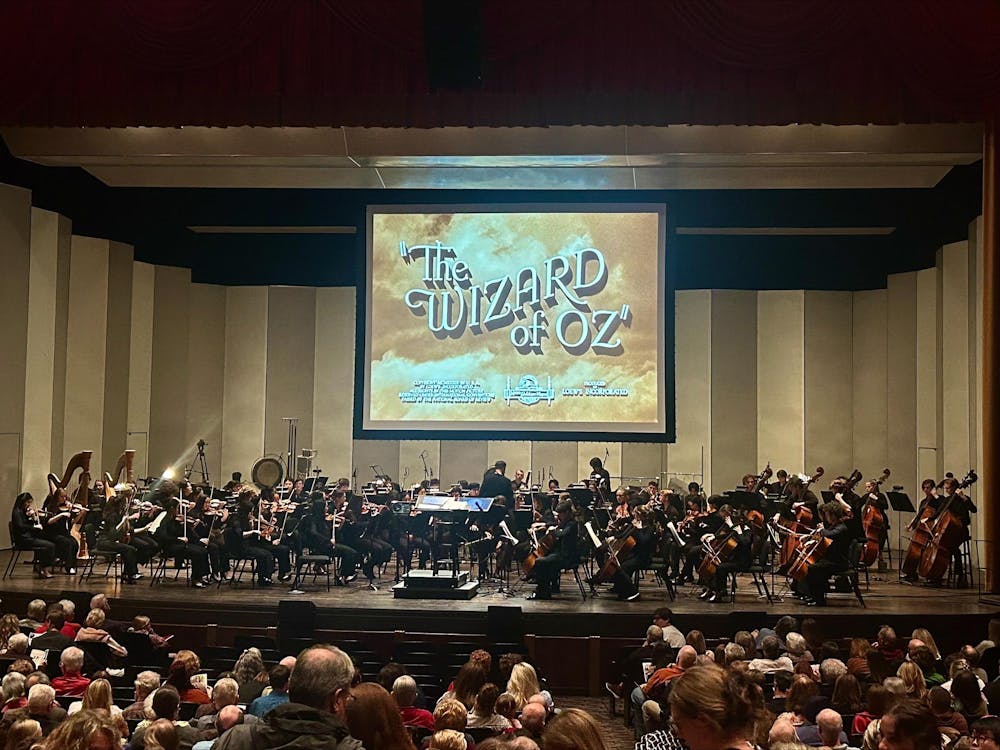
The IU Auditorium welcomed families and people of all ages Friday, some in costume, for the opening of “The Wizard of Oz,” part of the Jacobs Live at the Movies performance series.
Although the 1939 original film projected on stage during the performance, it did not feature the original orchestral recording in its playback. Instead, the orchestra played the music live, following along closely with the film’s original cast and sound effects.
Maestro Constantine Kitsopoulos, who has conducted about 45 different films with a live orchestra, directed Friday’s performance. He has conducted “The Wizard of Oz” score before, but Friday marked his first performance of it with Jacobs’ musicians. He spoke about the challenge of remaining in sync with the original film and dialogue while also taking certain creative liberties.
“I’m bound to the film, because the film doesn’t stop for anybody,” he said, “but within the phrases, I can bend a little bit here and there, although not much. Basically, the challenge is to come up with a musical interpretation that fits the timings that’s somewhat my own, but faithful to the original.”
Kitsopoulos said film scores are often relegated to background noise, but that a live setting can truly make them stand out.
“Usually, the music is mixed in the background, so you don’t really hear much detail,” he said. “In this case, you hear all the orchestral detail live and in person, so it’s a wonderful experience.”
The film’s more well-known songs, such as “We’re Off to See the Wizard,” “Over the Rainbow” and “If I Only Had a Brain,” were met with the loudest applause. Some even had attendees laughing and singing along quietly to themselves. “Over the Rainbow,” though, generated not only the loudest applause, but had audience members completely transfixed.
Judy Gan, a sophomore flute performance student, said she expected audiences to resonate the most with “Over the Rainbow.”
“It’s just a really heartwarming song,” she said. “It’s just a really easy and small tune that’s easy to remember, and it’s been so popular for so long.”
The audience was a diverse crowd of all ages and backgrounds, including some who were seeing the film for the first time and others who were returning to a childhood classic. Olivia Gutierrez, a freshman music composition student, said she noticed aspects of the movie she hadn’t registered when she watched it as a kid.
“There was a lot I didn’t put together when I watched it as a kid,” she said. “It’s a lot funnier than it was when I was a kid.”
Throughout the performance, much of the music was meant to echo the actors’ speaking or musical rhythms. For some audience members, the orchestra blended so seamlessly along with the film’s scenes that they tended to almost not notice it at times.
Freshman music education major Daniel Weaver and freshman trombone and linguistics student Oliver Keough both thought the orchestra was incredibly in sync with the film.
“I think it really speaks to their musicianship that, like, I forget there’s a whole orchestra playing,” Weaver said. “Especially considering how long they’re playing, how much is involved and that they have to be focused on it the entire time. You know, they only get one chance at it, and it’s so seamless we almost forget they’re there.”
The original story of “The Wizard of Oz” was published as a book by L. Frank Baum in 1900, and the story has remained present in the ever-changing landscape of pop culture. From the 1939 film to different interpretations of the same core story, like 1978’s “The Wiz” and the “Wicked” Broadway musical, “The Wizard of Oz” is a story audiences keep returning to. Following the success of the 2024 film adaptation of “Wicked” and during the release month of its sequel, the story is especially prevalent in modern pop culture.
Despite the original story being over a century old, attendees thought the themes within “The Wizard of Oz” were still resonant today.
“I think the moral of it is still very relevant and relatable,” Keough said. “It’s not really about getting the magical wizard to give them the brain or the heart, it’s about what’s always been there inside you. It’s really aboutcoming of age, which is always a relevant theme.”