
Across the state of Indiana, pressure groups, government entities and community members challenged around 50 books’ position on library shelves in 2024, according to the American Library Association.
Challenged books were alleged to include gender identity, LGBTQIA+ themes or sexually explicit content. But local libraries like the Monroe County Library are combatting what their banned book campaign calls “censorship” by highlighting some of the books that are commonly-banned nationwide.
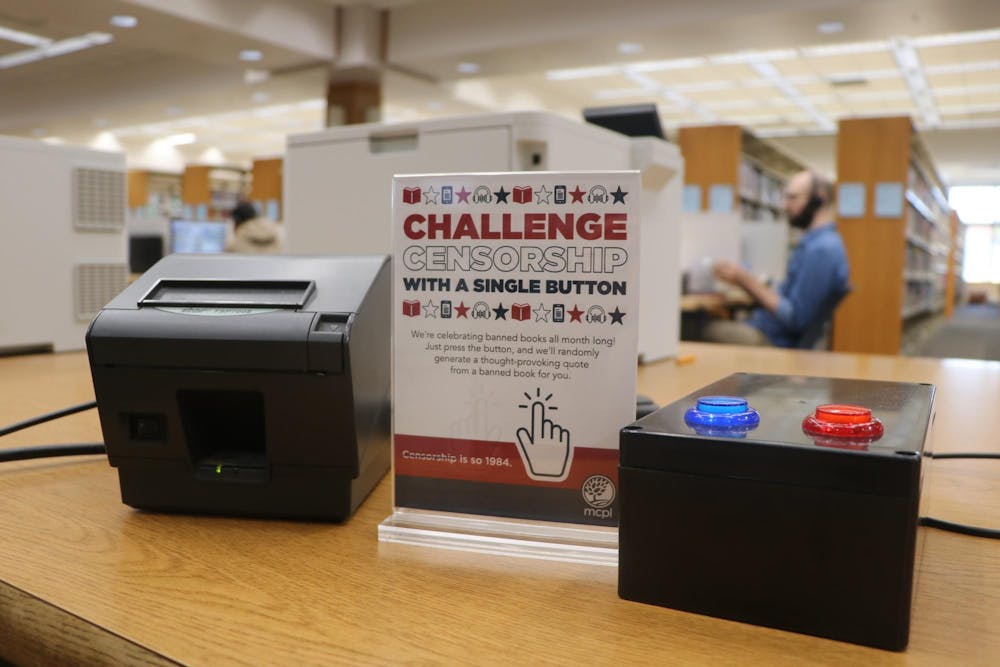
MCPL has banned book displays in each library branch and a banned book quote generator machine in the downtown library during October.
The banned book quote generator is accompanied by a sign that reads “challenge censorship with a single button.” The library’s campaign this year was titled “Read for Your Rights: Censorship is so 1984.”
According to ALA, pressure groups, government entities and community members attempted to take 5,813 books off the shelves nationwide in 2024. Nearly 2,500 of those titles were challenged for the first time in 2024, which is the third highest number of unique challenged titles ALA has ever recorded.
In 2024, the most consistently challenged books in Indiana libraries were “All Boys Aren’t Blue” by George M. Johnson, “Fred Gets Dressed” by Peter Brown, “Gender Queer” by Maia Kobabe, “Hurricane Child” by Kacen Callender and “It’s Perfectly Normal” by Robie H. Harris. These books are all geared toward young people, according to ALA, and include LGBTQIA+ themes and discussions about puberty and sexual health.
Tori Lawhorn, communications and marketing director for MCPL, said many of the top 10 challenged titles have remained consistent for the past few years.
MCPL has a collection development policy which describes the guidelines the library uses to purchase materials. If a community member disagrees with the inclusion of a certain book, they can complete a request for reconsideration form, and the library will put the material through their formal review process.
The committee that reviews the request then makes a recommendation to the library director who decides what action should be taken, if any.
MCPL faces no more than one official request for reconsideration each year, Lawhorn said, and most concerns from the community are dealt with through conversations between the community member and the library staff.
“As a public library, we do serve everyone, and we have materials that should reflect our community,” Lawhorn said. “So, while you might see something that you might not necessarily want to read, you definitely don’t have to read it.”
The library also has a suggest-a-purchase form so community members who do not see their interests represented in the library’s collection can request specific new materials that reflect their own values.
Part of MCPL’s mission, Lawhorn said, is to provide equitable and impartial access to information.
“We believe, and are champions of, intellectual freedom,” Lawhorn said. “That’s the foundation of libraries as a whole, and that’s something we are incredibly committed to.”
Lawhorn said other local county libraries do not have the same community support.
“It’s important to be able to choose what you want to consume and when and how,” Lawhorn said.
Sophia Congdon, second-year Master of Library Sciences student and president of the IU Bloomington ALA Student Chapter, said Banned Books Week draws attention to the topic, which many people outside the literary world don’t think about often.
“I think people take their libraries and their public schools for granted, so I think it’s important that we remind people that this is a year-round issue, and not just something to think about right at the start of the school year or when a book that you particularly like is on the chopping block,” Congdon said.
In 2023, then-Indiana Gov. Eric Holcomb signed House Enrolled Act 1447 into law, which requires schools to publicly post their library catalogs and allow community members and parents to challenge materials they find inappropriate.
Congdon said K-12 students are most affected by book banning.
“Censorship harms everyone,” Congdon said. “It keeps books out of the hands of students who are interested in learning about those topics, and it kind of just perpetuates the spread of misinformation.”
For example, she said, when books that discuss sexuality get banned, it can restrict children from learning about the human body and puberty during that period of their life.
Congdon said libraries can often deal with requests to ban books by simply moving challenged material from the children’s or teenager’s section and into the adult section.
The smaller the library, Congdon said, the more harmful book bans are. Without enough room for separation of departments, there is no way to just move the book from one section to the next, so the book must be completely removed.
“I think that a lot of people masquerade under this children’s crusade that they have going where they’re like, we want harmful books out of the reach of children,” Congdon said. “But in reality, what they’re doing is promoting censorship at all levels.”
Howard Rosenbaum, professor of information science in the Department of Information and Library Science in the Luddy School at IUB, is an expert on intellectual freedom. He defined the term as “the ability people have to think for themselves without outside interference and without restriction.”
Book banning has become an important instrument in culture wars, Rosenbaum said. He also said banning books makes librarians’ jobs more difficult, as they lose access to all materials possible to curate a collection.
The process of book ban request reviews does not have an equivalent process in schools, Rosenbaum said, which means school librarians are often simply told what they can and can’t include.
Lawhorn said Banned Books Week especially took off around 2021, when campaigns to suppress books grew. Rosenbaum echoed that, saying since the beginning of the COVID-19 pandemic, there has been a nationally organized effort to ban books.
Rosenbaum said students must have intellectual freedom in order to learn. People who push for book bans, he said, seem to operate under the assumption that books are the primary way that children learn about the world.
He said that the irony of the book-banning movement is the fact that children learn most of what they know from social media and a mix of other information sources.
Still, Rosenbaum said books serve an important purpose of giving children alternate views of the world, and students’ learning is negatively affected by book bans.
“People should have the right to pursue whatever information they want and develop their own ways of thinking, even if it’s ways of thinking that you don’t agree with,” Rosenbaum said.


