
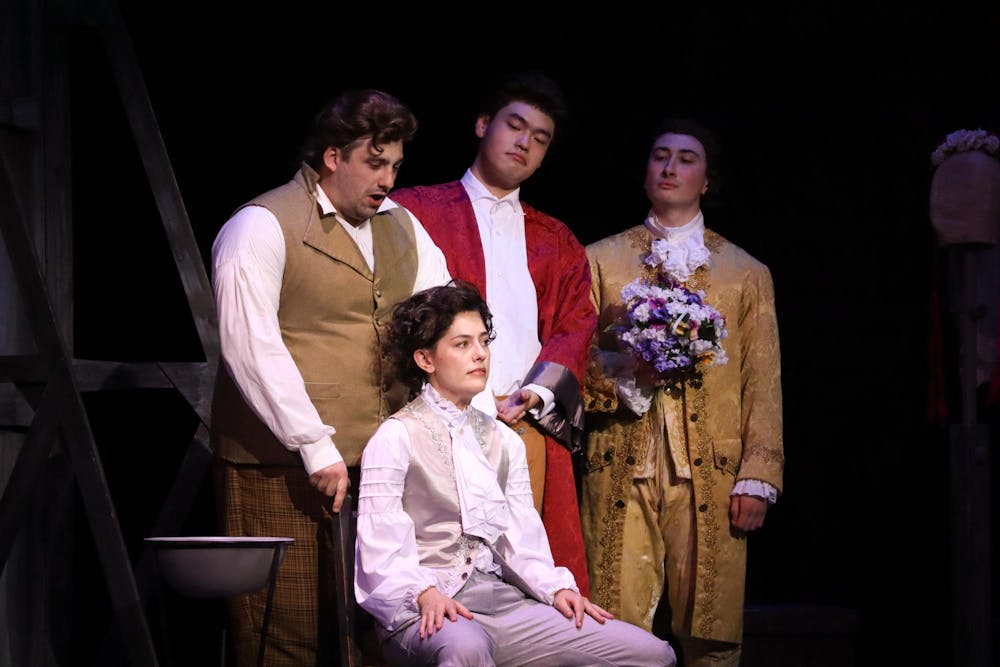
Mozart’s “The Marriage of Figaro,” a tale of love, drama and revolution, will be adapted by the Jacobs School of Music Opera and Ballet Theater at the Musical Arts Center this weekend. The opera will run from Sept. 27 to Oct. 4.
The opera is sung in Italian, but English subtitles will be displayed above the stage. Performed by two different casts, the show will be split up depending on the date. The first group will perform Sept. 27 and Oct. 2, while the second will be featured in the Sept. 28 and Oct. 4 shows. This allows performers time to rest and recharge, rather than exert their voices two days in a row.
The opera was originally based on the controversial 1784 play “The Marriage of Figaro” by Beaumarchais, which unsettled European rulers for its mockery of the aristocracy. Soon after, the opera of the same name was put on, marking Mozart’s first of three collaborations with librettist Lorenzo da Ponte. The opera became widely known as radical for its time because it featured underclass servants as its lead characters.
The opera itself follows servant Figaro as he strives to upend the plans of his master, Count Almaviva, who wants to revive an old custom that would allow him to sleep with Figaro’s fiancée, Susanna. The events that follow contain themes of love, gratitude and class struggle with added elements of drama and humor.
Director Crystal Manich believes a major underlying message of the show is the idea that success is possible despite one’s social class or circumstances.
“It’s the idea that the classes that have been created arbitrarily in society actually don’t matter when it comes to wit and intelligence, and that the underdog can certainly be the top dog,” Manich said “So, I think that right away we connect to Figaro as a representation of that.”
Although “The Marriage of Figaro” was written at the end of the 18th century, Manich thinks that its story still resonates with universal audiences today.
“I think that even today, we can recognize the ingenuity of the story and how we perceive class now,” Manich said. “We’ve seen so much revolution since the time that this show was created. So, I think that we can really take away some beautiful things from it and we can also still be entertained by it.”
Much of the show’s comic relief is provided by the character Cherubino, a hormonal teenage boy undergoing puberty who falls in love with every woman he sees.
Miranda Nilan, a second year masters student in Vocal Performance at IU, plays Cherubino in the show’s second cast. For her, the most fulfilling part about playing her character is getting to make the audience laugh.
“I myself am a very silly person, and I find myself happiest when I’m able to make other people laugh and happy,” Nilan said, “So, the fact that I could play such a funny character who’s just so goofy allows me to kind of let go.”
For those who have never seen an opera before, Nilan believes it is a common misconception that the performance medium is too posh or high-class for the average person. She disagrees with this idea, believing that opera can be enjoyable for anyone, and that “The Marriage of Figaro” especially has themes and humor that many different people can resonate with.
With a mix of both relatability and comedy, Nilan thinks that the opera is something audience members of any age and background can become captivated with.
“For me, I think the comedy is what people will engage with the most throughout this opera,” Nilan said. “There are things that people nowadays can connect with that are going on in the story, and there’s timeless humor in it as well.”
Audiences can also enjoy the elaborate costumes of the performers as they move about the stage. The characters’ ensembles give an obvious nod to the show’s historical context while still prioritizing aesthetics and practicality.
Costume coordinator Elizabeth Licata said many of the costumes were chosen to reflect the personalities of the characters.
“Susanna is very cute and fun, so her dresses are very sweet, beautiful and innocent,” Licata said. “I really love her hot pink wedding dress. It’s such a striking moment.”
A vital aspect of an opera, in addition to the performers’ vocals, is the show’s live instrumentation. Although the vocals are the audience’s main focus, the orchestra adds essential color and life to the performance.
The pit orchestra for this adaptation of “The Marriage of Figaro” is conducted by Kevin Murphy, an IU Jacobs professor of collaborative piano. He spoke about Mozart’s composition as an integral facet of the experience this opera can provide audiences with.
“Mozart is a genius of a mixture of music and drama, and I think the orchestra is really one of the characters in an opera, and it’s just elegant writing,” Murphy said. “Mozart, I think, instills something in the listener that is undeniable, and you can’t help but feel the warmth and the joy and the depth of human emotion and human relationships in his music.”
The show will open Saturday at 7:30 p.m.


