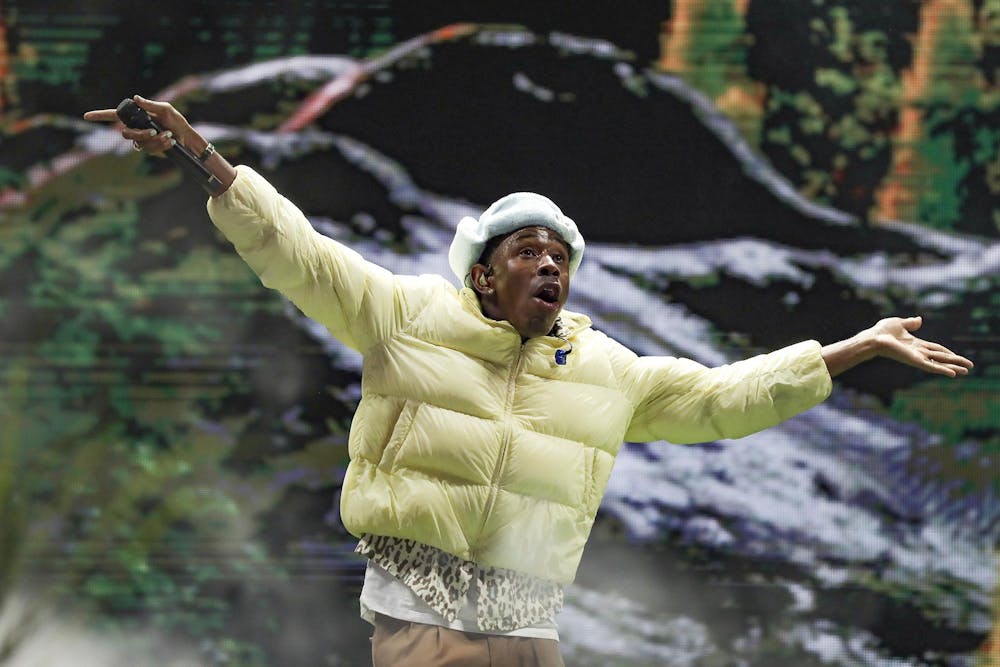
American singer and rapper Tyler, the Creator recently released his ninth studio album, “DON’T TAP THE GLASS,” on July 21, 2025. The 28-minute long hip-hop and rap record is brisk and to the point, laced with upbeat synths and features from notable artists like Pharell Williams and Yebba.
“DON’T TAP THE GLASS” is, at its core, a dance album. In an Instagram post, Tyler said some of his friends refuse to dance in public for fear of being filmed. That sentiment made him “wonder how much of our human spirit got killed because of the fear of being a meme all for having a good time.”
Tyler combated the fear of letting loose by holding a listening party for the album, writing in that same post that it was one of the greatest nights of his life.
“No phones allowed. No cameras, just speakers and a sweatbox,” he said in the post. “Everyone was dancing. Moving. Expressing. Sweating. It was truly beautiful.”
Tyler concluded the post by urging his listeners to get up and move when it came to their own listening experience.
“This album was not made for sitting still. Dancing, driving, running, any type of movement is recommended to maybe understand the spirit of it,” he said.
This sentiment is reinforced in the opening lines of “Big Poe,” with Tyler speaking in a robotic voice as he welcomes the audience to the album and introduces three key rules: the listener has to move while listening, must “only speak in glory” and “leave your baggage at home” and, lastly, “don’t tap the glass.”
The phrase “leave your baggage at home” instantly reminded me of Tyler’s 2021 album “Call Me If You Get Lost.” The album explored themes of exploration and travel, adorned with imagery of suitcases that represented both physical and emotional baggage.
Not only does the phrase seem to be an homage to Tyler’s past projects, but it also sets the mood for “DON’T TAP THE GLASS.” Unlike “Call Me If You Get Lost” or his eighth studio album, “Chromakopia,” which were both more conceptual and in depth works, this album is all about loosening up and having fun — letting go of the baggage and just enjoying the music.
“Big Poe,” featuring Pharrell Williams, packed with sexually explicit lyrics and a Busta Rhyme’s sample, encapsulates the essence of having fun with music perfectly. Although I was not a fan of the song upon my first listen, it has quickly grown on me and become a favorite of mine — the playfulness and carefree nature of the song is contagious.
“Big Poe” transitions seamlessly into the second track, “Sugar On My Tongue.” As soon as I heard this track, which is another playful and sexually explicit song, I knew it would be a fan favorite. It is repetitive, catchy and easy to listen and groove to.
Following “Sugar On My Tongue” are “Sucka Free” and “Mommanem,” two songs that, to me, feel more like filler songs. Especially after the first two tracks, these seemed to be easily forgettable with nothing to make them really stand out.
Midway through the album is “Stop Playing With Me,” a cocky and arrogant rap that seems similar to one of Tyler’s earlier songs, “Rah Tah Tah.” It was no surprise when Tyler referenced the “Chromakopia” song in one of his verses, referencing the title, “Rah Tah Tah,” in one of his verses.
The next track, “Ring Ring Ring,” also feels reminiscent of Tyler’s past songs that reference phone calls — “Answer,” “911/Mr. Lonely” and “Momma Talk” are a few examples. In “Ring Ring Ring,” Tyler sings to the girl he is interested in, begging her to pick up the phone and call him back. This track is more melodic than the previous songs in the album and has a gentler, easy flow that solidifies it as another favorite of mine.
The seventh track on the album is “Don’t Tap That Glass/Tweakin,’” a bold, boastful rap with aggressive beats and confident lyrics. Following this track are two songs that feel more like interludes: “Don’t You Worry Baby feat. Madison McFerrin” and “I’ll Take Care of You feat. Yebba.” Both songs are melodic yet catchy as well as chill, while still being upbeat and danceable.
The album concludes with “Tell Me What It Is,” an introspective and honest track that displays Tyler’s heart on his sleeve and offers a juxtaposition to the lighthearted, lively vibe of the rest of the album. He opens up about his romantic struggles, singing, “I can buy the galaxy / But can’t afford to look for love / Where’s the map / I don’t know / Is there traffic to my soul?”
Tyler’s latest project ends as it began, with his robotic voice saying he hoped the listeners enjoyed themselves. He concludes the album with, “The glass was not tapped. Thank you… until next time,” which could be hinting at a next possible project in the works.
“DON’T TAP THE GLASS” is sonically engaging, short and sweet. Tyler raps hurriedly through each verse and seems to intentionally refrain from implementing emotional storytelling and more thought-provoking lyrics, as he did for “Chromakopia.”
The message “don’t tap the glass” could be being used literally — Tyler is urging the audience to put the phones down to enjoy the music and to, literally, not tap the glass screen of a phone. But the phrase could also be expressing how he feels like an animal in a glass cage due to his fame, fed up with fans ‘tapping the glass,’ which was a major theme in “Chromakopia,” as well.
No matter how the album is interpreted, “DON’T TAP THE GLASS” is a unique and refreshing album that serves as a reminder to let loose, have fun and most importantly, dance.