
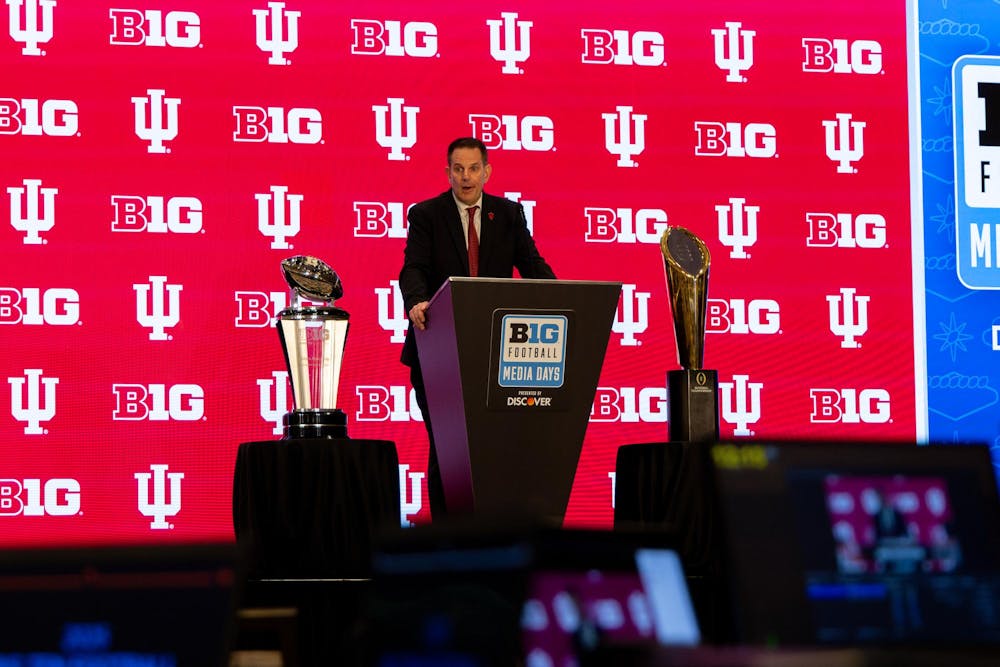
Indiana football head coach Curt Cignetti defended the program’s decisions on non-conference scheduling at Big Ten Media Days on Tuesday at the Mandalay Bay Convention Center in Las Vegas.
The Hoosiers made national headlines last week when they cancelled their home-and-home series with the University of Virginia that was slated for 2027 and 2028, paying the Cavaliers a $500,000 buyout.
That judgment was made as an institution in 2023 before head coach Curt Cignetti was hired to replace former head coach Tom Allen, although he did sign off on it. Instead, Indiana added Kennesaw State University and Austin Peay State University to its slate in place of Virginia.
“Look, here’s the bottom line,” Cignetti said in a press conference. “We picked up an extra home game, and we play nine conference games.”
Each Big Ten school plays nine conference games in the regular season, as opposed to the Southeastern Conference’s eight. Like Indiana, SEC schools play Group of Five or Football Championship Subdivision opponents during their nonconference schedule.
Cignetti came prepared with a plethora of numbers to back up the Hoosiers’ future schedule.
“12 of the 16 SEC teams play three G5 (Group of Five) or an FCS (Football Championship Subdivision) game,” Cignetti said. “12 of those teams play 36 games, 29 G5 games and seven FCS games, and one less conference game.”
SEC power Georgia’s non-conference schedule includes Marshall University, Austin Peay and the University of North Carolina at Charlotte. The Bulldogs then finish their season with a rivalry game against Atlantic Coast Conference rival Georgia Institute of Technology.
“We figured we would just adopt SEC scheduling philosophy, you know,” Cignetti said. “Some people don't like it. I'm more focused in on those nine conference games.”
During Indiana’s historic 2024 season in which it went 11-2 and made its first appearance in the College Football Playoff, the Hoosiers were dragged for their widely dubbed weak schedule. The Cream and Crimson played two G5 schools and one FCS school before playing just one ranked team in their conference schedule: Ohio State.
However, Big Ten commissioner Tony Petitti defended Indiana during his press conference Tuesday, explaining Indiana played the two teams — Michigan and Washington — that made the national championship game the previous season.
Cignetti didn’t just come armed with statistics to defend his program. He also laid out a new CFP format — one the Big Ten has proposed to the SEC — should it expand past the current 12-team layout to a 16-team one.
The second-year head coach suggested staging play-in games to decide who earns automatic qualification in the CFP from the Big Ten and SEC. The two teams that reach the conference championship game would automatically qualify. Meanwhile, Nos. 3 through 6 in the regular season standings would face off with a playoff berth at stake.
“You want to decide that on the field and make sure everybody's strength of schedule is what it needs to be?” Cignetti said. “Let's make everybody play nine conference games, and on championship weekend, three will play six, four will play five.”
Cignetti cited Ohio State, which won the national championship in 2024, as an example. The Buckeyes finished fourth in the Big Ten, meaning any of the four teams could be capable of hoisting the national championship trophy come Monday night in mid-January.
Under the format Cignetti discussed, the Big Ten and SEC would each have four automatic bids, the Big 12 with two, the ACC with two and G5 with one. The remaining three slots would be at-large bids.
Each Power Four school would also transition to playing nine conference games during the regular season.
Contrary to Cignetti and the Big Ten’s vision, the SEC wants the CFP to remain in its current format where each Power Four conference champion earns an automatic bid alongside the highest-ranked G5 school.
Maryland head coach Michael Locksley, who was backstage during Cignetti’s press conference awaiting his turn at the podium, gave his opinion on Cignetti’s proposal.
“I heard Curt,” Locksley said. “Man, he had this whole thing mapped out. Whatever Curt said, I agree with, because Curt has that thing figured out.”
Locksley then stated he wanted to “stay within my lane” as playoff negotiations are a part of Petitti’s — whom he said he trusts — responsibilities as commissioner.
Petitti, who assumed his role just over two years ago, said the Big Ten wants to “better connect” the regular season with the postseason.
“A critical goal of any post-season format, regardless of sport, is to keep as many teams alive as deep into the season as possible,” Petitti said. “We want more conference games to matter in November. Also, the playoff format should not function as a disincentive to schedule tough, nonconference games.”
No matter how the CFP looks in the future, Cignetti has one prevailing belief that could help decide which teams are worthy of selection.
“We need to standardize the schedule across the board if we want to have objective criteria for who should be in the playoffs and who shouldn't,” Cignetti said, “and we need to take the decision-making off the committee to some degree.”
Dalton James covers Indiana basketball and football for the Indiana Daily Student. You can follow him at @DaltonMJames on X and contact him via email at jamesdm@iu.edu.


