
Editor's note: All opinions, columns and letters reflect the views of the individual writer and not necessarily those of the IDS or its staffers.
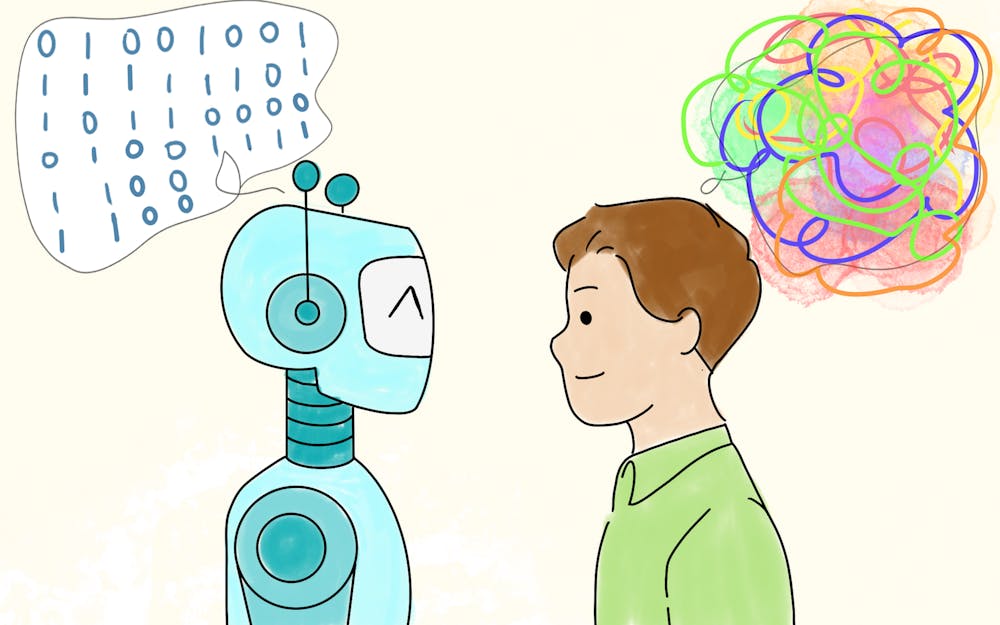
I’ve always enjoyed the friction of thinking through a challenge. I thrive in the chaos, the creativity, the frustration, and the joy when it finally clicks. It’s the messiness in the middle where I feel most alive. But recently, something shifted.
As a data science student, I use AI almost every day. Whether I’m debugging code, creating visualizations, summarizing research papers, or quickly learning to use new tools, I rely on it to accelerate my work and catch mistakes or insights I might have missed. I now solve things faster than ever. But after the job is done, I feel empty. Without the chaos and the struggle, there is no sense of accomplishment. Instead, in that silence, I feel like I’ve lost something that made me deeply human.
While I was trying to put these feelings into words, I remembered something chilling from “The Three-Body Problem,” a sci-fi novel series I like. In the final book, after Earth is destroyed, a spaceship named Gravity carries the last surviving part of humanity in search of a new home. Without a deeper sense of why they are surviving or what makes them human anymore, they begin to lose the will to live. One by one, they die, not from violence or disaster, but from quiet surrender. They become disconnected from the people they once were and the world that gave them meaning. The loss of purpose and belonging slowly wears down their will to live and their sense of what it means to be human.
I am not floating in space. But sometimes I feel like I’m in my own version of Gravity. I am doing my work and checking off my to-do lists, but I feel disconnected from the version of myself that used to love problem-solving. The curiosity is fading, and it terrifies me. This makes me ask myself, “Am I losing the part of me that makes me feel human?” Then I wonder, “If AI can now do so many things we once believed only humans could, what’s our role? Where do we fit in this evolving world? What unique value do we still bring?”
Some companies now expect their employees to use AI. Some CEOs have even made it mandatory that hiring will only be considered if AI cannot do the job. We are not just using AI anymore. We are being compared to it. I used to be proud of my ability to think creatively, my curiosity, and my persistence. But now these skills are seen as “less efficient,” a distraction. It is nice to have, but not required.
But in a world that values efficiency above all else, it’s easy to forget that some of our most human traits can’t be measured in speed or productivity. AI doesn’t wake up in the middle of the night with a vague idea it can’t shake. It doesn’t chug caffeine and scribble half-baked thoughts in a notebook, hoping they make sense in the morning. It cannot think outside the box. It reminds me of that one smart kid in school — always top of the class, great at memorizing, and excellent on paper. AI is great at optimizing what’s already out there; but creating something from nothing? Not yet.
As AI takes over more of the work I once took pride in, it forces me to question what intelligence truly means in a world no longer defined by struggle and discovery. I’m left navigating this strange middle ground, where progress demands that I adapt but also threatens the essence of what I once valued.
I am not rejecting AI. I am not surrendering to it either. I use it like an editor that takes my original, raw ideas and refines them. I don’t let it write for me. It isn’t my ghostwriter. I don’t feel like it solves my problems completely. It helps me out and even creates polished noise but is super convincing. To me, the struggle is the process. That’s what makes the solution meaningful.
I know that AI is here to stay. But every innovation also brings a strange, subtle emotional toll that must be acknowledged. AI hasn’t just changed the way I used to work. It’s making me question what it means to be alive and engaged. As I ask what makes me human in this AI-driven world, I know I am not alone. As we redefine intelligence and what makes us unique, I hold onto this one truth: AI cannot replace the messiness, the struggle, and the soul behind the work. That’s still ours.
Aathirai Senthilkumar Thamaraiselvi (she/her) is a 2025 graduate of IU with a master's degree in data science.



