
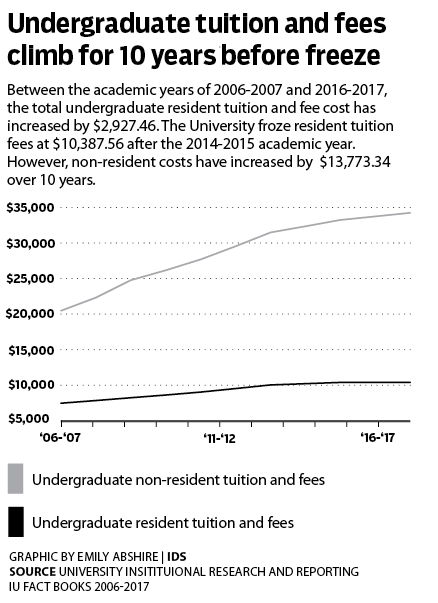
As colleges and universities around the country attempt to address student debt, IU is in its second year of an in-state tuition freeze.
The tuition freeze was approved by the Board of Trustees after the 2014-2015 academic year, at the advice of IU President Michael McRobbie, and was announced alongside a 3.7 percent spending increase from the previous year, according to a press release.
Simultaneously, Purdue University is in its fifth year of tuition freeze for in-state students, a decision that gained Purdue President Mitch Daniels national attention.
In June 2015, when McRobbie first announced the freeze, IU had already kept tuition flat for 18,000 students, according to the release.
After the initial approval, McRobbie spoke about the University’s success in contributing to Indiana’s increase in people with college degrees and said tuition was relatively low.
“IU Bloomington students already enjoy the lowest average net cost of attendance among Big Ten institutions, and the tuition rates approved today will further strengthen our efforts to keep an IU education affordable for all students,” McRobbie said during his announcement.
Meng Xinyuan, a freshman from China, said he was aware of IU’s current tuition freeze but did not feel strongly about tuition increases for out-of-state or international students.
He said the University should follow Purdue’s example if it helps students who struggle with the cost of college, unless the measure proves detrimental to the school’s operation.
“I think if the tuition is enough for that school to keep it the same, it’s okay,” Xinyuan said. “I think most schools increase their tuition for each year, so if IU increases it a little bit, it’s okay.”
Xinyuan agreed with the current policy of continuing to raise out-of-state and international students’ tuition.
He said students from outside of Indiana should have to pay more tuition, as IU is the largest public university in the state.
He said the current tuition freeze was a right step in helping students pay for their education.
Xinyuan said if IU wanted to attract more students in general, the school should offer more scholarships and compensate textbook costs for students who qualify.
The University subsidizes first-year doctoral student Aditha Vada’s tuition because he is a Ph.D. candidate.
Vada understands why the tuition increases for out-of-state students.
He studies computer science and finished his master’s degree at Saarland University in Germany.
He said the European higher education model does rely as much on tuition and fees because most of the schooling was government-funded.
IU receives money from the government, but Vada said it was not to the extent he observed in Europe.
Since he does not currently pay for his schooling, Vada said he did not have a strong opinion on tuition freezes and hikes.
He said he does not object to the out-of-state distinction, as the higher tuition generates more funding for the University.
“It might be hurtful for people outside the state, but I understand the logic behind it,” Vada said.



