
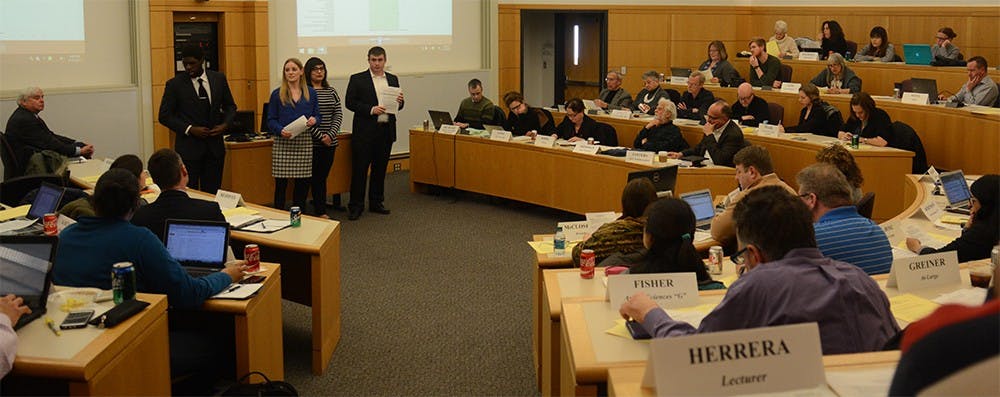
“Students are the lifeblood of this campus,” BFC committee member Scott Shackelford said.
The BFC, comprised of three types of committees of IU Bloomington faculty members, students and professional staff, exercises legislative and consultative authority over a variety of student and faculty issues.
According to Shackelford, everything that his committee and the BFC do “ultimately boils down to enhancing the student experience.”
With the BFC Campus Sustainability Advisory Board’s contribution to the Energy Challenge competition and the BFC Teaching and Learning Spaces Committee’s efforts to improve classrooms, committees are working toward Shackelford’s goal.
Within the Council are 13 campus committees, five elected committees and more than a dozen standing committees. The three types of committees differ in the ways that members join and the ways in which meetings are held.
The five elected committees handle issues ranging from athletics to faculty misconduct. These committees are formed as the BFC elects members from a slate of nominees prepared by the BFC Nomination Committee.
The standing committees focus on matters like student affairs, budgeting and diversity among students.
Typically, campus committees are convened by administrative offices. These committees are composed of volunteer members and BFC-nominated council members who serve as faculty representatives. Campus committees include the Campus Sustainability Advisory Board, the Transportation Policy Advisory Committee and the Teaching and Learning Spaces Committee.
“The Campus Sustainability Advisory Committee and IU Office of Sustainability have worked directly with a large number of amazing students in developing programs that have both improved our campus and also had very positive impacts in Bloomington,” faculty co-chair Tom Evans said.
But Evans said the benefits do not cease at senior year.
“Working with students to improve the way that resources are used on campus can have both direct short benefits as well as long-term impacts as students take sustainability-oriented practices they learn at IU with them after they graduate,” Evans said.
Sustainability is a theme among campus committees, as Shackelford said, the Transportation Policy Advisory Committee seeks to provide and promote “an array of walkable, bikeable, and mass transit transportation options that are laid out in a sustainable and integrated way and that interface well with Bloomington.”
Whitney Schlegel, a member of the Teaching and Learning Spaces Committee, also draws from the natural setting of the university when working with her committee.
“We are fortunate to teach and learn on one of the most beautiful college campuses and it seems only fitting that we should aim to employ the same sense of inspirational space to our formal and informal learning spaces on campus,” Schlegel said.
Much like Evans, Schlegel focuses on fostering a bright future for students. She said her committee recognizes that “how and where we educate is as important to our students’ future, our future, as what we teach.”
In addition, Schlegel said the committee hopes that “its work can contribute to cultivating a robust teaching and learning community readied to take on the complexity and the challenges of the 21st century.”



