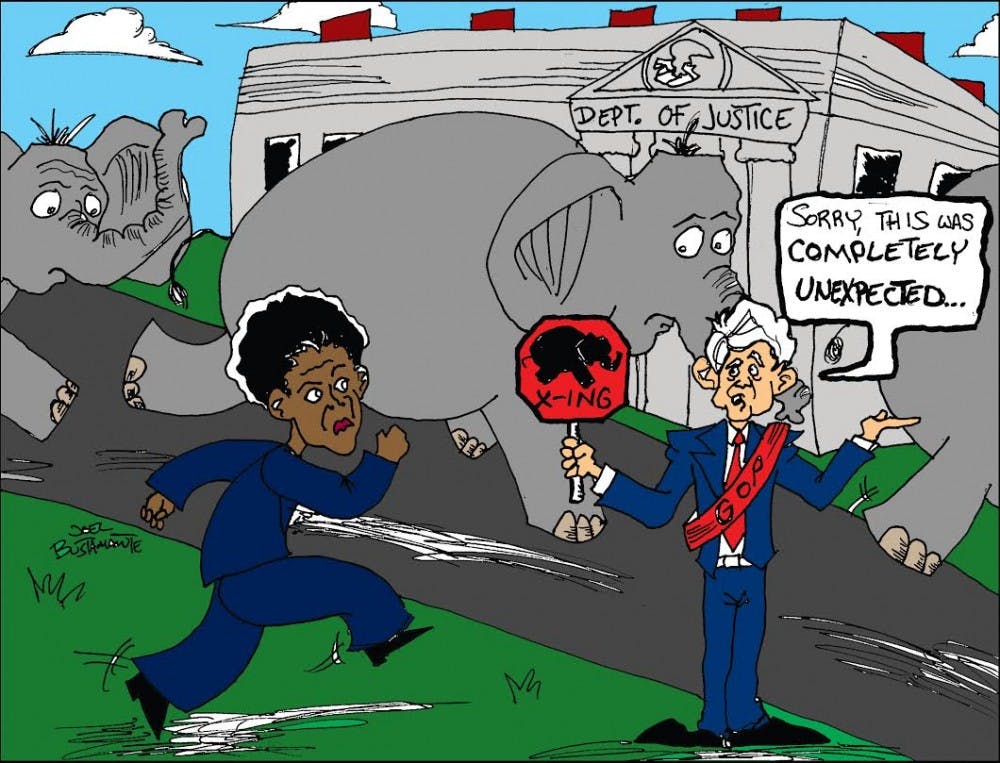
We’ve had yet another historic moment for United States leadership. Loretta E. Lynch was approved to be ?Attorney General on April 23, making her the 83rd individual to have the position and the first African-American woman to do so.
Lynch’s path to the position has been closely monitored.
While this is certainly a spirited time for many supporters, the Editorial Board is severely displeased with the various roadblocks Congress set up for Lynch along the way.
According to ABC News, Lynch has said she “hopes to have a productive relationship with Congress.”
The Editorial Board is doubtful such a relationship can develop, as the installment of Lynch as our next Attorney General has been stalled at virtually ?every possible step.
Only two other nominees to be in the prestigious office have taken longer to be approved than Lynch; Edwin Meese III, a President Reagan nomination, and A. Mitchell Palmer, a selection made by President Wilson. While Republicans have expressed a strong desire to replace Attorney General Eric H. Holder Jr., Lynch has apparently not been any more pleasing to their pallet. Lynch’s nomination has been delayed by any means necessary.
A prominent example of this is Senate Majority Leader Mitch McConnell’s seemingly inane delay until the passing of a drawn-out human trafficking bill. After weeks of back-and-forth banter, this measure passed by a vote of 99 to 0.
The Board believes Lynch has become — much like many of her contemporaries — a pawn in the grand scheme of American political operations. Lynch highlights the endless tug-of-war between Republicans ?and Democrats.
Perhaps most significantly, this debacle with Lynch’s nomination foreshadows how partisan politics will play out during the 2016 election.
Senator Ted Cruz, a prominent 2016 presidential candidate, represents what we feel to be an irrefutably far-right America. The Reagan-worshipers of yesteryear will be joined by a new wave of young voters that have a distinctly conservative view of our ?country’s future to help secure a tea-party approved America. Cruz has threatened Lynch’s nomination, calling her “lawless.”
These extremely divisive politics will continue to be a disservice to ?America’s development.
A powerful push by contemporary Republican leaders has left America with a remarkably un-diverse set of choices for the next election; more than likely, the American public will be able to choose either an extremely far-right conservative leader or a moderate.
Much of the disapproval the Republican Senate shares for Lynch stems from her connections to ?President Obama.
Although individuals such as Obama and Lynch are believed by many to disprove the relevancy of race in modern American politics, GOP responses to either individual could not prove this ideal more wrong. Throughout critics’ vicious attacks on Obama and his politics, the discussion of racism inevitably rises to the surface.
In the case of Lynch, it is perhaps ?no different.