If you’ve paid any attention to the news within the last few months, chances are good you’ve heard all about Edward Snowden, the National Security Agency surveillance agenda he leaked and the privacy versus security debate.
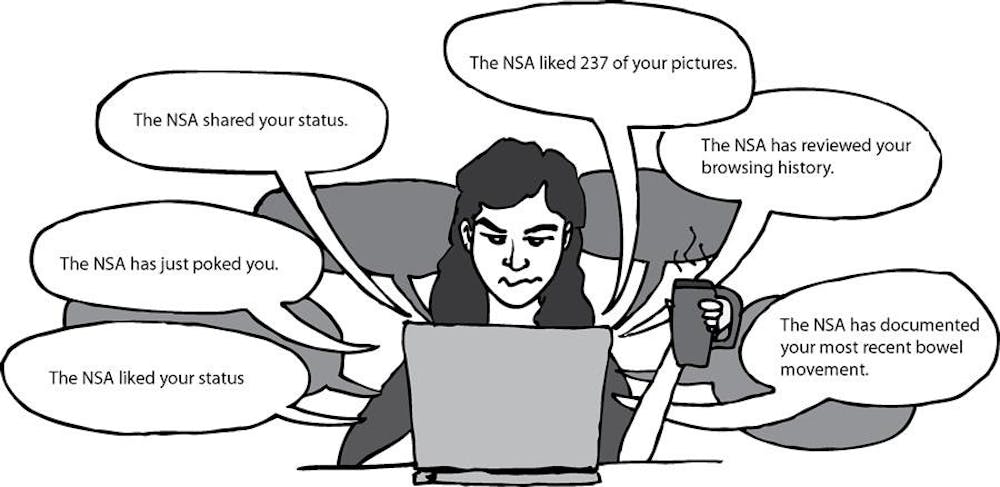
In fact, if you’ve talked to anyone else about your thoughts on the matter, chances are good the NSA collected that data and evaluated it for potentially threatening content.
The Huffington Post reported last week the NSA collected the contact lists of around 440,000 personal email and IM accounts every day in 2012. Furthermore, France has declared outrage at 70 million French telephone records and text messages the NSA has gathered for review.
It has been difficult to gauge just how shocked we all should be in light of the mystery and vague equivocation surrounding the scandal, but a question remains. Isn’t that how it’s supposed to be?
When the Washington Post reported the NSA had partnered with the CIA drone strike program to read the private email exchanges of a prominent Al-Qaida member, pinpoint his location and kill him, they were told by government officials to keep certain specifics under wraps because revealing details could jeopardize current and future missions.
Remember Ben Affleck’s “Argo”? Now imagine how differently it could have ended had the government been forced to divulge all details to the press.
In America, a freer country compared to the rest of the world, publicity is the price we pay for publicity. Everything we do now in the wake of the technological revolution is online, recorded in someone’s news feed, computer history or spam filter.
Our generation has grown up with the adage that what happens on the Internet stays on the Internet, whether you’ve deleted it or not, and when none of us bother to check the privacy settings on our Facebooks, it’s more than a little selfish to hoard meaningless emails and texts when the accessibility of that data could be saving lives.
It is true the data collected by the NSA is less effective than traditional law enforcement methods. Since 2001, jihadist extremists have organized 42 terrorist plots on American soil. Nine came to fruition and 33 were stopped before harm could be done. Of those 33, 29 were neutralized with means of intelligence outside the NSA.
But four attacks were halted. The lives that could have been lost in those four cases were saved via data collected by the NSA’s surveillance program.
The senseless violence of terrorism claims lives daily. The extensive data collection isn’t ideal, but Americans cannot let our sense of entitlement stand in the way of reducing the worldwide body count.
Nobody likes compromise. This month’s shutdown proved that much.
But freedom isn’t free, and as citizens of a world governed by the shockingly public Internet, adding our meager personal data to the millions is a small price to pay for life.
— opinion@idsnews.com
Follow the Opinion Desk on Twitter @ids_opinion.
NSAble
WE SAY: whether you like it or not, the NSA protects our freedoms
Get stories like this in your inbox
Subscribe