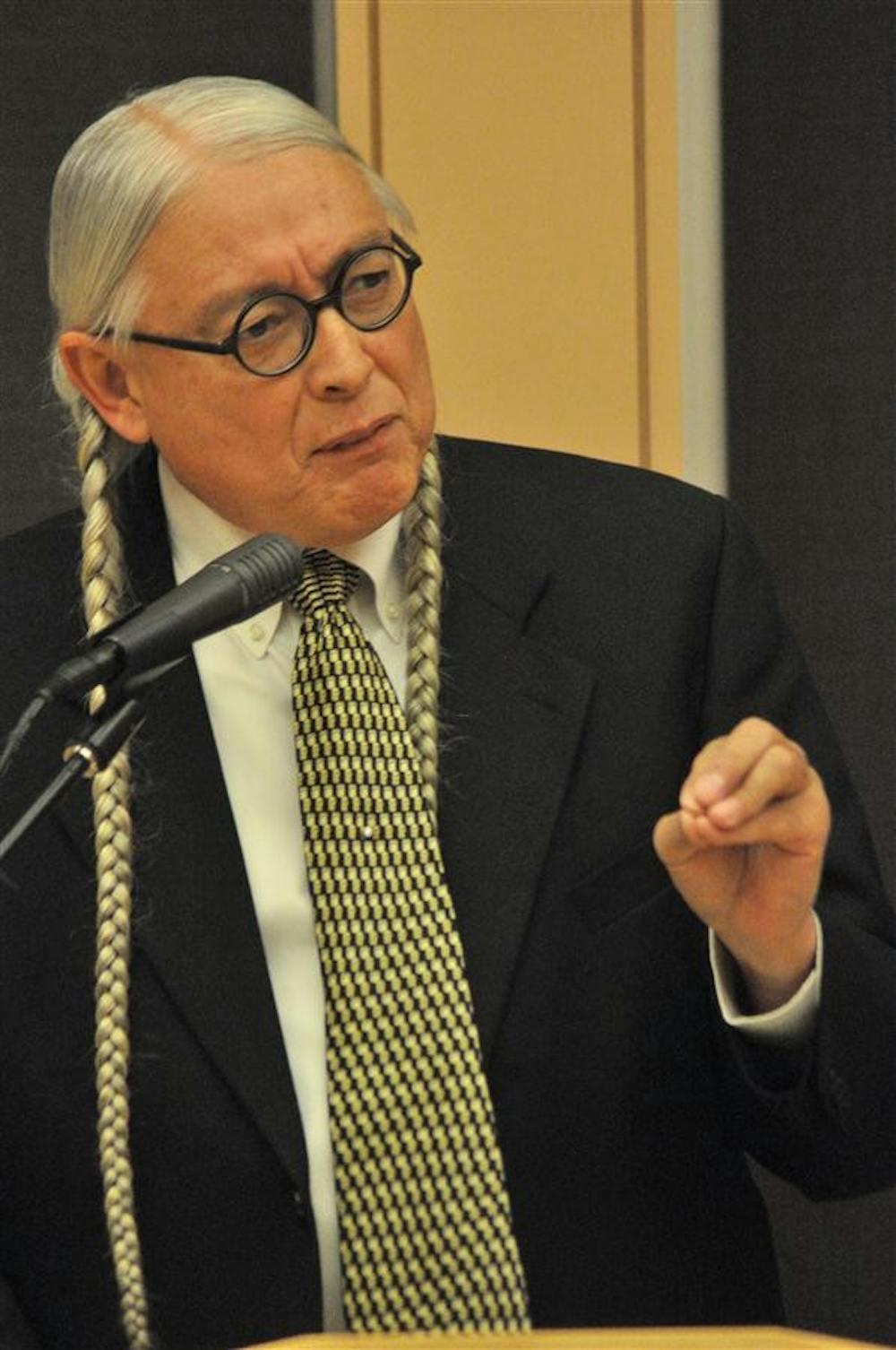
Ethics and human rights were topics discussed by Walter Echo-Hawk, a Native American attorney, at the Neal-Marshall Black Culture Center Wednesday night.
Echo-Hawk’s lecture was part of the College of Arts and Sciences’ fall 2012 Themester, “Good Behavior, Bad Behavior: From Molecules to Morality.”
“I think it is vitally important for every student, every attorney to consider ethics in your education no matter what your major might be,” Echo-Hawk said.
Echo-Hawk said he has had the opportunity to reflect on core values and ethics as an advocate for native people.
“That sense of right and wrong which helps us human beings distinguish what is right and inherently bad,” Echo-Hawk said. “We need our moral compass to help us get through this life.”
He also said there is relevance of ethics concerning the day after the elections.
“I think that this election is a good time to take stock as to where we are,” Echo-Hawk said. “It’s timely to take a look at ethics to the treatment of indigenous peoples, as well.”
Echo-Hawk discussed the United Nations Declaration on the Rights of Indigenous People.
It highlights the self-determination of all people and says indigenous people should be free from discrimination.
“It really is one of those very rare landmark happenings that only comes along rarely in the course of history that promises to change the world,” Echo-Hawk said. “It lays out minimum human right standards for indigenous people for their well-being.”
Echo-Hawk discussed cases featured in his book, “In the Courts of the Conqueror: The 10 Worst Indian Law Cases Ever Decided,” such as Johnson v. McIntosh, where the United States Supreme Court looked to the doctrines of conquest and ruled that Indian tribes do not have legal rights to their land.
“Non-Indian judges have to cross a mysterious cultural divide to consider cultural issues,” Echo-Hawk said. “It’s very difficult to do. They aren’t Indians.”
He said one cannot reasonably expect justice when the doors of a courtroom are closed. Echo-Hawk also spoke highly of the U.S. judicial system.
“It’s that separation of powers that keeps us free as a people,” he said. “There are many safeguards to make our system impartial, so that we can make fair decisions handed down.”
Echo-Hawk said the legacy of unethical treatment can be seen in Indian
reservations.
“In the native rights movement, we have the legacy of conquest and colonialism,” he said.
Echo-Hawk said there is now a more ethical foundation for rights than they’ve seen during colonialism.
“Our rights as indigenous people are inherent rights that are unalienable rights that arise from our cultures and nationhood,” he said.
Echo-Hawk said the current challenge for students is to work in collaboration with native people for human rights.
“I think the advent of this new U.N. declaration framework gives us a new event that we can shoot for and stand in the light of justice,” Echo-Hawk said.
Attorney reveals cultural issues
Get stories like this in your inbox
Subscribe