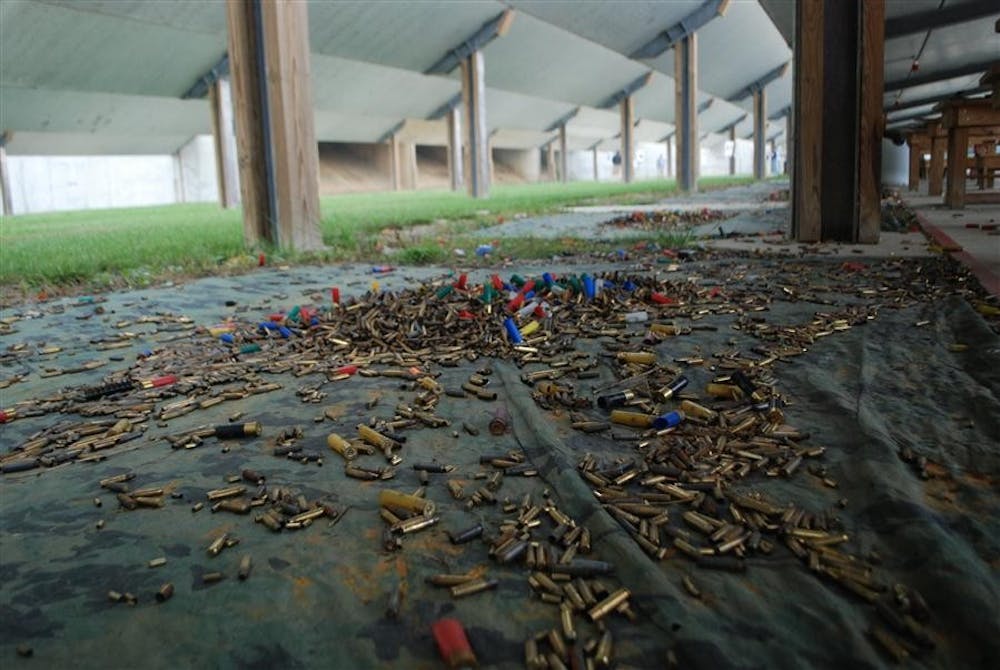
The smell of gunpowder filled the chilly air as blasts from an assortment of firearms penetrated the wax earplugs given for protection.
To the right, at Atterbury Shooting Range in Edinburgh, Ind., seasoned shooters practiced with military-style rifles and handguns.
To the left, participants in the Indiana Department of Natural Resources’ Hunt, Fish, Eat program practiced with shotguns, some taking aim for the very first time.
Spearheaded by Division of Fish and Wildlife Restoration biologist Scott Salmon and Hoosier Outdoor Heritage Coordinator Amanda Wuestefeld, the program was a four-session course designed to teach anyone 18 or older to hunt whitetail deer. It taught everything from shooting a gun or bow to the basics of removing the deer’s internal organs.
The four sessions spanned Sept. 20 to last Thursday and covered information about hunting seasons, safety, equipment and obtaining hunting licenses.
Hunting education courses are required for anyone born after 1986 who wants a hunting license, so the event was geared toward people looking for a broader introduction to the sport before obtaining a license, Salmon said.
Wuestefeld, who has worked for the DNR for 16 years, planned the activities for the program and arranged for the speakers and facilities.
Three of the sessions took place at the Monroe County Fairgrounds with one session at Atterbury.
Speakers included a conservation officer, a state deer biologist and a waterfowl research biologist.
“It’s not something where you go to the store, go buy a gun and go out and get a deer,” Wuestefeld said. “It’s all about practice.”
The main value she wants participants to take away from the program is the camaraderie. People hunt for food and entertainment, but it’s a social thing, she said.
After the first two sessions at the fairgrounds, which covered archery, safety and licenses, the group met at Atterbury to practice with firearms. They were given 20-gauge pump shotguns and were warned to always treat the guns as if they were loaded.
Each participant paired with a more experienced range officer and shot at targets 50 yards away.
Chief Range Safety Officer Cary “Buzz” Arney patrolled the range, announcing a 10-minute ceasefire after every 20 minutes of shooting.
Arney was a door gunner on a helicopter that was shot down in Vietnam. He has a Distinguished Flying Cross and a Purple Heart. After the war, he worked at the Indiana Bell Telephone Company for 33 years and is now “retired and just having fun.”
The program attracted people from different backgrounds with different levels of hunting experience. Self-proclaimed computer geek Bob Stockton of Ladoga, Ind., started hunting to spend time with his children. He had been hunting for a couple years but never had any actual training.
“A lot of guys go hunting to try and get a big rack on the wall,” he said. “I’m very much out for the food.”
Though Stockton hunts for sustenance, what he wants people to get out of the course is that guns aren’t bad.
“Guns aren’t bad. People are bad,” Stockton said. “Guns are amoral.”
He carries a Glock 23 pistol at all times.
Meg Nickless, an IU graduate student, took the course with her husband as part of their quest to find sustainable food sources.
Nickless heard about the class from the DNR Facebook page.
“I started thinking that hunting is something that people have been doing to provide for their families for years,” she said. “Maybe I can do that.”
Nickless said she feels hunters are misrepresented as cruel and uncaring of
animals.
“All the hunters I’ve ever met eat the meat they take, and if it’s too much, they donate it to a meat locker or to families in need,” she said.
Sports and bragging rights become part of it as people try to become better hunters, Nickless said, but that’s a good thing.
“You want to learn a clean shot so the animals don’t suffer,” she said. “If you can’t kill it, you shouldn’t take the shot.”
Following the practice at the shooting range, the program concluded with one last session at the fairgrounds, during which Salmon and Wuestefeld led an exercise that taught participants to track blood to find a deer that has been shot.
They broke into groups of three and followed different trails, ultimately succeeding in finding the “buck,” a dollar bill tucked in a plastic bag in the woods.
After the exercise, they returned to the fairgrounds community building for a presentation on field dressing, which included a video of a boy removing the organs of an elk.
Wuestefeld rewarded participants with freshly cooked venison steaks. During the previous sessions, she treated them to venison jerky, venison meatballs and corned venison, all of which she prepared from her family’s deer.
Waterfowl biologist Adam Phelps spoke to the group about the field dressing process and other procedures for processing deer.
He advised people to wear orange clothes head to toe when hunting.
“There’s not a deer out there that’s worth getting killed over,” Phelps said.
At the end of the final session, once the plates of venison steaks and A.1. Steak Sauce had been thrown away, participants were given a survey about the program and a mentor matching form.
The program will not be the last of its kind, nor will the learning end here, Salmon said. Now that they have completed Hunt, Fish, Eat, participants have the option to participate in a hunt with an experienced hunter.
“This is not a one-hit wonder by any means,” Salmon said. “We want to work with them more.”
Program trains deer hunters
DNR program teaches practical skills for sport, survival
Get stories like this in your inbox
Subscribe