
When 26-year-old Alfred Kinsey arrived in Bloomington in fall 1920, he was a virgin.
Recently recruited from Harvard University by zoologist Carl Eigenmann, Kinsey had never dated a woman or masturbated without a sincere sense of shame, according to
“Sex, The Measure of All Things,” a biography of Kinsey’s life.
The only sex he studied was in the variation of gall wasps’ reproductive organ sizes.
Eighteen years, 160,000 galls, six articles and two books later, Kinsey was reputable in the scientific world and an esteemed faculty member. He was also a successful lover to his wife, Clara Kinsey, and adamantly sexual.
It could have ended there, but in 1938, two events altered the course of his life.
Herman B Wells became president of the University and “Forbidden,” a sex education film, stimulated strong student interest in an honest and accurate sex education course.
The pro-sex education course tack was taken strongly by the Indiana Daily Student in the form of decisive editorials. The Association of Women Students approached the new president and persuaded him to ask Kinsey to teach the course.
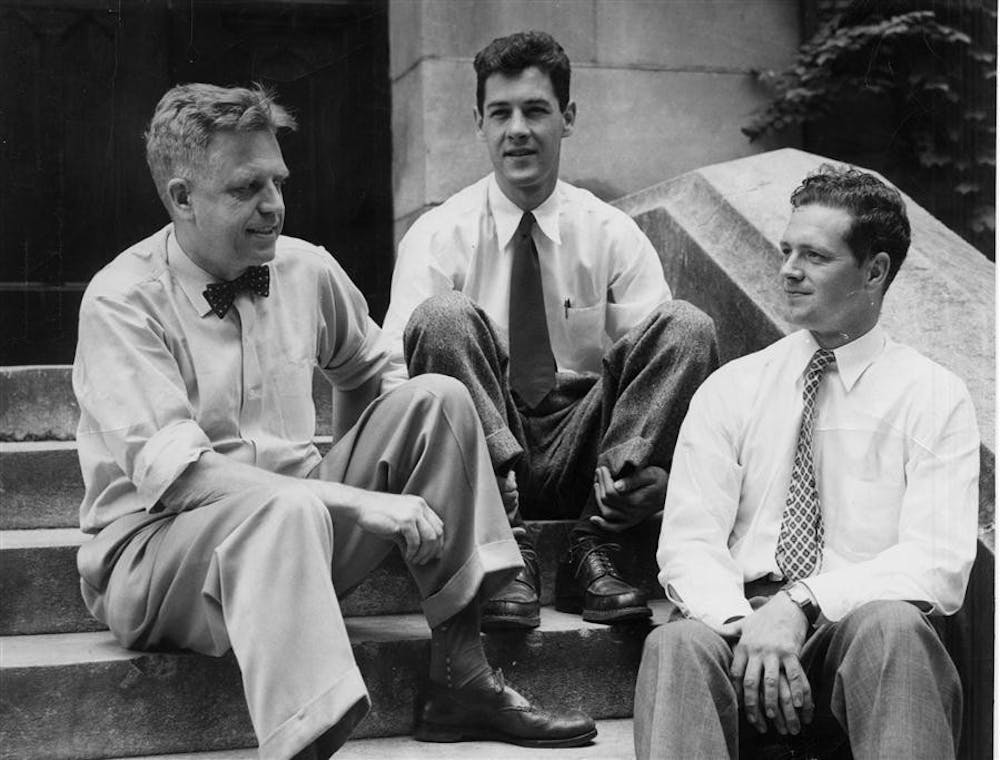
Without IU students, Kinsey’s controversial sex research and the wave of sexual liberation that followed might have never happened.
The students who had rallied for the course packed the classrooms, promoted Kinsey’s unconventional teachings and were the first sexual history interviews Kinsey conducted.
The nonprofit Kinsey Institute in Sex, Gender and Reproduction, established in 1948 and largely funded by the University, is linked to his relationship with IU students.
Kinsey died in 1956, and what followed was nearly 40 years of detached, closed-door research at the Kinsey Institute, said Catherine Johnson-Roehr, the curator of art, artifacts and photography at the Kinsey Institute.
Nestled in the upper floors of Morrison Hall since 1967, the Kinsey Institute lulled into a period of quiet sex research and publication, a stark contrast to its public heyday when the sexual behavior books were published in 1948 and 1953, Johnson-Roehr said.
“We had a little desire to be hidden because some people didn’t like what we do,” she said.
But as the conservative movements to denounce Kinsey waned and public discourse about sex increased, the Kinsey Institute’s role in informing the discourse once again became important, Director of Communications Jennifer Bass said.
During the mid-1990s, John Bancroft became director, and the Kinsey Institute began to reconcile its relationship with the Bloomington campus, Johnson-Roehr said.
“John Bancroft had a British philosophy that being more open is a good thing for the institute,” Johnson-Roehr said. “Opening the institute would be demystifying and show its personable nature.”
The Kinsey Institute’s social liberation began in 1996 with the online presence of its first website.
Bass had recently joined the Institute, and like Bancroft, she believed a public presence and inclusion, especially with IU students, was necessary.
Working with the online site, Bass developed The Kinsey Institute Sexuality Information Service for Students, an online resource for IU students and the precursor to Kinsey Confidential.
“We had all this information and all these students on campus, and we had the opportunity to give back,” Bass said. “There is a need for and a lot of information about sex on the Internet, but not all can be trusted. We knew we could give a trusted source.”
The administration helped establish a campus presence in 2000 with the opening of the Kinsey Institute to public tours that continue to this day,
The Institute also opened its extensive library and collections to students and
faculty.
Johnson-Roehr began at the institute in 2000 and was assigned to showcase the institute’s vast cultural collection of 100,000 sexual and erotic items in exhibitions, the first of which opened in 2002 to great public interest.
“Kinsey began the collection thinking that someone made it, someone bought it and someone kept it, so these items had importance to society and says something about human beings,” Johnson-Roehr said.
Though the institute does not offer courses to students, receptionist Pat Lacy sees students, faculty, researchers and classes walk the institute’s three floors daily.
“We have tremendous archival materials in the library and art departments, and today, a lot of IU classes from all studies come to see the art, or faculty members use our resources as a teaching tool,” Lacy said.
Following the release of the 2004 Hollywood documentary “Kinsey,” the institute strives to be involved in panel discussions, Themester events and IU Cinema screenings.
“Today, we are actively trying to convince students we are here for them,” Johnson-Roehr explained.
However, this has become increasingly difficult for the institute that long ago outgrew the space in Morrison Hall, Johnson-Roehr said.
The people who run the institute feel a connection to the University and have no plans to take it from Bloomington, Johnson-Roehr explained, but with fewer grants and University funds due to the recession as well as no funding allocated for advertising, its physical presence can be lost on such a large campus.
While those at the institute wait and hope to one day secure enough private funding to build a new location, it remains open for students every week day.
It’s a subtle reminder that without student interest, Kinsey’s legacy could well be limited to the shadow boxes of gall wasps he cherished for 18 years.
Kinsey’s success connected to students’ enthusiasm
Get stories like this in your inbox
Subscribe



