The 2012 Academy Award nominees for Best Costume Design elicit eras from the 16th century to the 1930s and span works from mature designers such as Sandy Powell to newcomers Lisy Christl and Mark Bridges. Let’s tour their platforms and place our bids before the big night unveils this year’s valiant victor.
1. Mark Bridges, “The Artist”
Style is most essential in silence, so Mark Bridges’ designs for silent film “The Artist” had to speak loudly. His second feat? Bridges had to create the colorful world of 1920s Hollywood without exactly that — color. To fill the two voids, Bridges’ designs were all about contrast and texture. Sure, he had to wonder how tangerine would look in black and white, but he also sought to sculpt a scene that’s visually appealing to modern moviegoers. Though nothing is too lavishly construed, some simple pieces say quite a bit. My staple pick is the white-laced headband worn by Peppy. Though nothing extravagant, the white band, along with many of her headpieces, creates an essential contrast to her otherwise dull cut. These simple efforts land Bridges as my top pick.
2. Sandy Powell, “Hugo”
No particular item strikes me as salient or brilliant in Sandy Powell’s costume creations for “Hugo.” But paired with the undaunted cinematography, the selective use of color gives the film an animated quality comparable to what we saw in last year’s winner, “Alice in Wonderland.” The picture is carried not by ludicrous Mad Hatter-esque vibrancies, but by subtle selections. Although I feel more vivacious hues could have added an element of energy to the tale, the dexterous Powell knew exactly what she was doing. Her recurring patterns of selectively colored stripes, dots, argyle and plaid with textures exaggerated the characters’ movements while maintaining the 1930s-Paris essence.
3. Lisy Christl, “Anonymous”
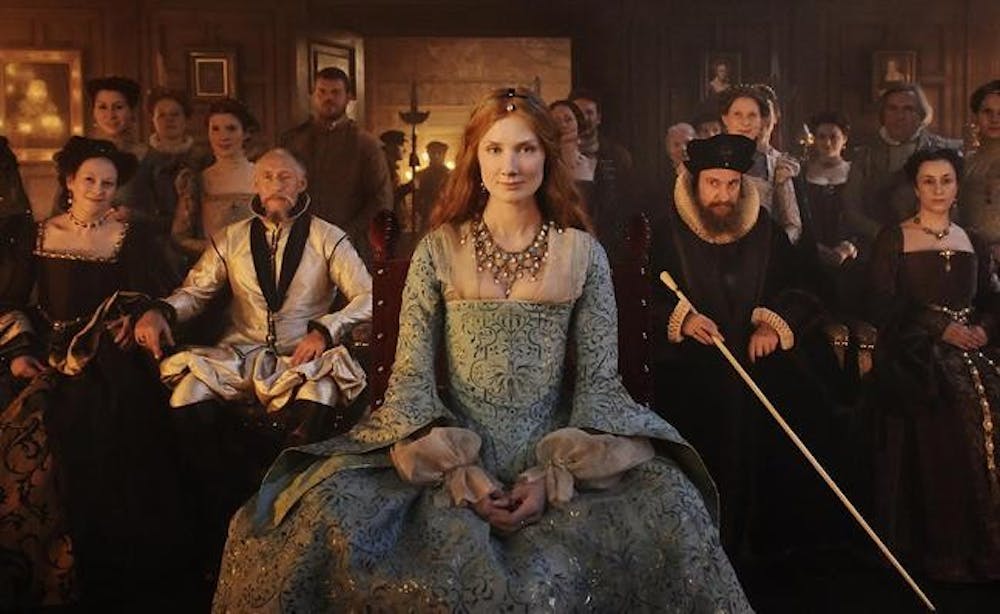
Lisy Christl’s designs are indulgently overwhelming. To compliment an exaggerated Shakespearean plot, Christl exaggerated colors, collars and non-colloquial dresses to earn her first Oscar nomination. Unlike similar reproductions of 16th century fashions, Christl truly implemented her taste into the outfits initially drawn from portraits of the era, including the 1588 “Armada Portrait.” Her work arguably surpasses any adaptation to date; however, her designs’ high standards didn’t seem to parallel those of the cast. The labeled mediocrities unfortunately didn’t fit Christl’s colossal visions, landing her third on my list.
4. Arianne Phillips, “W.E.”
For Pop-Couture readers, we knew this was coming. How could it not, when the jewelry alone in “W.E.” plays as much of a role as characters Wallis Simpson or King Edward VIII. With 1930s royal replicas influenced by visits to the Metropolitan and Louvre, the delicately constructed pieces speak for themselves. However, costume designer Arianne Phillips’ fine portrayal might have left too little room for her own presence in the work, which is the flaw that placed her work nearly last on my Oscar listing. Nonetheless, the designer’s bold yet elegant outfits perfectly illustrate couture as American Simpson’s refuge arguably turns her into the most despised woman in England’s history — an outfitted plot that certainly makes Phillips a deserving nominee.
5. Michael O’Connor, “Jane Eyre”
Michael O’Connor’s mode, like Eyre, is poor and plain but never heartless. His authenticity, possibly more than any other designer, lies with the classic 1847 novel-turned-feature film’s tale of a young governess with a haunted past. Necklines are high and buttoned, as if to hint that secrets live beneath. Even more interesting for a period piece, St. John Rivers’ outfits are just as detailed as the female lead’s. The interplay between Rivers and Eyre brings a certain fierceness to each of the characters, shown in bolder hues, as in the reds and blacks of Eyre’s cloak. It’s suspenseful but softly realistic to reflect the truthful nature of the age. However, I felt no part of O’Connor’s work made a specific statement that deserved a nomination, placing him last on my list.
Pop-Couture
Get stories like this in your inbox
Subscribe