
Some were interested in studying there in the near future. Others related to the rich culture. Still others wanted to know more about the various IU collaborations made.
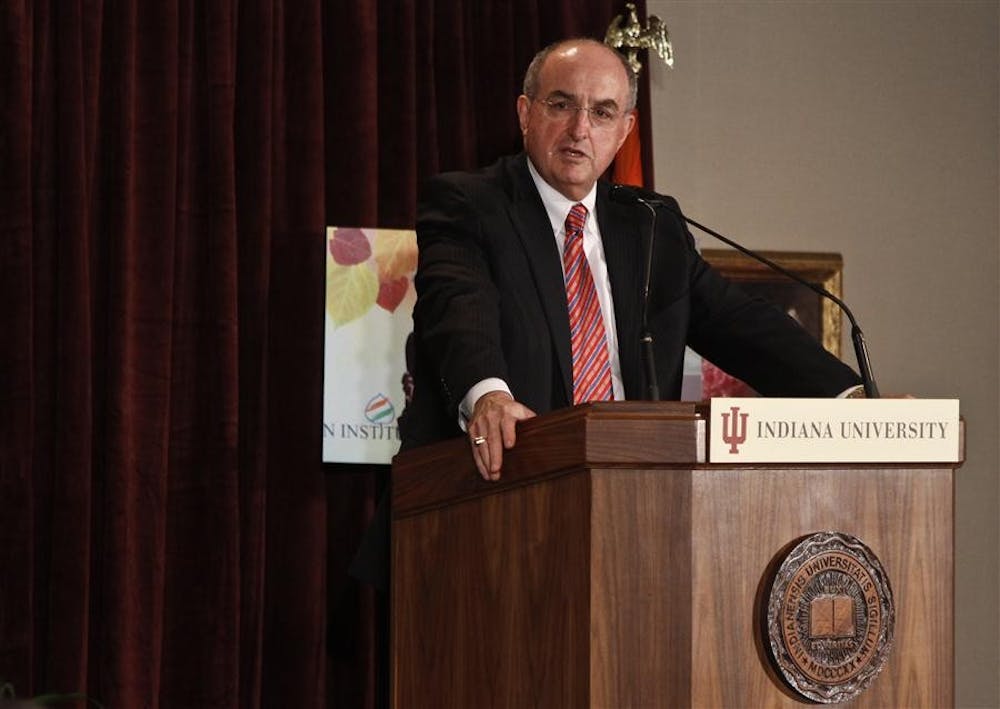
Whatever the reason, a diverse group gathered Tuesday in the Grand Foyer of the IU Auditorium to listen as President Michael McRobbie spoke about his recent trip to India.
David Zaret, vice president of international affairs and part of the delegation to India, introduced McRobbie to the crowd clustered before him.
This presidential forum was co-sponsored by Zaret’s office and the Department of India Studies, he said.
“This visit was not a tour,” Zaret said, affirming that the delegation of IU deans and other faculty worked hard making connections each day of the two-week visit.
McRobbie stepped to the podium, flanked by an American flag and an Indian flag with photos of the delegation behind him.
Once initial applause subsided, he began by explaining that although he had stopped briefly in India at the age of four, this trip, beginning in late August and concluding early September, was his first true trip to India. McRobbie also claimed to be the first sitting IU president to visit India.
The idea for such a presidential forum stemmed from a similar event about two years prior. The administration visited Korea and invited Korean faculty and students for a reception following the administration’s return.
This time, however, McRobbie opened the event to all those interested.
He went on to explain the trip was made in an effort to maintain the standards of international engagement so important in today’s society.
“The world is becoming completely internationalized,” he said. “There’s no aspect of the world of academia not affected by international engagement.”
McRobbie said there were four main components behind the delegation’s visit: increasing study abroad opportunities, increasing the influx of foreign students to IU, supporting faculty research and establishing relationships with international institutions that complement IU.
With more than 240 Indian faculty members and more than 800 Indian students at IU, these components were particularly important in India, he said.
He cited many prominent collaborations with Indian facilities, including agreements with the India Institute of Technology in Mumbai, the inauguration of the New Delhi chapter of the IU Alumni Association and agreements with the University of Hyderabad, along with other universities.
McRobbie expressed excitement about the partnership with Infosys, a technological giant in Bangalore, India. The organization promised to include IU on the recruitment list for fellowships and internships.
“I think for IU students, this will provide an exciting opportunity to work with a very dynamic and rapidly growing IT company,” McRobbie said.
The delegation had one day off, which it used to tour the area.
“We had the opportunity to see the Taj Mahal, one of the truly remarkable architectural features of the world,” he said.
Vanashri Nargund, a Ph.D. in the School of Education, is from India and focuses on the Indian education system.
“I wanted to know more about what kinds of collaborations happened when he was in India,” she said.
The outline of the trip ended and the floor was opened up for audience questions. Concerns included IU involvement in Indian public health and collaborations with Indian arts and religion as well as those involving technology.
Nargund stepped up as well, questioning teacher training programs in India and what might be done to improve them.
“They’re trying to establish something to train the people who train the teachers,” Zaret answered.
Forum recounts lessons from India visit
McRobbie speaks about trip overseas
Get stories like this in your inbox
Subscribe



