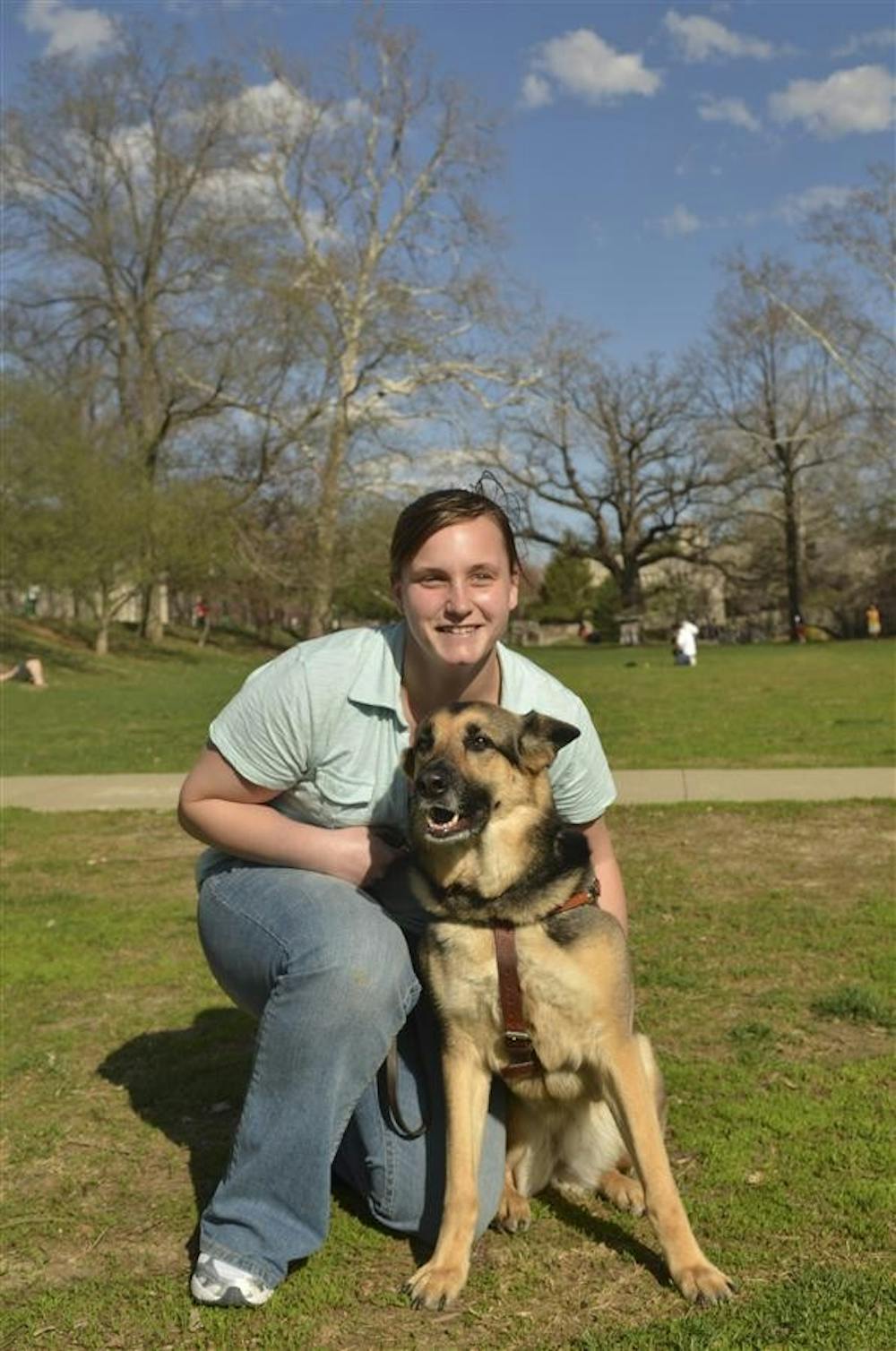
Verna is more than junior Mika Baugh’s best friend. She is her guide.
The German shepherd has been assisting Baugh for the past two and a half years as her seeing-eye dog.
“She doesn’t provide substitute sight,” she said. “She is not a GPS system. I can’t just tell her I want to go the library. I have to know where I want to go, and I have to know how to cross the streets and everything. She basically just makes sure I don’t get killed on the way there.”
These guide dogs are usually bred at one of the special schools in the United States to help the visually impaired navigate, Baugh said.
“Most of the schools are big enough that they have their own breeding program,” she said. “They live with a family for about a year and a half, and they learn basic obedience and social skills and everything then they go back to the school. They work with a professional instructor for four months, and the blind people get the dog, and we work with them with the instructor for anywhere from two to four weeks depending on how many dogs you’ve had in the past.”
Leader Dogs for the Blind in Michigan, The Seeing Eye in New Jersey and Guide Dogs for the Blind in California are some of the bigger training schools in the United States, Baugh said.
Verna, who was trained at The Seeing Eye, watches out for low-hanging branches, something that a cane isn’t capable of doing, Baugh said.
“The coolest thing I think that she does is if there is a low-hanging branch, she will look up and make sure that I don’t hit that,” she said. “That is one thing a cane won’t do. It can’t find low-hanging branches or whatever but she can.”
While Verna isn’t a vision replacement for Baugh, who has optic nerve hypoplasia, she expedites the process of getting places, Baugh said.
“It makes the process of whatever I want to do faster,” she said. “She goes to class. She goes pretty much everywhere except for an amusement park. She goes to
restaurants and stores and on the bus, just wherever I go.”
Seeing-eye dogs are allowed in any establishment under U.S. law.
“Every now and then you get people who want to try to tell you that you can’t come in,” she said. “Most of the time you just tell them this is a law and then they look at you funny but then they let you in because they really don’t have a choice.”
Baugh said having a guide dog is an interdependent thing.
“She relies on me for food and companionship and shelter and everything,” she said. “I rely on her to make sure that I don’t run into a light pole, so it is a mutual relationship. I think a lot of people think sometimes that the dog takes care of the blind people, which isn’t the case.”
The owner has to be able to do basic things like crossing a street before they are able to have a seeing-eye dog, Baugh said.
“The person that is handling the dog needs to know where they are going and how to get there and how to negotiate traffic and such,” she said. “It is just there to make sure things are safe and dogs don’t ‘take care’ of the blind people that they work with.”
While Baugh got Verna following her high school graduation, senior Ignasi Cambra, who has been blind since birth, got Pavot at age 14 in 2004.
Pavot was the first guide dog in Europe given to someone younger than 18,
Cambra said.
“In the U.S., most of the time they will not give dogs to people under 18,” he said. “I got this dog when I was 14 because the foundation, Mira, has this program that gives dogs to people who are underage. Supposedly, many people who are underage are not able to take care of a guide dog.”
Pavot is trained in French so all the commands are in French, Cambra said.
“The commands the dog has are such as go forward, stop, left and right,” he said. “It is fairly simple.”
Cambra said as time passes, the dog will learn how to get to a place.
“Basically, what the dog will do is avoid obstacles and find things,” he said. “The dog is not supposed to know where it is going, although many times they do. If you go to the same place every day or very often, the dog will pretty much know where it is going.”
Blind students, guide dogs depend on each other to get where they’re going
Get stories like this in your inbox
Subscribe