
Jacob Medlin wakes up at 10 a.m. The strong smell of his coffee starts to wake him up as he heads downstairs to the basement.
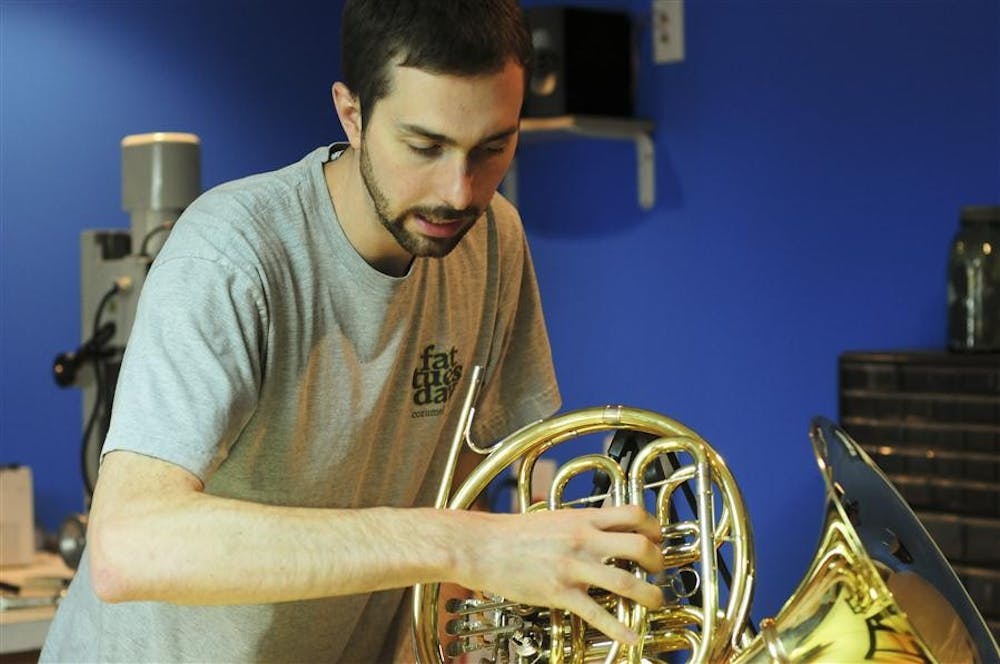
Standing at a large wooden table in his bright-blue University of North Carolina-themed workshop, Medlin continues his work, bending metal tubing by hand into an assortment of shapes and angles.
He has almost completed building one of many French horns for the year. But this horn isn’t for a regular customer. It’s for his childhood idol, Duane Dugger, third chair horn player for the Cincinnati Pops.
***
Medlin has always had music in his life. He remembers, at the age of 13, receiving a cassette tape of the Cincinnati Pops playing the themes to Star Trek. One of the horn players was none other than Dugger.
Medlin had no idea that 13 years later the musician he idolized so much would be looking to him for help.
Growing up in North Carolina with a French horn player for a father and a clarinet player for a mother, Medlin’s decision to play an instrument was obvious.
Choosing bass clarinet, mostly because his elementary school did not offer horn, Medlin was content with his choice of instrument. That was, until his middle school auditions.
Standing in front of his sixth grade band director, all Medlin could do was squeak and squawk. Because the middle school did not have a bass clarinet, Medlin said he was forced to audition on a regular clarinet.
“I admittedly was terrible,” he said. “That’s when the band director told me I was crappy.”
Although there was incentive from his band director, Medlin said his move to horn was mostly his idea. Taking lessons from his father, Medlin continued playing horn all through high school with increasing interest and talent.
Once ready for college, Medlin decided to make horn his career by declaring a music performance major at the UNC.
Finishing his undergraduate degree in 2006, Medlin started looking for graduate programs to continue studying horn. He soon found his pursuit of a graduate degree problematic, as he wasn’t getting into the programs he wanted.
“The undergraduate program I went through had a lot of turnover,” he said. “I was there for four years and had five different teachers. I was learning a new system every year, so you really don’t have a lot of continuity.”
As time went on and Medlin still hadn’t found a graduate program, he said he started to consider another interest — instrument repair. Medlin said he found repair school a good alternative if he didn’t get in anywhere he wanted.
Even though he was considering a new path, Medlin finally found a graduate program at the University of Victoria in British Columbia, which he finished in the spring of 2007.
With an undergraduate and graduate degree down, Medlin was still not satisfied with his training on the horn. So he made his move to IU to pursue his master’s in music performance.
***
Coming to IU, Medlin was assigned professor of horn Rick Seraphinoff as an adviser. Medlin soon learned Seraphinoff also happened to be a world-renowned natural horn builder (the valve-less predecessor to the double horn more commonly seen today).
Still with an interest in building and repair, Medlin started to observe Seraphinoff at work.
“One thing led to another, and soon I started working for him,” Medlin said.
While going to school full-time, Medlin was learning building techniques from one of the most well-known horn makers in the U.S. on the side. Starting out just working on repairs for the University, Medlin progressed so fast he soon was rebuilding all of the school’s natural horns.
Gaining enough confidence from working with his adviser, Medlin said he was ready to give building a horn from scratch a shot. By the end of 2008, Medlin had finished his first double horn.
“It actually went really well,” he said. “I think I mostly got lucky, but it was exciting.”
***
Now at age 26, Medlin said he is not trying to completely change the world of horn design, just the way horns are bought and built.
Right now, if you buy a horn, you get on the website or call the maker, he said. In a few weeks or a few years, depending on who you get it from, he said, you open a box, and that’s your horn.
“Because people have different jaw structures, different teeth and a whole bunch of things that make them play differently,” Medlin said, “sending someone a horn and saying ‘Figure it out’ to me is not the way to do it.”
Medlin said he works differently by keeping the musician buying the horn involved in the process.
Having the customer come and play the horn before it is finished, Medlin said, allows him to fine tune the horn to perfectly fit whoever is playing it.
Medlin said he has gotten a lot of flak from professionals about his preliminary theories of constructing a horn.
He said he has been working on changing the balance of the horn and the way the horn vibrates and projects sound. Because horn players are so traditional, he said, they don’t like change.
“People always say you just need the one horn,” he said. “I think there is room, especially with horn players of today who have to be accurate and have to play perfectly basically all the time, to make the numbers of horns people rotate through more than just one or two.”
By making changes to the horn, Medlin said he hopes to personalize each instrument for its owner and make it better suited for the style of playing it will be used for.
***
Medlin works in his shop 10 to 15 hours a day. As he works at bending the tube, he hears the humming of violins and cellos.
He begins to solder small metal braces on the tubing while there are triumphant blasts of brass horns. As he keeps an eye on every little detail, the sweet sounds of woodwinds resonate through the shop.
The songs of the orchestra are not inside his head. They are coming from the Hayden Symphony Pandora station playing on his computer.
And if he’s not listening to classical music, he’s enthralled in a world of science fiction. A world where the planets of the Milky Way Galaxy are connected to each other and to planets across the universe by a series of gates.
In contrast to the sounds of orchestral music, scenes from season nine of “Stargate SG1” flash across his TV screen.
All the time he spends on every detail of the horn, he said, is for a purpose. Medlin said he wants to make sure his horns look like he spent time on them.
“I made a decision that it mattered to me that the horn looked like I spent a lot of time on it and that it looked like a craftsman made it,” he said. “Not just like someone just bought a bunch of parts and put them together.”
In the end, Medlin said the quality of the horn outweighs any amount of time he spends. He said he could probably cut the time he spends by 20 hours if he ordered all of the parts, but that would make the horn not perfectly made for each individual.
At the end of this year, Medlin said he will have made and sold 10 horns, each selling for about $8,500.
He said this is an increase from the previous year, when he only made five, and the year before that, when he only made three.
Medlin said someday he will try to make the jump to join the more elite builders who sell their horns for up to $13,000.
Before he can do that, though, he said he needs to make his horns more prominent.
“I got my first horn in a major orchestra this year,” he said, speaking of Dugger and the Cincinnati Pops. “Originally, I thought I would be building good quality student instruments, but my approach is different enough and my horns are good enough that I’m getting a lot of feedback from professionals saying, ‘This is what I want to play, and this is what the professional world needs.’”
***
It’s a Wednesday afternoon. Medlin hears the crunching of gravel under tires as a car comes down his driveway.
The car parks, the door opens and Medlin’s childhood idol, Dugger, steps out. He has come to the shop to play the horn Medlin custom built for the Cincinnati Pops third chair horn player.
A feeling of excitement takes over Medlin at the thought of having this musician on his list of customers. As Dugger walks to the glass door and steps inside the shop, Medlin greets his idol.
He hands Dugger the horn he had been working on for weeks.
Dugger puts the horn to his lips, takes a breath and plays. Perfection.
Jacobs masters student pioneers new way of constructing horns
Get stories like this in your inbox
Subscribe



