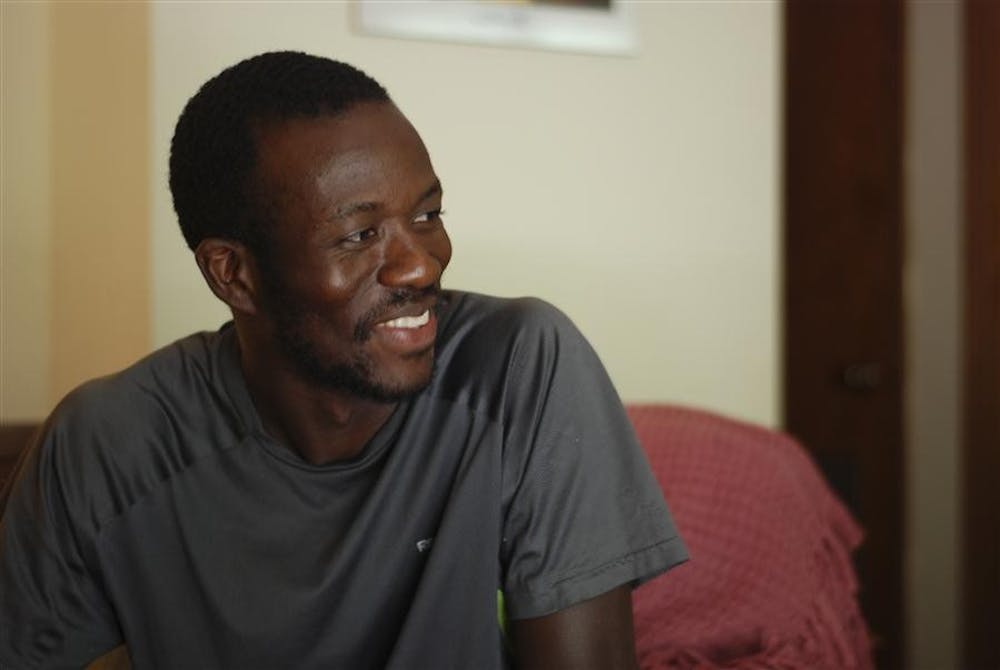
One foot forward, and Eric Beba’s mind goes back in time.
With each step 29-year-old Beba takes on his approximately 1,.000-mile journey from Savannah, Ga., to Chicago, he recalls his earlier years living in Burkina Faso.
When Beba was 7 years old, his father died while fighting in the Burkina Faso military.
After his father’s death, Beba’s life became even more difficult.
Living within the walls of a three-bedroom house in the village of Bobo-Dioulasso were more than 15 family members from his mother’s side.
Though Beba said his family was better off than many others, they were still poor.
Still, Beba admitted he was lucky: He had two meals a day, simple holiday celebrations, a pair of shoes and clothes to wear.
“I was really poor,” Beba said, “but I was happy. But it was not an easy life.”
It is not his strength or stamina that keeps him walking.
It is Africa.
“It is my heart bringing me there, not my feet,” Beba said.
With only 200 miles left after a stop in Bloomington until Tuesday, Beba has averaged about 35 miles a day since June 7, trudging from 5 a.m. to midnight — making it evident that heat and a bad ankle have yet to slow Beba down.
Mental strength
With nothing more than a backpack, walking sticks, water, an iPod playing K’naan’s song “Waving Flag,” his favorite meal (the Whopper) and a piece of cloth reading “Peace and Hope in Africa” pinned to his backpack shoulder straps, Beba is making his way to the Windy City.
The journey might not always be easy — he has been exposed to threats of gunshot and bears — but to Beba it is well worth it.
Once a gun was pointed toward Beba because of a misunderstanding.
What Beba thought was a 24-hour store was actually a house, and the owner thought Beba was attempting to break in.
And while in Tennessee, Beba had to walk through mountains, and when a local told him bears were around, he became frightened for his safety as he made his way through late at night.
A walk that turned into a mountain climb was no simple physical task: His right ankle was weaker during the earlier parts of the walk.
It was walking sticks that carried him for some of the time.
“It is more mental than physical,” Beba said. “Mentally, I just forget about how bad it is.”
Even though Beba had these unpleasant experiences, he said they were isolated incidents. As soon as Beba takes a step into a new town, he instantly becomes an anomaly and creates a stir. He said that he has received screams, horn blows and has had his photo taken with admirers.
But it is not the fleeting fame that Beba appreciates most. It is the kindness of strangers. Beba said that he has been offered places to sleep — hotels and churches — as well as food and water. Through his journey, Beba has learned of church mission trips to Africa and Haiti.
And it is this altruism that continuously inspires Beba to help the people of Africa.
“A person will not work hard if they don’t see close results,” Beba said. “My example is — if a guy is walking on a highway and he does not see anything, he will start walking slow. But if he sees a sign he will speed up. Or lights. Or a roof. I have to show my African people that hope is so close, but you just need to get there. I just need to show them the way.”
Needs of his people
Beba said he wants the people of Africa — specifically those of Burkina Faso — to change their mind-set, realize their full potential and have more hope.
“The people of Africa have several handicaps,” Beba said. “We are slaves of our own mind. We think the government should change the country, and we think that our individual efforts are not going to be much.”
About four years ago, 70 percent of people in Burkina Faso remained uneducated, Beba said, and more than money and prayers are needed — priorities must change.
Beba was fortunate. He set foot on American soil Dec. 28, 2004.
Before coming to the U.S., he traveled to Ghana to practice and study English.
He came to the U.S. thanks to his mother.
The Burkina Faso government gave his family compensation money for his father’s death, and his mother put nearly all of the money toward his education.
But Beba did not always do all he could to receive an education. While in Burkina Faso, he was expelled from school.
He went away to boarding school, but when he came back to town, he wanted to catch up with his friends and party.
School was not his No. 1 priority, and even his mother gave up on him, he said.
“I took school for granted,” Beba said. “Once I got to America, then everything has changed. I have a different perspective now. I’ve met some people that have really inspired me. And I realized, ‘Wow, this is your last shot.’ I want to go all the way to the top as high as I possibly can.”
Now education is one of Beba’s main focuses for Burkina Faso.
He and his mother are to set up a school in their village of Bobo-Dioulasso in October free of charge. Public schools in Burkina Faso cost $20, a price many residents can’t afford, Beba said.
He also said a school building is not even needed. A teacher paid $20 to $50, some shade and children yearning for knowledge are the only necessities to make this school a success, Beba said.
He hopes to start an organization, which he calls “an African Peace Corps,” that would encourage people to volunteer in their own country.
He said that through his organization, jobs will be created, children will be taught and hospitals will be built.
“We need people to love their country,” Beba said. “We will do a lot of things for Africa, for America and for world peace. ... The plan covers a lot, but yes, I can.”
With so many goals and ideas, Beba will need some help to make this all possible, including support from his family and friends in America and Africa.
But the person he wants to help him the most is none other than Oprah Winfrey.
“She has enough money to help out,” Beba said. “And she does a great job. She is really influential, and I love her.”
And with his passion, he hopes that he is destined to reach Chicago, get Oprah’s attention and help his people.
Only dedication
But before doing all that, Beba made a stop in Bloomington to stay with his friends, Teresa Lynch and Nicholas Matthews.
Lynch was Beba’s neighbor at Armstrong Atlantic State University, where Beba is getting his master’s in information technology.
When she found out about Beba’s long trek, she told him he must stop to rest at her apartment in Bloomington.
“He is so passionate and very sincere,” Lynch said. “He has such a positive attitude.”
“It’s infectious,” Matthews said.
Beba had talked about walking from Savannah to Chicago for a year before posting it on Facebook.
But once he posted it, Lynch knew he would go through with it — which concerned her.
“I knew he was dedicated and would do it,” Lynch said, “but I was worried he wouldn’t physically be able to make it. But with only 200 miles left, it is clear he will.”
Though Lynch and Matthews are supportive of his efforts, many people, including some of his own family members, do not have faith that he can accomplish all of his goals.
“The people in my village did not even believe in me,” Beba said. “They were already laughing at me when I set out to walk to Chicago, but I believe that now they have changed their minds.”
But his optimistic attitude keeps him walking and makes people notice him, Lynch said.
“Whenever he talks, it is so uplifting and sincere that you can’t help but be interested,” Lynch said. “He is the first person I have listened to speak for six to seven hours.”
Even though people from Africa to America might doubt him, Beba’s mission can’t be stopped.
“I am not playing,” Beba said. “In 2010, the mission will be the biggest thing in the world. We will not fail. What I will do will be even crazier.”
Eric Beba stops in Bloomington on walk for Africa
Get stories like this in your inbox
Subscribe