After enduring months of rising unemployment and other economic woes, Hoosiers finally heard some good news last week.
According to the U.S. Bureau of Labor Statistics, the state’s unemployment rate dropped from 10.6 percent in July to 9.9 percent in August. Indiana joined just three other states in the distinction of experiencing a “measurable” decrease in the jobless rate over this period.
This good news, however, came just days after the announcement of the layoff of 164 employees of Bloomington’s GE Consumer and Industrial Plant.
The juxtaposition of these two developments highlights an important aspect of this and previous economic recoveries, namely the role of small businesses in overall job creation.
According to the federal Small Business Administration, small businesses “generated 64 percent of net new jobs” between 1992 and 2007, and it appears that this resilient type of enterprise is, as usual, doing one of the things it does best: driving job creation.
Just as small businesses continued hiring for months after larger employers began layoffs at the beginning of the recession, recent news would seem to indicate they are also beginning to hire anew while larger employers continue to shed jobs.
This is not surprising because small businesses represent one of the most fluid and dynamic sectors of the U.S. economy.
In the same way that it is easier to turn a speedboat than it is to turn an aircraft carrier, it is often easier for small firms to nimbly navigate the treacherous waters of a recession than it is for behemoth corporations that cannot change the way they do business on the turn of a dime.
The fluidity and dynamism of the world of small business is captured by the fact that just over half of all small businesses last for more than five years.
All of this raises some important questions about small businesses in particular.
First, given the vital importance of small businesses to economic recovery, how prudent are plans currently circulating in Congress that raise the payroll tax and the income tax? Doing so could very well depress employers’ incentive to hire (keeping in mind that most small businesses pay the personal income tax, not the corporate tax).
Second, how can individuals, businesses, and policymakers capitalize on and learn from the success of small businesses to benefit themselves and society at large?
The news items mentioned above invite broader questions.
Are these improving unemployment numbers the beginning of a trend, a mere fluke, or worse, simply attributable to decisions by the unemployed to stop looking for work and thus cease to be officially classified as unemployed?
Also, what – if anything – about Indiana’s regulatory environment might have contributed to its apparent role at the forefront of new job growth, and how can such policies be improved upon here and in other states?
Finding and acting on the answers to these questions will be vital if Hoosiers hope to continue hearing good economic news in the months and years ahead.
Encouraging economic news
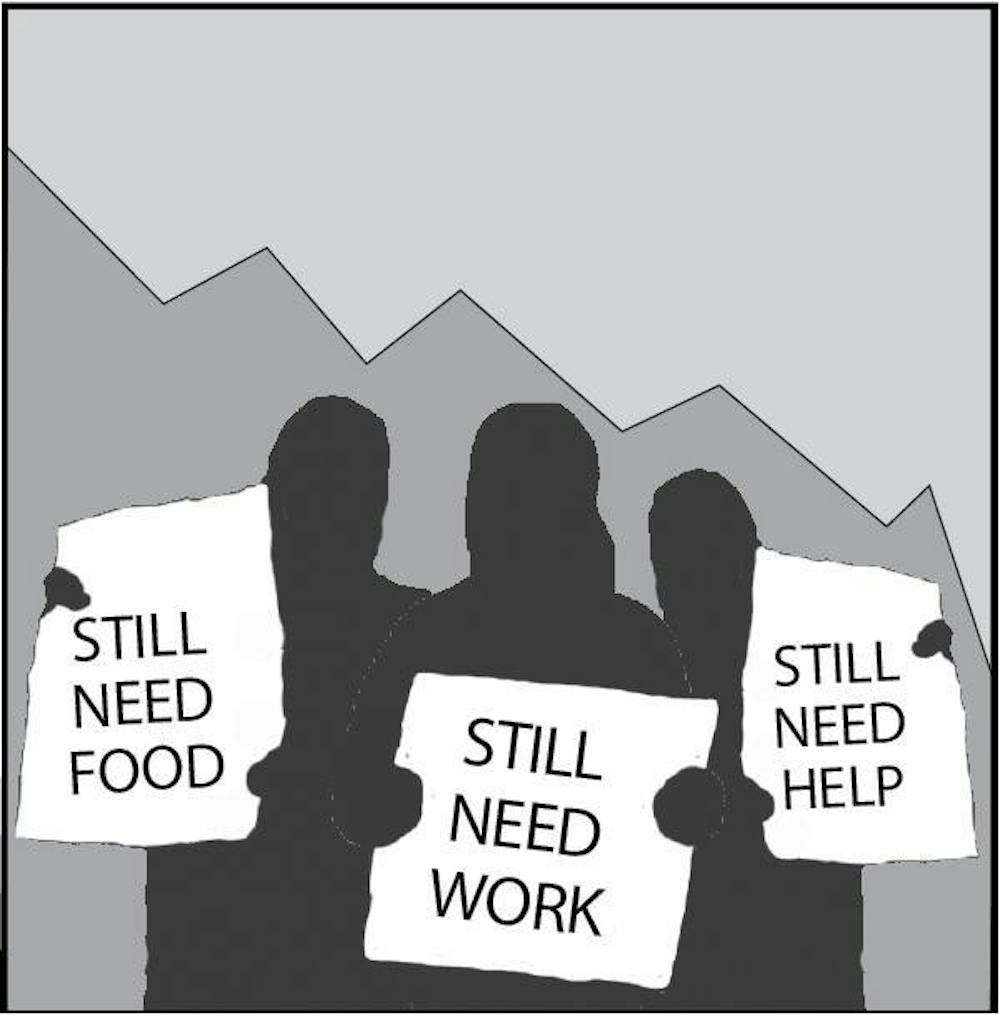
WE SAY Unemployment might be falling, but there’s still work to be done.
Get stories like this in your inbox
Subscribe