WE SAY BT didn’t act maliciously in denying atheists an ad spot.
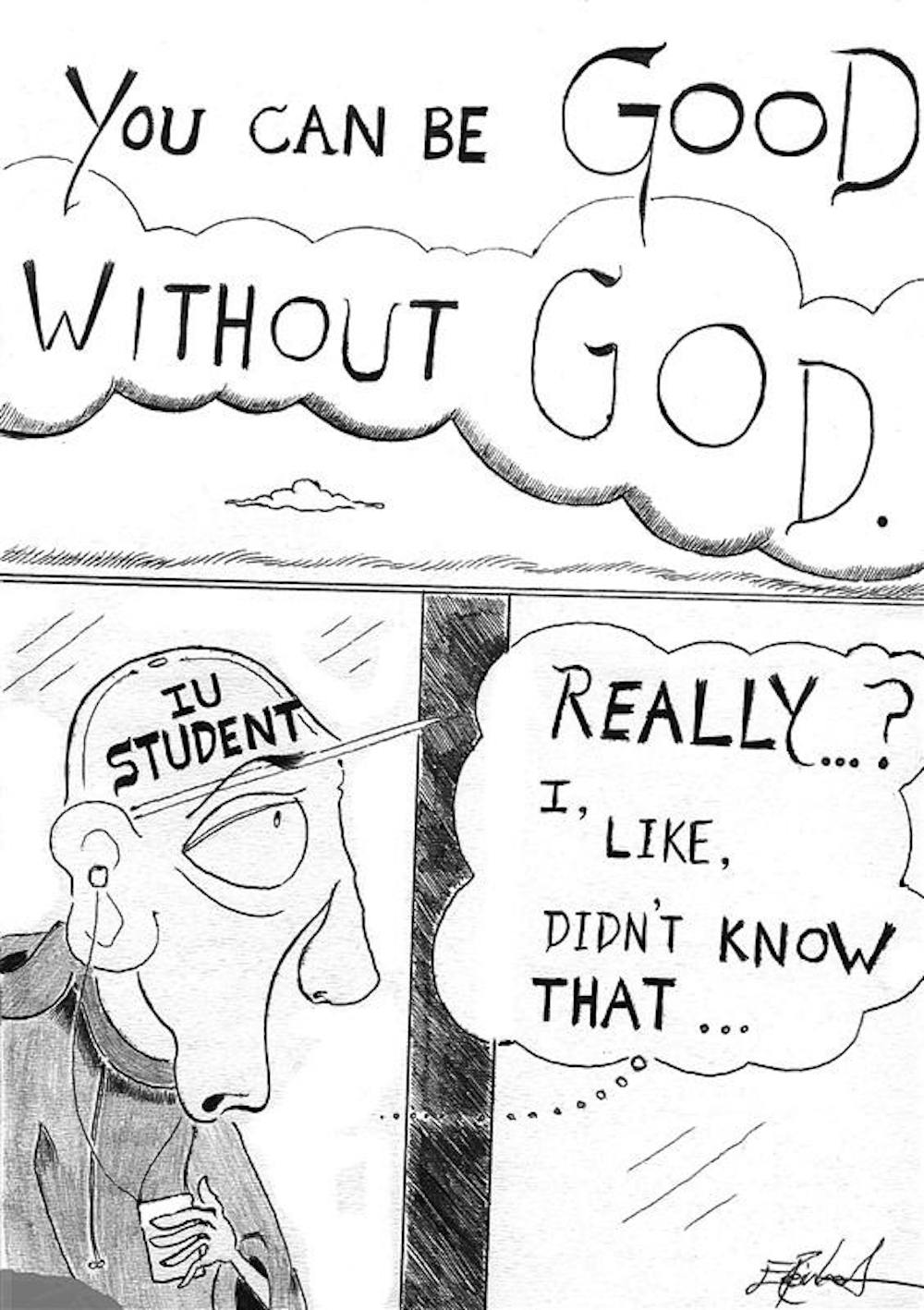
Bloomington Transit reached a settlement with members of the Indiana Atheist Bus Campaign, which filed a federal lawsuit earlier this summer for not being permitted to run an advertisement on public buses. The ad, “You can be good without God,” will be posted in the weeks to come and at the standard ad rate, according to the campaign’s Web site.
The Web site went on to hail this settlement as “a victory not just for atheism and secularism, but for free speech all around.” It’s likely that few will have a problem with the ad. In fact, on the contrary, for Indiana, it’s the most tactful religious-themed ad – far more tactful than the billboard screaming, “HELL IS REAL,” on Interstate 65.
But this wasn’t a suppression of free speech, or at least any more of a suppression than not allowing a “HELL IS REAL” ad to run on the bus. As a public transportation corporation, it’s good it has limitations on what can be advertised on buses that our collective tax money paid for.
Bloomington Transit was not malicious to think an atheist advertisement would violate its advertising policy, which bans statements for or against “controversial public issues.”
It’s not even objectively wrong, as legal justice might suggest. After all, an arbitrary hand must decide what’s controversial. And although the ad “You can be good without God” is subtle, to say that it isn’t controversial is to say that almost no one would quarrel with it. Nearly every public issue is controversial to some. Some public issues are obviously controversial – abortion, for instance – and others we all agree aren’t, such as racial equality. The issue of atheism is somewhere in between.
If the lawsuit complains about the ad policy unfairly discriminating due to being “too vague,” then it hasn’t changed anything with this settlement. Instead, we now have an idiosyncratic instance of a semi-controversial issue making the cut. But what about the next one? The “flawed” policy hasn’t changed.
For instances like these in which issues aren’t quite completely controversial or completely non-controversial, the content and language of the ad ought to be considered when deciding whether it’s too “controversial.”
Smartly, the atheist campaigners chose a noninflammatory ad that merely seeks to make a poignant statement to those who believe atheists are necessarily amoral or immoral. The ad is about acceptance. Had the campaign instead been confrontational, say, running an ad like “God is a child’s fairy-tale. Go snort some more pixie dust,” then of course more residents of Bloomington would be upset. The tone of the ad can tilt a semi-controversial issue one way or another and, therefore, should be considered as well.
Again, it’s hard to say whether the issue of atheism alone is still controversial to enough people. Obviously, Bloomington Transit thought so. But the vague policy, according to the atheists’ lawsuit, hasn’t changed. It seems they were content only with their own success. Oh well, atheists aren’t martyrs?
BT concedes to atheists
Get stories like this in your inbox
Subscribe