
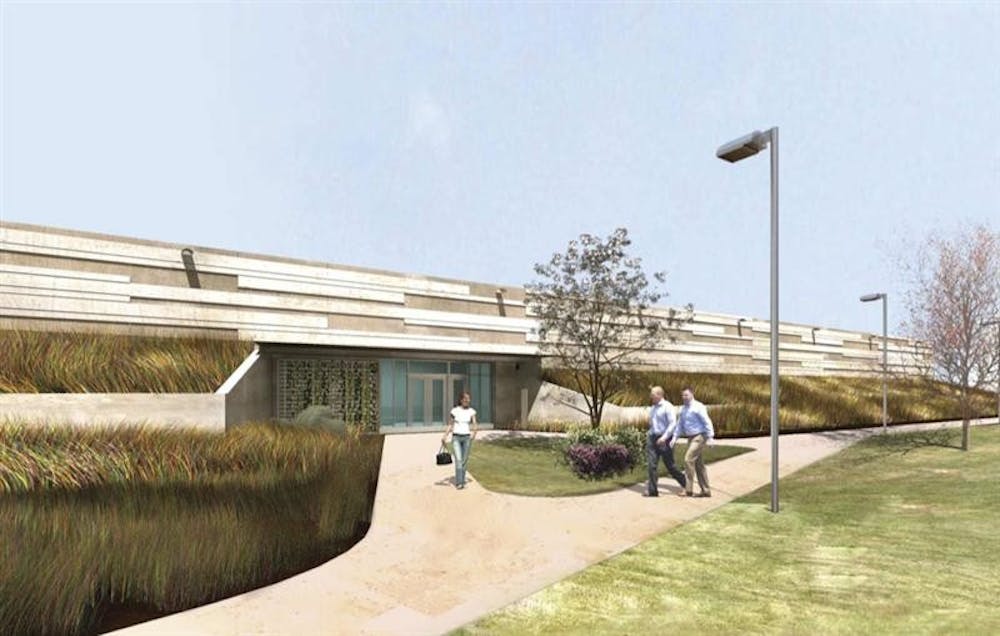
Eighty-two thousand square feet surrounded by concrete, enclosed by towering metal fences and protected by biometric security features isn’t a description of Alcatraz. It’s IU’s new $36-million data center, located northeast of the intersection of East 10th Street and the Indiana 46 Bypass.
IU’s data center, resembling a bomb shelter in design, was built for the purpose of housing and protecting crucial networking, storage and computing equipment like Big Red, IU’s world-renowned supercomputer, currently housed in an old elementary school.
The center was originally set to open this spring, but a steam leak in January pushed the date back more than six months, said Julie Wernert, a manager for University Information Technology Services. The center is now set to function by the end of 2009 but broke ground in late 2007.
In addition to stability, the new data center should also make it easier for University programs to receive federal funding and grants, said Craig Stewart, executive director of the Pervasive Technology Institute.
“The new building is critical to grant competitiveness for three reasons: security of data, continuity of service and physical security,” Stewart said. “When we write proposals to federal government agencies, one consistent criterion is ‘tell us about your physical infrastructure,’ and this center allows us to answer this confidently and with a competitive edge over other universities.”
A competitive edge in federal grant approvals may open up opportunities beyond the realm of the university. Wernert said the multi-million dollar project should create much-needed job opportunities in bad economic times.
“For every $1 million in federal grants, 40 jobs are created,” Wernert said. “Beyond our desperate need for a new facility, the creation of new job and research opportunities is the real story here.”
In addition to job creation and technological expansion, the new data center is considered a sound investment for its security and “green” initiatives. Two-thirds of the new building is supporting infrastructure, giving it enough stability to withstand an F5 tornado as well as the ability to keep lights off a majority of the time. The use of concrete throughout the structure not only adds support, but also conducts heat easily – a great energy saver for a building that must be kept at an optimal 70 degrees Fahrenheit.
“Everything in this building was built purposefully bland,” said Rob Lowden, enterprise infrastructure director for UITS. “It is meant to provide an unprecedented level of security and is strictly for functionality. Also, we are doing all we can to provide a green environment for our new technology home.”
Stewart said that even though development was set back slightly, it doesn’t overshadow the need for the center.
“This is the single most important move in three decades in terms of insuring the safety and expansion of our cyber infrastructure and intellectual and artistic output,” Stewart said. “There are tens of thousands of people engaged in research at IU, and with this new center, we are going to be able to ensure each of those individuals a safe and secure place to access and store information that is most important to them. I’m happy to see this finally taking place.”
IU’s new technology home set back by several months
New data center would increase federal grant appeal
Get stories like this in your inbox
Subscribe



