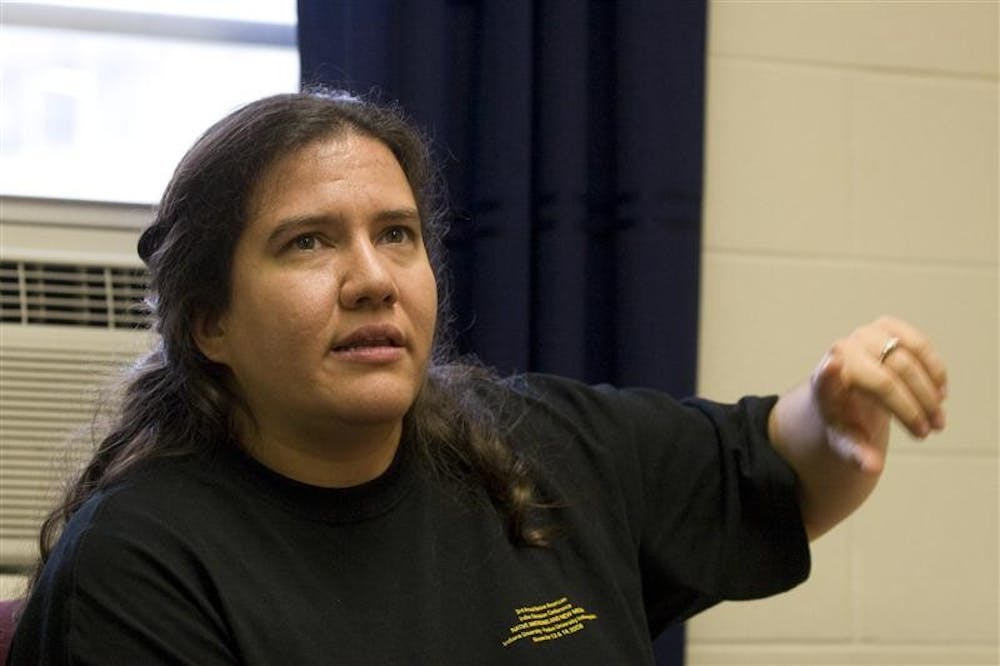
Interim director Lillian Casillas was spending a quiet Friday evening at the First Nations Educational and Culture Center when, to her surprise, in walked several students who happened to be in the building. Soon they were asking questions and spending time in the center’s study room.
“In the old place, there was no place for spontaneous traffic,” she said.
The center opened its doors from 11 a.m. to 5 p.m. Tuesday to celebrate its second anniversary and new location. The center moved from two offices on the sixth floor of Eigenmann Hall to seven offices on the second floor of Weatherly Hall at Ashton Center.
The center provides resources and support to American Indian students but is also open for public use.
“It’s a milestone, but not an ending milestone,” said Edwin Marshall, IU vice president for diversity, equity and multicultural affairs. “It’s a beginning milestone.”
Junior Nathen Steininger, president of IU’s American Indian Student Association, said the new center provides a permanent place for his group and the graduate student group to have office hours and call-out meetings.
Dean of Students Dick McKaig said for some students, it’s the first place with which they will be involved on campus. He added that the new location is more visible and will hopefully increase the number of American Indian students enrolled in the University.
“The institution provides the framework to help, and the students go from there,” he said.
Graduate student and the organizations’ treasurer Del Criscenzo-Boyer said in addition to the groups’ office hours, she hoped some of the American Indian students who teach or are associate instructors will have their office hours at the center to give more people an opportunity to go there.
Also new at the center is a computer lab, a study room and a library. Casillas, who is also director of La Casa/Latino Cultural Center, said she noticed there are students who come for the computers at La Casa and stay for other reasons. In the study room, there is an opportunity for students to have dialogues. She added she hoped the same thing would happen at the new First Nations center.
“It can be a real center where people can be and relax,” Criscenzo-Boyer said.
She said the study room can be used to hang out or just lie down and read a book.
The center is waiting for computers to arrive, but Mary Connors, the center’s program assistant, said they should arrive this week. The library is filled with books, DVDs, CDs and several periodicals available for checkout.
“It’s a good educational resource for anybody on campus or in the public,” said Connors.
Criscenzo-Boyer said the center is not as visible as other culture centers because it’s at the end of a building. But she said what happens to the center’s visibility will be the decision of the new permanent director.
Casillas said she is working to help the center create a foundation for the new director. The center will launch a new Web site, including a virtual tour of the center along with a rewrite of the mission statement. She added that the advisory committee is composed of the main leadership and has given the center direction.
During the open house, guests gathered in the hallway between the offices to listen to Johnny Flynn, director of Native American Student Alliance at IU-Purdue University Indianapolis.
“This place is about unity,” he said. “All tribes, all nations can come here and be a part of this.”
He led the group by asking each person to hold Indian tobacco in his or her left hand and pray by thinking of the worst person in his or her life and forgiving him or her.
Flynn said he would take the tobacco and create tobacco ties to burn so the smoke of the prayers will reach the spirits.
Flynn said there are many treaties in which the Indians of Indiana asked for an education.
“It’s the law of the land that Indians should get an education,” he said, “and it’s taking people like these folks down here to make that happen.”
First Nations Center celebrates 2nd anniversary, new location
Get stories like this in your inbox
Subscribe