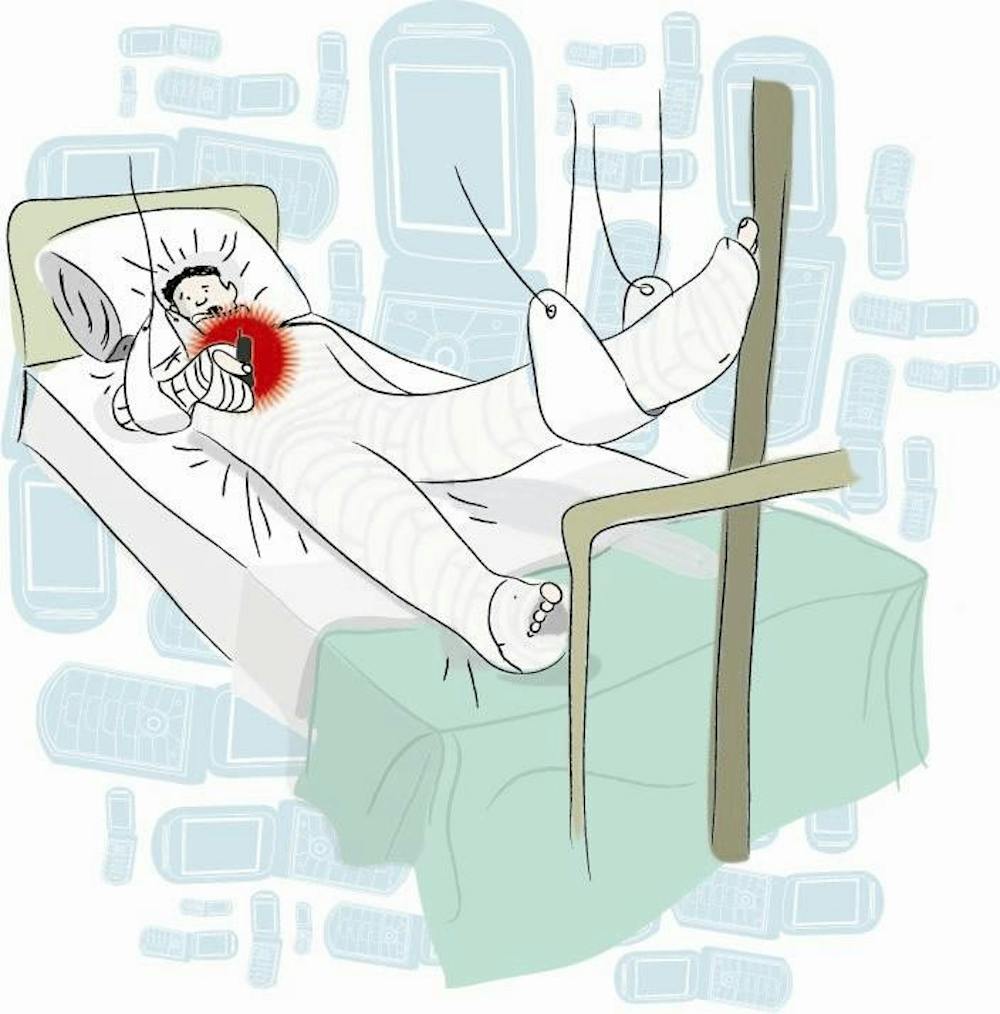
Sophomore Brooke Lichtman stepped into the stairwell of the Herman B Wells library to text her ex-boyfriend. They were fighting through cell phone messages. As she walked down the stairs, eyes locked on the screen, her foot slipped, and she plopped down one, two, three steps. The pain won’t slow her thumbs, she said.
“It was like out of a movie, and you could see the whole animation and sound effects going on,” Lichtman said, adding that she sprang back up after her fall. “It was because I was not paying attention whatsoever. Literally all I was doing was looking at my phone and texting.”
Everyone has heard that text messaging while driving is dangerous, and Monroe County commissioners made it illegal for motorists to text while behind the wheel.
But for college students who log more miles by foot than by car, text-walking is a threat to both their bodies and their prides.
Consider senior Justin Liu.
He was walking down Grant Street, texting, when he ran into a “No Parking” sign.
“I hit it with my chest and the right part of my shoulder,” Liu said. “I looked around, and there was a girl looking at me and laughing. No bruises: My pride was injured, that was all.”
Nationally, text-messaging pedestrians are enough of a concern that the American College of Emergency Physicians issued a warning last summer that as students returned to school, they should be cautious of the dangers of text messaging while walking. The alert said physicians were seeing chin and face injuries and, in rare cases, death from collisions with cars.
In London, British telephone directory service 118 118 wrapped lampposts and telephone poles in thick padding to protect text-walkers from injuring themselves. A YouTube video of incidents released in 2008 raised awareness of the growing issue.
In the Illinois House of Representatives, Ken Dunkin, D-Chicago, introduced a bill in January 2008 that stipulated anyone caught text messaging while crossing an intersection could be fined $25.
Before cell phones, reading books distracted students, said Melissa Henige, chairwoman of the Bicycle and Pedestrian Safety Commission of Bloomington. Then came CD players and iPods. And now cell phones are the main dangerous diversion.
Outside the Indiana Memorial Union Biddle Hotel on a recent afternoon, out of more than 150 students who passed by, nearly 80 held onto, talked on or text messaged with their phones.
Henige said she is concerned about pedestrian safety when technology and transportation overlap.
“Anytime your senses – especially eyesight and hearing – are impaired, there probably will be an increase in accidents,” she said. “Overall, when you’re text messaging, reading, listening to an iPod – you have to raise your awareness of the areas that could have dangers like roads and places with higher traffic.”
Henige mentioned Jordan Avenue in front of the Musical Arts Center and 10th Street between the Wells Library and the Kelley School of Business as places to exercise particular caution.
“You know your schedule,” she said. “Figure out your routes, and figure out the safest way. You need to be aware of your surroundings. It’s not necessarily the iPods and the BlackBerrys that are causing the accidents – it’s the people that are unaware.”
Junior Ian Thake was leaving class at Ballantine Hall when he decided to send a text message to his mom, whom he said was just learning to text. Thake, an experienced texter, briefly looked up to check for cars, then, looking back down, stepped directly into the path of an oncoming bicycle.
“He hit my side,” Thake said. “I didn’t see him at all. I don’t remember any thud, but he fell over. I didn’t go to the health center. It was just sort of a scrape-your-knee injury, and there were no lasting effects. I was just embarrassed.”
The biker rode away from the scene.
Nancy S. Macklin, director of nursing at the IU Health Center, said she has not seen a notable increase of sprained ankles, cuts or bruises from text-walking.
Lichtman said injured students are more likely to tell their friends than a registered nurse about their incidences.
“I wasn’t going to go in to the health center and be like, ‘I have a bruise on my butt,’” she said. “I’m sure there are people who walk off curbs and run into things, but it’s not always big enough to seek medical help.”
A click of the thumb, a slip of the foot: Why texting and walking don't mix
Get stories like this in your inbox
Subscribe